
Buzzing with Fear: Understanding and Overcoming Spheksophobia

Why Am I So Afraid of Wasps?
If you have a strong fear of wasps, you will know this isn’t just a small dislike.
It’s that sudden jolt when something buzzes near your ear.
That instant tension in your body when a wasp comes too close.
That feeling of “I need to get away from this right now.”
Why do these bright yellow and black striped insects seem to have a clear mission: to ruin our picnics, drink our fizzy pop and sting us should we dare to intervene. Heaven forbid we enjoy our jam sandwiches and take in the sunshine in peace!
It’s easy to understand why people get annoyed, stressed or even panicked at even the buzzing sound of wasp let alone at the sight of one.
But, obviously, that’s not the full story behind what many of us tend to consider to be the most annoying of insects. There is more than meets the eye to these often misunderstood creatures.
This article will help you understand wasps in a very different and more positve way. You will learn how wasps really aren't as evil as they might seem. Additionally, it will help you understand why the fear reaction happens around wasps and—most importantly—how you can begin to feel calmer, more in control, and less restricted by this fear.
Find Out How You Can Overcome Your Fear of Wasps in Just One Day
What Is the Fear of Wasps?
The fear of wasps, known as spheksophobia, is an intense and automatic fear response triggered by the presence of wasps.
For some people, it’s manageable.
But for many, it feels completely overwhelming — like your body reacts before you’ve even had a chance to think. And because wasps tend to appear during the very times you want to relax — sunny days, parks, outdoor meals — this fear can start to take over moments that are meant to feel enjoyable
If you have Spheksophobia, you might also have apiphobia, a bee phobia or even entomophobia, a general fear of all insects. Additionally, you could also be suffering from mysophobia - the fear of pain.
OK, that's enough unpronounceable phobias, let's keep to the fear of wasps, and find out how simple it can be to overcome it.
Despite what you might think about your anxiety or fear around wasps, it can be overcome. Here, at Creature Courage, we find most sufferers are able to overcome their fears in just a day, and we've written this article to help you understand that process of pushing past your fears and live in peace with what are actually truly interesting insects!
Do I Have Spheksophobia? Symptoms of a Wasp Phobia
People with Spheksophobia usually get into flight or fight mode when encountering wasps. Most usually flee the scene to avoid encountering a wasp in the first place! They may also suffer from numerous symptoms upon encountering wasps, including:
- Shallow breathing
- The urge to flee, but remaining paralysed due to the fear
- Feeling their heartbeat race from the anxiety
- A light-headed or dizziness
- Nausea or sickness
- Often feeling like nothing else exists beyond the perceived battle with the wasp, a detachment from the world around them
- An intractable belief that wasps are only out to harm them - just to be clear - they're not
Many people describe it as if the world narrows down to just one thing:
“Where is it? What is it doing? Is it coming closer?”
Panic attacks are the most common symptom, as phobic individuals often experience a sense of powerlessness against the pressing fear. It's important to note that while these reactions may seem extreme, they are very real and distressing for those experiencing them.
How A Wasp Phobia Is Formed

Most animal phobias form in childhood. Going back to that picnic analogy, a fear of wasps typically stems from negative childhood experiences or learned behaviour from parents or other caregivers.
That level of focus is not random — it’s your brain trying to protect you.
It could have come from a wasp trying to climb over the edge of your soda glass and you instinctively waved an arm out, catching it as it tried to duck out of the way. Then, you felt that sharp pain that many of us are all too familiar with.
Of course, getting stung by a wasp is a very clear example of how a phobia might form, but it's actually quite rare. You’re only likely to be stung once every 20 years on average. Many peopl go there entire lives without being stung!
it's when we first encounter wasps as children that we are most likely to be stung. This there fore, is perhaps why Spheksophobia is one of the most common and embedded phobias.
Children can also learn the fear of wasps from a parent who is acting fearful around wasps or other insects. Being witness to a loved one being stung or seeing something scary or negative in the media about wasps can also be plenty enough to trigger a fear response.
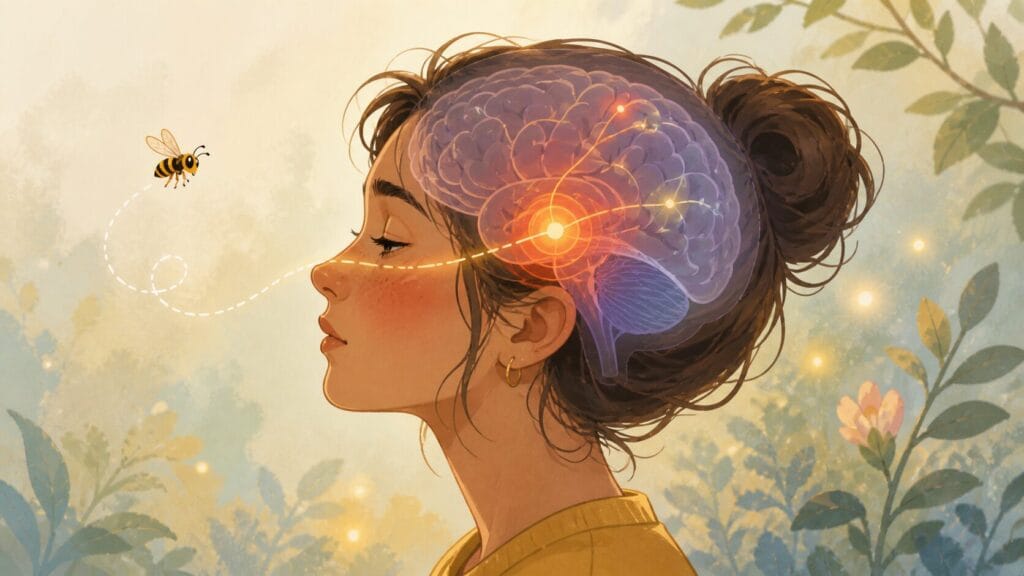
But the real driver sits deeper in the brain.
Your amygdala — your internal threat detector — is designed to react fast, not accurately.
And wasps tick every box that activates it:
- Fast, unpredictable movement
- Buzzing sound close to the head
- Sudden changes in direction
So your brain makes a split-second decision:
“This could be dangerous — react now.” It doesn't care if it is ACTUALLY dangerous. Better safe than sorry is the defualt reaction of this more primative part of our brain.
That’s why people often swat or flinch without thinking.
Ironically, that reaction can make things worse.
To a wasp, sudden movements can feel threatening — which increases the chance of a defensive sting.
Over time, your brain learns:
“Wasps = danger”
And the reaction becomes stronger and faster each time you avoid and run away from wasps.
Fascinating Facts About Wasps
This is where things begin to shift.
Because wasps are not just “things that sting.” Lets start understanding wasps as fascinating and interesting creatures. Additionly, ones that are vital for the ecosystem!
They are far more interesting than most people realise. For example:
- Some wasps can recognise faces and remember interactions
- Many species are highly intelligent hunters
- There are over 120 thousand species of wasps, most of which people never notice
- The smallest known wasp species—and smallest known insects overall—are fairy wasps (family Mymaridae), often called fairyflies. These microscopic parasitoid wasps are roughly the size of a single-celled amoeba
- The majority of wasps are not aggressive unless provoked. Most species can't sting humans at all!
When your brain starts to see complexity instead of threat, something important happens: Fear begins to loosen its grip.
How Wasps Help Humans and the Environment
Despite their fearsome reputation, wasps provide several benefits to local ecology that are frequently underappreciated.
- Wasps are impressive predators that prey upon many other harmful insects that can damage our crops. Due to this, they are sometimes used by farmers as a chemical-free form of pest control
- Wasps, like bees, play a role in plant pollination; in fact, some plants rely exclusively on wasps for pollination
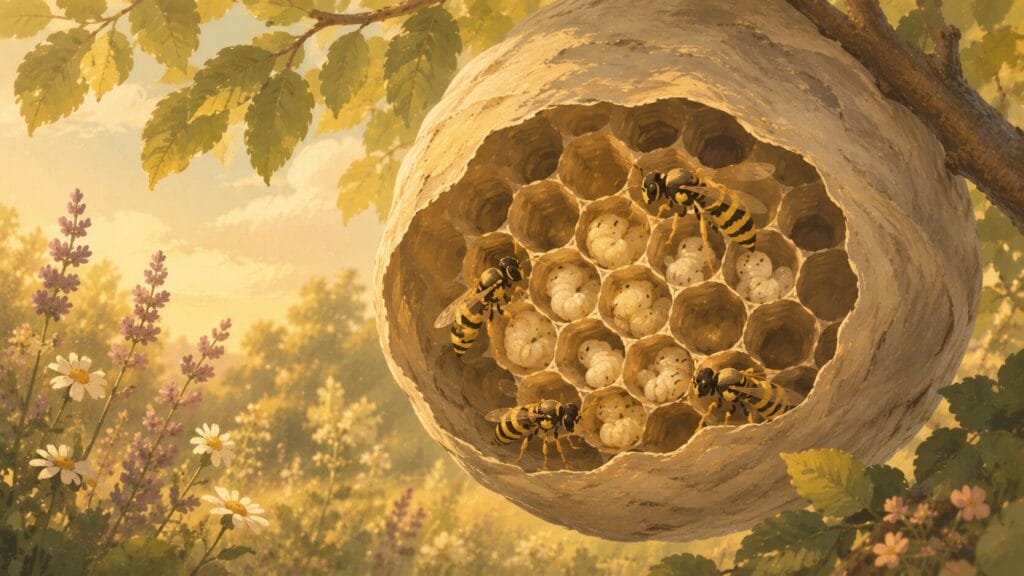
- Did you know that wasps know how to make paper? They chew up bark and regurgitate it into building materials for their nests, creating intricate structures that can house a family of thousands
- No wasp actively seeks aggression against humans, and very few actually retaliate against our attempts to squish them. Their occasional aggressive behaviour is usually only a defensive response to what it perceives as an immediate threat
- Wasps have a complex social structure and communicate by using pheromones and even visual cues to help convey information to their nest
- It might surprise you, but wasps are actually incredibly useful. They play a quiet but powerful role in keeping ecosystems balanced.
Natural pest control
Wasps hunt insects like aphids and caterpillars, helping protect crops and gardens. The Royal Entomological Society highlights their importance in controlling pest populations naturally.
Supporting plant life
Some wasps contribute to pollination, helping plants reproduce and ecosystems thrive.
Maintaining balance
They are part of the food chain, supporting biodiversity and healthy environments. You can explore more about their role through the Wildlife Trusts, which explains how different species contribute to nature. When you begin to see wasps as part of a system — not just a threat — your perspective starts to change.

Identifying Wasps: Whats the difference Between Wasps and Bees?
Learning to identify wasps can help in managing your fear. Here are some key differences between wasps and bees:
- Wasps are more slender, with a smooth body without hair and a narrow waist.
- Wasps have brighter colouring, often with vivid yellow and black stripes. However, some wasp species are red, brown, and even metallic blue!
- Wasps' nests are typically made from a regurgitated paper-like material, while bees' hives are made of wax.
- Wasps' wings fold lengthwise whilst at rest, maintaining that sleek and narrow appearance at all times.
Types of Wasps
There are a variety of wasps beyond the well-known yellow and black, However, the ones you’re most likely to encounter are:
- Yellow Jacket: known for their distinctive yellow and black stripes
- Hornets: larger than yellow jackets, with some species reaching up to a massive 2 inches in length
- Mud Dauber: solitary wasps that build nests out of mud
- Cicada Killer: very large wasps that prey on cicadas but rarely sting humans
- Paper Wasps: named after their paper-like nests, often found in the eaves and overhangs of buildings

Why Do Wasps Sting?
One of the most important things to understand when overcoming the fear of wasps is that wasps are not trying to be cruel or malicious.
Wasps do not actively seek out humans to sting. They primarily use their stingers for hunting prey and in self-defence. Unlike bees, wasps are capable of stinging multiple times. However, they will still not sting indiscriminately, rarely doing so unless threatened or their nest is disturbed. But, yes, it does hurt, but it's not an extreme pain, more of an irritant for a few hours, but the pain quickly fades.
For most people, a wasp sting is painful, yes, but not dangerous. Yet, for those with allergies, a sting can be genuinely life-threatening, which contributes to the fear many people have of wasps.
Again, it’s important to state that less than 3% of the population have any sort of allergy to wasp stings, and the average person is only likely to be stung once or twice in their entire life!
Most of the time, a wasp stings because it feels threatened.
From a human perspective, it can feel frightening when a wasp flies close to your face or refuses to leave you alone. But from the wasp’s perspective, the world is full of danger too.
Wasps spend much of their lives protecting their colony, gathering food, and helping raise developing larvae inside the nest. Those larvae are essentially their babies and the future survival of the colony.
Imagine if a giant creature hundreds of times larger than you suddenly started waving its arms aggressively near your home, trying to crush it, purposly or accidentally threatening your family.
Most living creatures would react defensively. Wasps don't understand that we don't want to eat their children.
When humans swat, panic, or lash out, the wasp’s survival instincts activate just like ours do. In many cases, the sting is not an act of aggression — it is an act of defence.
Understanding this can help shift the fear of wasps away from the idea that they are “evil” or intentionally attacking people.
Why Are Wasps So Annoying in Late Summer?
Many people notice that wasps seem far more irritating toward the end of summer.
This often reinforces the fear of wasps, because it can feel as though they suddenly become aggressive or obsessed with humans.
But the reality is actually quite sad.
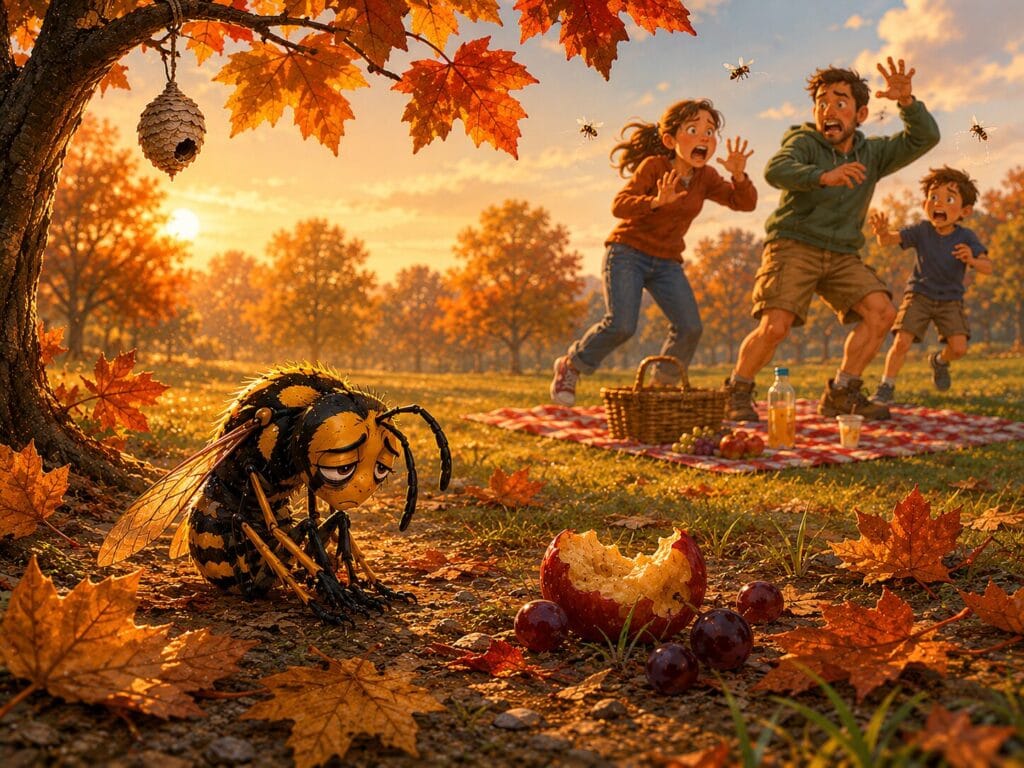
Earlier in the season, worker wasps spend most of their time hunting insects and gathering protein-rich food to feed the developing young inside the nest. Strangely, the young babies secret a sweet juice that the adults can eat. So adults and babies feed each other.
By late summer, however, the colony begins to decline.
The queen slows down egg production, no more babies are left to provide food for the adults. As food sources become scarcer, many worker wasps are approaching the end of their short lives. They are kicked out and made homeless.
This is why they suddenly become highly attracted to:
- Sugary drinks
- Ice cream
- Fruit
- Picnic food
- Sweet smells
They are not becoming “meaner.” They are becoming desperate for energy.
Many late-summer wasps are exhausted, starving, and instinctively searching for quick sugar sources before the colder weather arrives. They are just looking for a sugary snack before they die. They have no interest in stinging anyone.
When viewed through this lens, the behaviour starts to feel less personal and more understandable.
Seeing Wasps From a Different Perspective
One of the most powerful ways to reduce the fear of wasps is to begin seeing them as living creatures trying to survive rather than as mindless threats.
Wasps live difficult lives.
They face predators, harsh weather, starvation, and constant danger. Most only live for a short period of time.
Like humans, they are simply trying to survive, protect their families, and respond to danger when they encounter it.
This does not mean you have to love wasps or want them crawling on you. Fear and caution are still natural. But compassion changes the emotional experience of fear.
Interestingly, fear and compassion are difficult for the brain to fully experience at the same intensity simultaneously. The more your brain begins to recognise the struggle, purpose, and vulnerability within the animal, the harder it becomes to view it purely as an enemy.
This shift from fear to understanding is often one of the first major psychological breakthroughs when overcoming the fear of wasps.
Dispelling Myths About Wasps
“Wasps are aggressive and attack people.”
Most wasps only sting when they feel threatened.
“They chase me on purpose.”
They are usually investigating movement, scent, or food — not targeting you.
“All wasps behave the same.”
There are thousands of species with different behaviours.
When you remove these assumptions, the fear starts to lose its certainty.
How Humans and Wasps Can Peacefully Coexist

When people experience a strong fear of wasps, the natural instinct is often to panic, swat, or escape as quickly as possible.
But interestingly, these reactions can sometimes increase the likelihood of a sting.
To a wasp, sudden arm movements or aggressive swatting can appear threatening. From its perspective, it may believe it is under attack and react defensively.
This is why one of the most important steps in overcoming the fear of wasps is learning how to respond differently.
You do not need to love wasps. You simply need to learn how to remain calmer and more controlled in their presence.
Move Calmly Around Wasps
Small behavioural changes can make a surprisingly big difference:
- Move slowly instead of swatting
- Avoid sudden movements near your face
- Stay calm and give the wasp space
- Allow the wasp to investigate briefly and move on naturally
Most wasps are not looking for conflict.
They are usually searching for food, exploring smells, or reacting to what they perceive as danger.
Flower Prints and Perfumes Can Confuse Wasps
Many people do not realise that certain clothing patterns and scents can accidentally attract wasps.
Bright floral prints can resemble flowers from a distance, while sweet perfumes, scented body sprays, and fruity shampoos may smell similar to nectar or food sources.
This does not mean you should become fearful of wearing these things, but understanding why wasps may show interest can help make their behaviour feel less personal or targeted.
In many cases, the wasp is not “coming after you” — it is simply responding to colours and smells that confuse its natural instincts.
Be Mindful of Food and Sweet Drinks
Wasps are strongly attracted to sugary food and drinks, especially in late summer when they are desperately searching for quick energy.
This means outdoor meals, fruit, fizzy drinks, cocktails, and ice cream can unintentionally attract them.
One surprisingly effective technique is setting up a small “decoy” plate of sugary food slightly away from where people are sitting. This can sometimes encourage wasps to focus their attention elsewhere instead of hovering around the main eating area.
Keeping drinks covered where possible can also reduce unpleasant surprises.

Retraining the Nervous System
People with a strong fear of wasps often become highly alert outdoors, constantly scanning for movement or buzzing sounds.
Unfortunately, this keeps the nervous system activated and reinforces the idea that danger is everywhere.
Practising slow breathing, grounding techniques, and gently redirecting your attention back to conversations or activities can help teach the brain that the situation is manageable.
Over time, these calmer experiences begin retraining the nervous system.
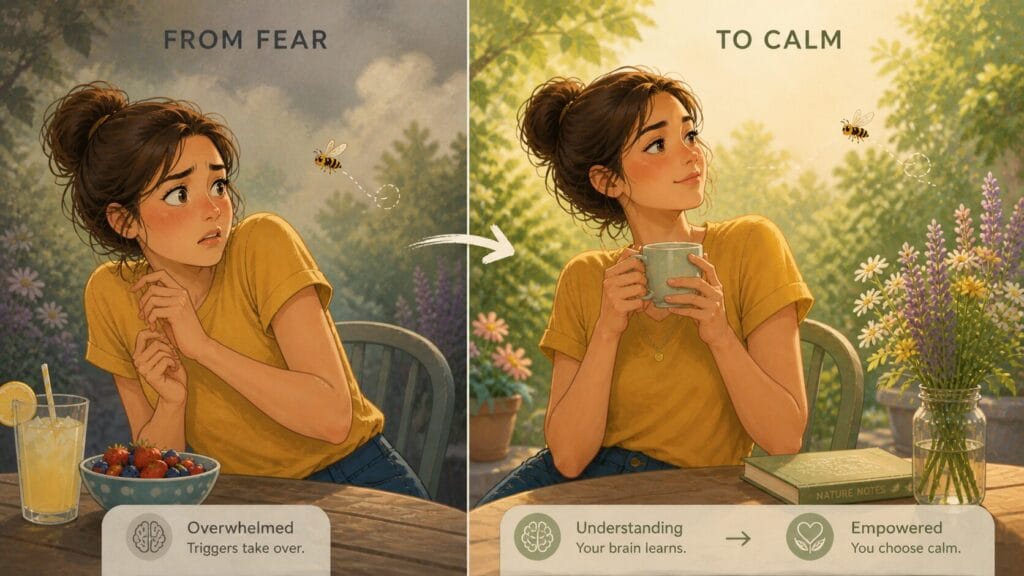
Instead of automatically reacting with panic, the brain slowly learns:
“I can handle this safely.”
Why Address the Fear of Wasps?
This is where many people underestimate the impact.
The fear of wasps doesn’t just show up in one moment — it starts shaping your behaviour.
At the extreme end, those with a fear of wasps may choose to stay indoors on those sunny days when wasps are most likely to be active. They might even keep the windows closed despite it being stiflingly hot.
Yet, those suffering with a milder form of the phobia may still avoid going out to places such as parks, and may even avoid florists or places that have a lot of trees, flowers, or plants.
You might notice yourself:
- Avoiding parks or gardens
- Feeling tense at barbecues or outdoor events
- Watching constantly for movement instead of relaxing
- Dreading summer rather than enjoying it
It’s not just about wasps anymore. It becomes about losing your sense of ease in everyday life.
And that’s the part worth changing Here’s the key thing most people don’t realise:
You cannot think your way out of a phobia.
Because your fear response is not coming from your thinking brain — it’s coming from your survival brain.
So the way forward is different. It involves:
- Understanding what is actually happening
- Learning how to calm your nervous system
- Gradually facing the fear in a controlled way
Avoidance keeps the fear alive. Experience — the right kind of experience — is what changes it.
Overcoming Your Fear: How to Treat A Fear of Wasps
If you suffer from an extreme or irrational fear of wasps, there is help available, and we offer a full range of options to help you overcome your wasp phobia:
- Hypnosis: One of the most tried and tested methods of treating any phobia. In a hypnotic state, affected individuals are brought into a sense of relaxation and peace. From there, you can be better helped to evaluate the stress or the underlying traumatic event catalysing your phobia. Though hypnosis is a useful tool to help overcome the fear of wasps, its unlikely to be effective on it's own without exposure therapy.
- Neuro-Linguistic Programming (NLP): This form of psychotherapy aims to detect the brain's faulty-matching ability, which leads to the fight or flight response. NLP can successfully help you ward off the symptoms of spheksophobia
- Self-help techniques: This is not going to eradicate your wasp fear but by including techniques like deep breathing, meditation, or positive visualisation before you might encounter wasps (or at the sight of wasps) can help you remain calm and under control. Further, practising self-help techniques regularly, whilst away from stress responses, can help you quickly reach a calmer state when encountering such a situation
- Exposure therapy: Gradually exposing yourself to wasps within a controlled environment can help desensitise you to their presence. This might start by simply looking at pictures of wasps, progressing to watching videos, and eventually observing live wasps from a safe distance. It might sound far-fetched but with the right therapy and coach alongside you, it’s perfectly achievable
- Research by Michelle Craske shows that exposure works through something called inhibitory learning — where your brain learns a new, safer response through experience.
- Cognitive Behavioural Therapy (CBT): This therapy helps you identify and change negative thought patterns associated with wasps, replacing them with more rational, less fear-inducing thoughts
How Creature Courage Helps You Overcome the Fear of Wasps

Fear can be crippling, particularly at inopportune moments. Trying to adapt your life to the possibility of encountering wasps can be embarrassing and, certainly, inconvenient. Phobias can take over your life, but now it's time for you to take control.
At Creature Courage, we work with people who feel exactly like this every day.
People who are tired of avoiding, managing, and feeling on edge.
Our approach is different because it is experiential.
We don’t just talk about fear — we help you retrain your response to it.
This includes:
- One-day intensive therapy designed for rapid change
- Step-by-step exposure in a safe, controlled environment
- Real-time nervous system training
- Combining mutiple proven phobia fighting techniques
You can learn more about how this works here:
https://creaturecourage.com/why-one-day-phobia-therapy-works/
And read real client experiences here:
https://creaturecourage.com/testimonials/
This is about giving you your freedom back — not forcing you into something you’re not ready for.
Education is a powerful tool in overcoming fear, and it is something we heavily extol. The more you understand about wasps, their behaviour, and their role in our ecosystem, the less frightening they are likely to seem.
So, if you're struggling with a fear of wasps or any other insect phobia, don't hesitate to seek professional help. With the right support and techniques, you can learn to manage your fear and enjoy the outdoors without constant anxiety.
If your fear of wasps is affecting your life, it doesn’t have to stay that way.
With the right support, your brain can learn a completely different response.
One where you feel calm, steady, and in control — even when a wasp is nearby.
You can reach out here:
Contact Creature Courage Today
FAQ: Common Questions About Wasp Phobia
- Can the fear of wasps really be overcome?
Yes — your brain can learn a new response with the right approach - What if my fear feels too strong?
That’s exactly when structured, guided support can make the biggest difference. - What is the phobia of wasps called? The phobia or fear of wasps is called spheksophobia.
- How can I help someone with a wasp phobia? Be understanding and patient. Encourage them to seek professional help, and avoid forcing them into situations where wasps are likely to be present. Support their efforts to learn more about wasps and practice relaxation techniques.
- Are wasps dangerous? While wasps can sting and their venom can cause pain, and allergic reactions in some people, they are not inherently dangerous. Most wasps will only sting if they feel threatened or if their nest is disturbed.
- Do wasps bite or sting? Wasps sting rather than bite. They use their stinger, located at the end of their abdomen, to inject venom.
- How can I safely remove a wasp nest? It's best not to even try. Call a professional pest control service to remove a wasp’s nest. Remember, a wasp nest will house a great number of wasps and they will, undoubtedly, try and defend their home. It could get very painful.
- Is my fear of wasps irrational? A healthy respect for wasps is normal, but if your fear significantly impacts your daily life or causes extreme anxiety, it may be considered irrational. There’s probably a perfectly understandable reason as to why you have a fear of wasps but if it impacts on your day-to-day life seeking help from a mental health professional will be beneficial.
- Why do wasps seem to come towards me?
They are usually investigating scent, movement, or food — not targeting you. - Are wasps dangerous?
They can sting, but most stings happen when they feel threatened. Calm behaviour reduces risk.