

Introduction
If you’ve ever been told to “just think differently” about your fear, you’ve already been introduced—loosely—to the idea behind Cognitive Behavioural Therapy, often known as CBT.
But real CBT is far more structured, practical, and evidence-based than simply trying to “stay calm.”
In fact, it is one of the most widely researched psychological approaches for anxiety and phobias, used across the UK in both clinical and private settings.
This article will help you understand what CBT actually is and how it's used in therapy. Understanding what CBT is—and how it works—can help you feel more confident about taking the first step towards overcoming an animal phobia.
What Is Cognitive Behavioural Therapy (CBT)?
Cognitive Behavioural Therapy is a structured, goal-oriented form of psychological therapy that focuses on the relationship between:
- Thoughts
- Emotions
- Behaviours
The core idea is simple:
The way we think influences how we feel, and how we feel influences what we do.
In the context of a phobia, this often looks like:
- Thought: “That spider is dangerous.”
- Emotion: Fear or panic
- Behaviour: Avoidance (leaving the room, freezing, calling someone else)
CBT works by helping people identify and gently challenge these patterns, replacing them with more accurate and helpful responses.

How CBT Works in Therapy
In practice, CBT is not about forcing positive thinking. Instead, it helps you:
- Notice automatic thoughts
- Evaluate whether they are realistic
- Develop more balanced perspectives
- Gradually change behavioural responses
A therapist may guide you through exercises such as:
- Thought records (writing down fears and analysing them)
- Cognitive restructuring (challenging unhelpful beliefs)
- Behavioural experiments (testing fears in safe ways)
Over time, this helps reduce the intensity of the fear response and increases your sense of control.
Examples of CBT in Action
Example 1: Fear of Spiders
Someone with a spider phobia may automatically think:
“I won’t be able to cope if it moves.”
Through CBT, they might explore thinking about different alternatives, such as:
- How often has that actually happened?
- Whether they have coped in similar situations before.
- What would realistically happen if the spider moved?
This shifts the belief from: “I can’t cope.”
to: “This is uncomfortable, but I can handle it.”
Example 2: Fear of Dogs
A person afraid of dogs might assume:
“All dogs are unpredictable and dangerous.”
CBT helps break this down by:
- Examining evidence for and against the belief
- Learning about dog behaviour
- Testing small, controlled interactions
Over time, the brain begins to update its threat response.

What Does the Science Say?
Cognitive Behavioural Therapy is one of the most extensively studied treatments for anxiety disorders and phobias.
Research consistently shows that CBT can significantly reduce symptoms of fear and avoidance.
For example:
- A review published by the National Institute for Health and Care Excellence (NICE) recommends CBT as a first-line treatment for anxiety disorders
- A meta-analysis in Cognitive Therapy and Research found strong evidence supporting CBT’s effectiveness for specific phobias
- Research by David M. Clark and colleagues has demonstrated how changing thought patterns can directly influence emotional responses
You can explore more here:
Common Misconceptions About CBT
“It’s just about thinking positively.”
CBT is not about ignoring fear—it’s about understanding and recalibrating it.
“It works instantly.”
While CBT can be highly effective, it typically involves repeated practice over time to create lasting results. It is essentially conditioning the mind to have new positive habits. The good news is that if practiced regularly, this process usually doesn't take too long to create lasting positive change.
“Talking alone solves the problem.”
CBT often includes behavioural components such as exposure therapy, not just discussion.
Where CBT Fits in Treating Animal Phobias
CBT provides an important foundation for understanding fear.
It helps people:
- Make sense of their reactions
- Reduce catastrophic thinking
- Build a sense of control
However, on its own, cognitive understanding does not always fully change how the brain responds in real-life situations.
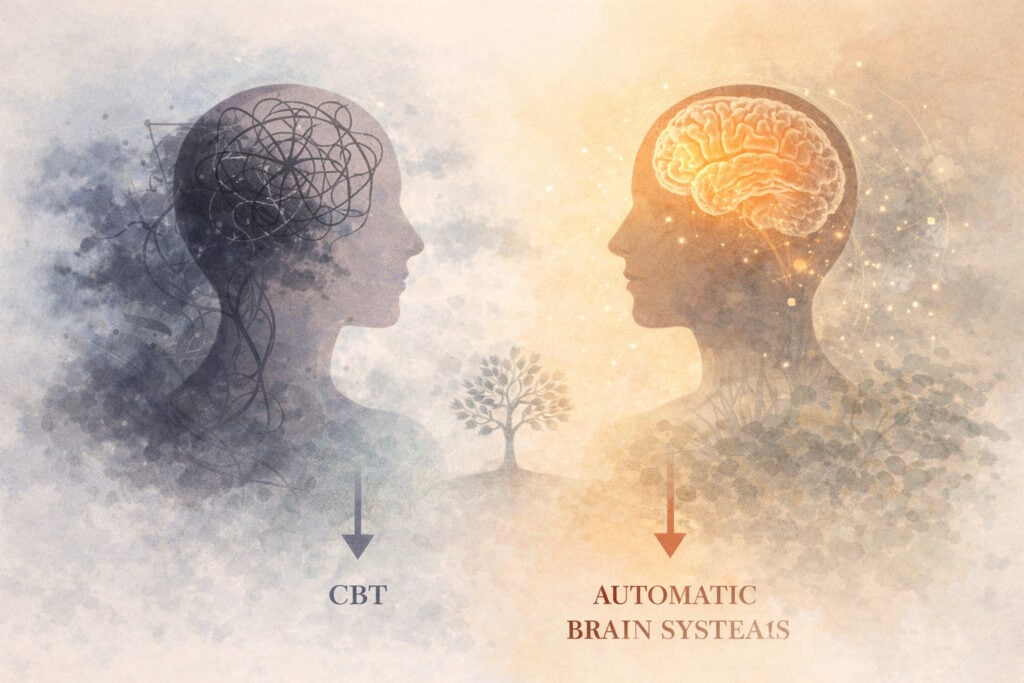
This is because fear responses are strongly linked to deeper, automatic brain systems.
How CBT Fits Into a Broader Approach
The most effective phobia treatments rarely rely on a single technique. Instead, they combine multiple approaches that work together to create lasting change.
These often include:
- Cognitive understanding (CBT)
- Emotional regulation skills
- Real-world experience through exposure
Cognitive Behavioural Therapy plays an important role in helping people understand their fears. It can reduce catastrophic thinking and build a sense of control.
However, understanding fear is only one part of the process.
For the brain to fully update its response, it usually needs direct experience. This is because fear responses are driven by deeper survival systems in the brain, which respond more strongly to experience than explanation alone.
This is where exposure-based work becomes essential.
While CBT helps you recognise that a feared animal may not be dangerous, exposure therapy allows your brain to experience that safety in real time.
This combination is powerful because:
- CBT prepares the mind
- Exposure retrains the nervous system
Together, they help shift fear from something that feels overwhelming and automatic to something that feels manageable and understood.
How We Use CBT at Creature Courage
At Creature Courage, Cognitive Behavioural Therapy is not used as a standalone, purely discussion-based approach.
Instead, it forms part of a practical, experience-led process designed to help people not only understand their fear, but actively change their response to it.
At Creature Courage, we believe in a holistic approach. We use a wide range of several different proven phobia-fighting techniques alongside CBT, such as:
- Animal Education: To build fascination and compassion, and to dispel myths
- Exposure Therapy: To allow the brain to update its fear response
- Guided Imagination Exercises: To transform how people see the animal
- General Anxiety Education: (Caveman Brain Awareness): To get the brain working for you instead of against you
- NLP Techniques: (Neuro-Linguistic Programming) Change how you understand the animal and anchor courage
- Hypnotherapy: To make changes in the deep subconscious and create relaxation
- Art Therapy: To help strengthen other techniques and make them memorable
Building Understanding Through Education
A key part of this begins with education.
We help clients learn about the animal they fear in a calm, structured way. This includes understanding behaviour, dispelling common myths, and learning how to interact safely.
As fear begins to decrease, this often creates space for something unexpected:
curiosity, and even fascination
This shift is important because it gives the mind a new direction to move toward—not just something to move away from.
Understanding the “Caveman Brain”
Alongside this, we teach clients how fear works in the brain.
We explain the role of the limbic system, often described as the “caveman brain,” and how it drives automatic fear responses.
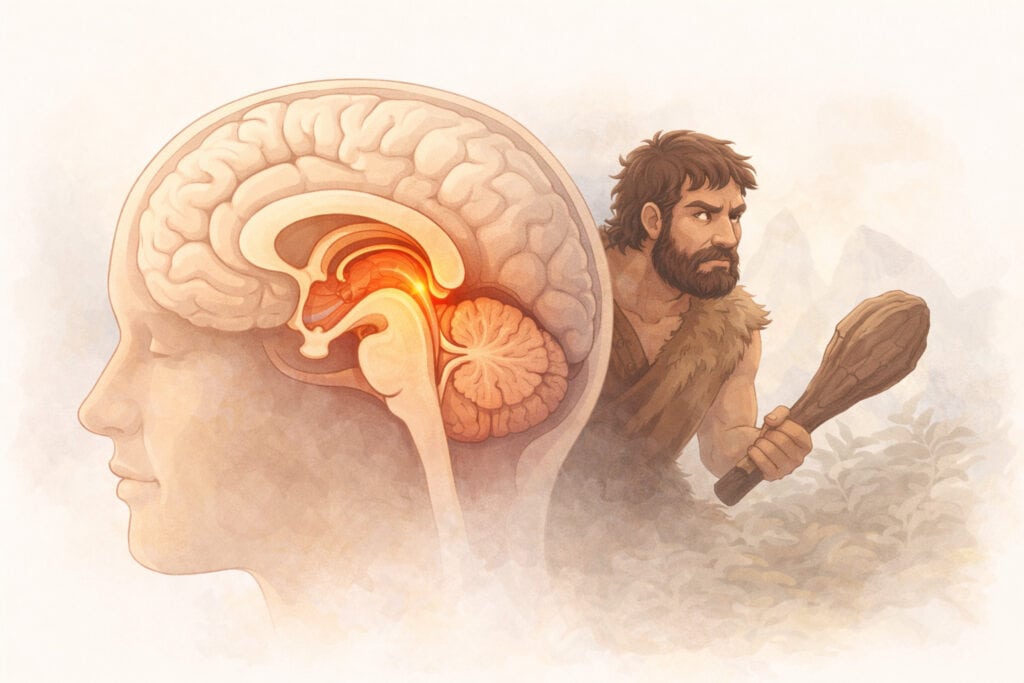
Clients learn that avoidance, while understandable, actually strengthens this system over time.
By understanding this, people begin to see their fear differently—not as something broken, but as something that has been learned and can be updated.
Developing Awareness and Control of Thoughts
We also focus on developing awareness and control over thought patterns.
Clients are guided to recognise how certain thoughts can amplify fear, and how shifting these patterns can begin to change emotional responses.
This is not about forcing positive thinking, but about creating more accurate and balanced interpretations of situations.
Over time, this builds a stronger sense of control and confidence.
Creating Habits of Courage
Importantly, we frame fear not as an isolated problem, but as part of a wider pattern.
Many people notice that avoidance shows up in multiple areas of life.
By addressing this pattern more broadly, clients can begin to build what we often describe as habits of courage, rather than habits of avoidance.
This wider shift can have a powerful impact beyond the original phobia.
Supporting the Nervous System
To support this process, we also teach simple techniques to help regulate the body.
This includes breathing and relaxation strategies that help calm the nervous system and send signals of safety back to the brain.
When the body becomes calmer, the mind is better able to respond differently.
Turning Understanding Into Real Change
Rather than focusing only on changing thoughts in isolation, our approach combines:
- Understanding fear
- Shifting thought patterns
- Regulating the body
- Experiencing change in real time

This integrated holistic approach reflects how the brain actually learns—through a combination of understanding, emotional regulation, and lived experience.
This allows cognitive change to move beyond theory—and become something that is directly felt and experienced.
Conclusion
Cognitive Behavioural Therapy is one of the most trusted and researched approaches for treating anxiety and phobias.
It gives people the tools to understand their fear, challenge unhelpful thinking patterns, and begin changing their responses.
For many, it is an essential first step toward regaining confidence and control.
If you are ready to face your fears and get over an animal phobia for good, please don't hesitate to contact us. We would love to tell you more about how the therapy works and how we can help support you on your journey to freedom!
FAQ About CBT for Animal Phobias
Is Cognitive Behavioural Therapy effective for animal phobias?
Yes, Cognitive Behavioural Therapy (CBT) is one of the most widely researched and recommended treatments for phobias.
It helps people understand how their thoughts, emotions, and behaviours interact, and provides practical tools to begin changing fear responses.
However, many people find that CBT is most effective when combined with real-world experience, allowing the brain to not only understand safety but experience it directly.
How long does CBT take to work for phobias?
Traditional CBT is often delivered over multiple sessions across several weeks or months.
The exact timeframe can vary depending on the individual, the severity of the phobia, and how the therapy is delivered.
Some people notice improvements quickly, while others benefit from a more gradual approach.
More immersive approaches that combine CBT with real-time experience can sometimes accelerate this process.
Does CBT involve facing the animal straight away?
Not if it’s done right.
CBT often begins with understanding fear, identifying thought patterns, and building coping strategies before any direct exposure takes place.
In many cases, exposure is introduced gradually and at a pace that feels manageable.
This helps build confidence step by step, rather than overwhelming the nervous system.
Can CBT help with severe or lifelong animal phobias?
Yes, CBT can be effective even for long-standing or intense fears.
Phobias are learned responses, which means they can be updated over time with the right approach.
However, more severe phobias may benefit from a combination of techniques, including education, emotional regulation, and guided real-world experience.
Is CBT suitable for children with animal fears?
Yes, CBT can be adapted for children and is commonly used to help young people understand and manage anxiety.
For children, it is often delivered in a more interactive and supportive way, using age-appropriate language and activities.
When combined with positive real-world experiences, it can help children build confidence and resilience around animals.