
The Fear of Spiders: Arachnophobia
Understanding and Getting Over Arachnophobia
Fear of spiders, also known as arachnophobia, is one of the most common animal phobias in the world and often debilitating. Arachnophobia affects millions of people worldwide, in the UK alone, approximately 11 million people suffer from a fear of spiders. Moreover, in the United States 10-12% of the population list it as their top phobia.
For some people, seeing a spider can trigger mild discomfort. For others, it can cause intense panic, crying, freezing, obsessive checking behaviours, or a desperate urge to escape the room immediately.
If you struggle with the fear of spiders, you are not weak, irrational, or “overreacting.” Your nervous system is simply responding as though you are in danger and trying to protect you. This is despite the fact the thinking, rational part of your brain knows the spider is unlikely to harm you.
However, it's important to understand that it's a learned fear. It is not hardwired in. Therefore, the fear can be treated and overcome. The good news is, often it can take as little as one day with the right treatment.
In this article, we will explore what arachnophobia is, why the fear develops, how it affects the brain and body, common symptoms, myths about spiders, and how fear of spiders can be overcome through compassionate, neuroscience-informed therapy.
Additionally, we will also explore the fascinating role spiders play in nature and how understanding them more deeply can often help to soften fear.
Check out our powerful Client Testimonial
What Is the Fear of Spiders?
The fear of spiders is known scientifically as arachnophobia. It is a specific phobia involving an intense fear response towards spiders or spider-like creatures. The reaction can range from mild anxiety to severe panic and avoidance that interferes with daily life.
For some people, the fear is triggered only by large spiders or fast-moving spiders. Others may react strongly to photographs, spider webs, shadows, television scenes, or even simply thinking about spiders.
Arachnophobia often involves more than dislike. Many people experience a genuine fight-or-flight response. The body may react automatically before the rational mind has time to catch up. This is because the brain’s threat detection systems can become highly sensitised to spiders over time.
People with spider phobia may:
- Avoid sheds, garages, lofts, or gardens
- Check rooms obsessively before sleeping
- Struggle to relax after spotting a spider
- Feel embarrassed or ashamed about their reaction
- Panic if they unexpectedly encounter a spider indoors
- Ask others to remove spiders for them
- Avoid certain films, documentaries, or social media content
For some individuals, the fear can become exhausting and emotionally consuming, especially during autumn when house spiders become more visible in the UK.
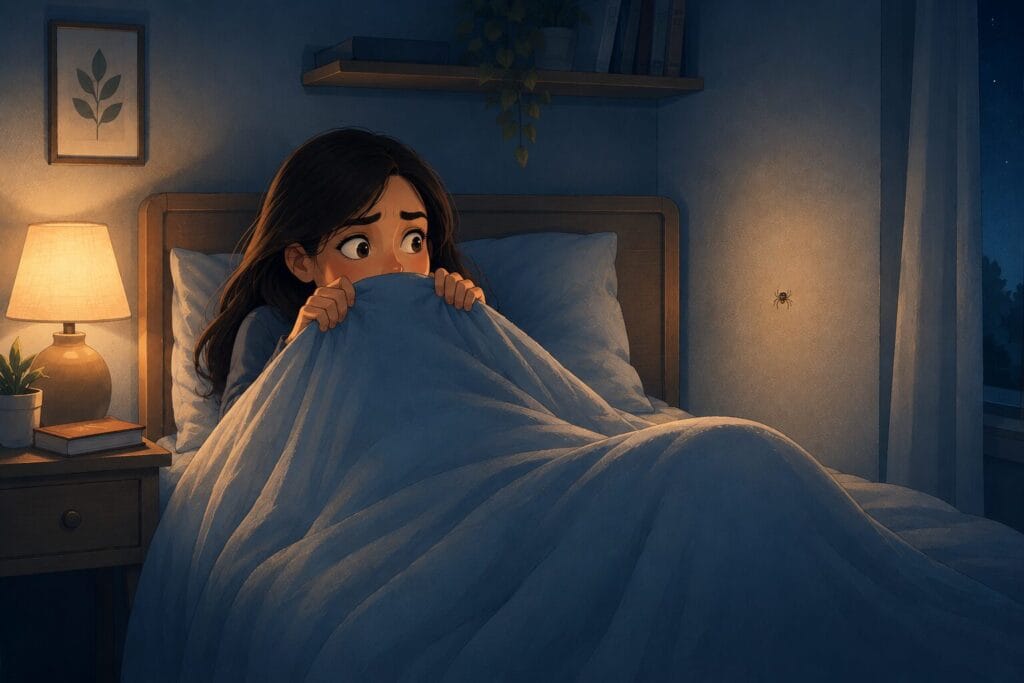
Symptoms of Spider Phobia
Symptoms of arachnophobia can vary greatly from person to person. Some people experience anxiety internally, while others have strong visible panic reactions.
Many people with arachnophobia experience intense physical symptoms such as a racing heart, shaking, dizziness, or panic, even when they know the spider is unlikely to harm them. The NHS explains that phobias can trigger powerful anxiety responses that feel very real to the nervous system
Common symptoms of spider phobia include:
- Rapid heartbeat
- Shaking or trembling
- Crying or screaming
- Sweating
- Feeling frozen or unable to move
- Nausea or dizziness
- Hypervigilance and obsessive checking
- Racing thoughts or catastrophic thinking
- Difficulty sleeping after seeing a spider
- Avoiding places where spiders may appear
- Panic attacks
- Intense disgust or revulsion
- Feeling unsafe even after the spider is gone
Again, it is important to not that these reactions are not a sign of weakness. They are signs that the brain has learned to associate spiders with danger.
How Fear of Spiders Develops
Spider phobias are rarely caused by one single thing. They are usually shaped by a combination of life experiences, learning, emotional memory, and the brain’s natural survival systems.
Some people develop arachnophobia after a frightening encounter with a spider during childhood. Others learn the fear indirectly by watching parents, siblings, films, television programmes, or social media portray spiders as dangerous and threatening. Our media often portrays spiders negatively
The human brain is also naturally designed to prioritise potential threats. Deep inside the brain is a structure called the amygdala, sometimes referred to as the brain’s “alarm system.” Its job is to detect danger and prepare the body to survive.
One of the reasons phobias can become stronger over time is because avoidance temporarily reduces anxiety. According to NHS Inform’s phobia self-help guide, avoiding a feared situation may feel relieving in the short term, but it often reinforces the fear cycle and makes future encounters feel even more threatening.
When somebody repeatedly reacts fearfully to spiders, the brain can begin treating spiders as an important threat to monitor and avoid. Over time, the nervous system becomes increasingly sensitive, meaning even tiny spiders or spider-related images can trigger strong anxiety.
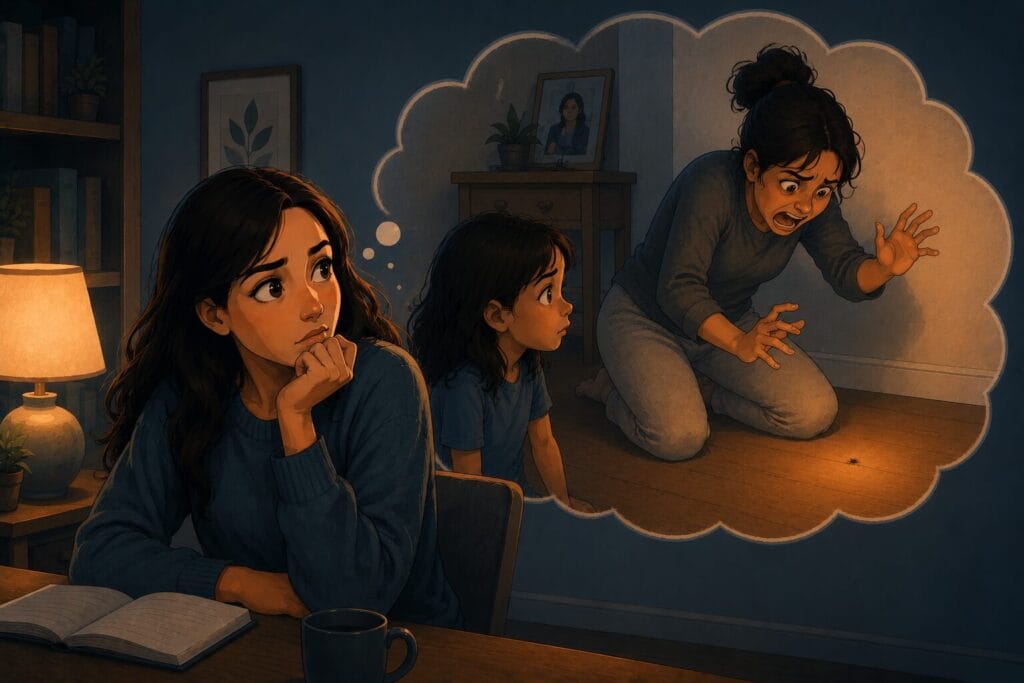
Avoidance unfortunately strengthens the fear cycle.
Each time somebody escapes, avoids, or immediately removes a spider, the brain receives temporary relief. While this feels good in the moment, it unintentionally teaches the nervous system:
“Avoidance kept me safe.”
This is one reason fears can grow stronger over time rather than naturally disappearing.
At Creature Courage, we often explain this through the idea of the “caveman brain.” Your modern thinking brain may understand that a house spider is unlikely to hurt you, but the older survival parts of the brain may still react automatically as though a threat is present.
The Cost of A Fear of Spiders
Many people try to simply “live around” their spider phobia for years. However, avoidance often comes with hidden emotional costs.
Arachnophobia can affect:
- Sleep
- Confidence
- Travel
- Gardening
- Home life
- Relationships
- Parenting
- Concentration
- General anxiety levels
Some people feel constantly on edge during spider season. Others avoid certain rooms, leave windows permanently shut, or rely heavily on other people for reassurance and spider removal. Because spiders can appear anytime and anyplace, it becomes a constant state of anxiety.
Additionally, many people will avoid travelling to certain destinations because of a fear of spiders and miss out on holidays and not see loved ones. This situation can also then cause tension in relationships.
The fear, as mentioned can easily be passed down to your children. If you leave a fear untreated, your children can start suffering in the same way.
A spider phobia can even be dangerous. There are several documented cases of people dying in car crashes due to a fear of spiders, sadly some with children involved.
Fear can also spread. A nervous system that becomes increasingly avoidant around spiders may start becoming more sensitive and reactive in other areas of life too. This means overall anxiety is heightened by an unaddressed spider phobia.
Addressing the fear is not about forcing yourself to “love spiders.” (Though many do after treatment, unbelieavable but true!) It is about reclaiming freedom, reducing panic, and teaching your nervous system that you are more capable than fear has led you to believe.
Overcoming spider phobia can create a powerful sense of confidence and emotional resilience that often extends far beyond spiders themselves. One of the first steps in getting over a spider phobia is to see them more positively.

Dispelling Common Myths About Spiders
As with many creatures we consider dangerous, there is myth, folklore and downright lies that keep us awake at night. Spiders do not gather in mass behind your wardrobe ready to pounce the moment you drift off to sleep. We wrote an in-depth blog about this here but check out these facts to help further put your mind at ease:
“All spiders are dangerous.”
This is one of the biggest misconceptions surrounding spiders. The vast majority of spiders are harmless to humans, especially in the UK. Spiders do not even make the the top 20 most dangerous animals in the world list. However, humans do! In addition:
- You are 300 times more likely to be killed by lightning than being bitten and killed by a spider
- There are less than 10 spider-related deaths worldwide each year.
- Even getting a bite from one of the world's most venomous spider species is highly unlikely to result in any serious reaction
- Talking of which, Australia's Funnel Web has the most potent venom of any spider, and yet, no one has died since the anti-venom was invented in 1981!
- In any case, most spider fangs can't break through our skin, anyway! Even in the odd case when they can, venom usually has no effect - most spider bites are what we call 'dry bites' and no venom is injected with the bite.
- Spiders do not want to attack us, when you consider how big we are to them, it should be little wonder that all they want to do is get away! They are only ever likely to bite if they see no other way out.
“Spiders chase people.”
Spiders do not hunt humans. If a spider appears to move towards somebody, it is usually confused, seeking shelter, or attempting escape. Most spiders have terrible eyesight and all spiders are deaf. When they are off their webs, they are very easily confused but never want to purposely come close to any animal bigger than itself. That makes no evoloutionary sense!
“House spiders want to crawl into your bed.”
There is no evidence that spiders deliberately seek out sleeping humans. As mentioned, spiders generally avoid large animals whenever possible. Interactions and contact with spiders in sleep is incredibly rare and just an accident on their part.
How Spiders Help Humans and the Environment
Spiders in Medical Research
Spider silk is also being studied in medicine. It is even being used in heart surgery! Spider silk combines flexibility and strength in ways scientists still find remarkable.
Recent studies have further underscored the importance of spiders, it has even found found that the combination of silkworm silk with spider silk can be used to help guide the regeneration of nerve function. Moreover, it is thought that spider venom can be incorporated into the development of new painkillers, which would be completely addiction free - it's absolutely incredible.
Spiders Are One of Nature’s Most Important Pest Controllers
Spiders eat A LOT of bugs. So much so, that without spiders, life on Earth would eventually begin collapsing under the weight of exploding insect populations. Crazy but true.
Collectively, all the spiders on Earth eat an astonishing 400 to 800 million tons of insects every single year — roughly equal to the total weight of the entire human population, if not double!
Spiders actually eat more insects than birds and bats combined. Without them, there would be dramatically more insects biting humans, spreading disease, contaminating food supplies, damaging crops, and overwhelming ecosystems.

Entire agricultural systems could struggle under the pressure. Essentially, everything would begin to die without spiders controlling insect populations.
Additionally, spiders help control insects that are vectors for diseases. Mosquitoes, flies, and other insects can carry diseases such as malaria, dengue fever, and Zika virus. Spiders, by preying on these insects, help reduce the spread of these diseases. This natural form of pest control is essential for maintaining public health, particularly in areas where these diseases are prevalent.
Also, just worth mentioning that the single most deadly animal on the planet is the mosquito. Mosquitoes kill up to a million people every year through the spread of diseases such as malaria.
What animals eat huge numbers of mosquitoes?
Yes. You guessed it. Spiders.
They are some of nature’s most important natural pest controllers and help regulate populations of flies, mosquitoes, and agricultural pests every single day without us even noticing.
Pesticide Free Crops: Spiders the Heros of Agriculture
Additionally, one of the most significant benefits of spiders is their impact on agriculture. By preying on insects that harm crops, spiders help farmers protect their yields. This natural pest control can lead to healthier crops and reduce the reliance on chemical pesticides, which can have harmful effects on the environment and human health.
As noted by the Food and Agriculture Organization (FAO), sustainable farming practices that incorporate natural predators like spiders can improve crop health and yield.
Spiders Help Support Healthy Ecosystems
Spiders also play an indirect but surprisingly important role in supporting plant life and healthy ecosystems.
Many of the insects spiders prey upon feed on decaying leaves and organic matter. While decomposition is essential in nature, large imbalances in these insect populations can disrupt the delicate nutrient cycling process that helps return nutrients back into the soil for plants to grow.
By helping regulate insect populations naturally, spiders contribute to healthier forests, gardens, wild plants, and ecosystems overall.
According to the British Arachnological Society, spiders are among the most important natural pest controllers in the environment. They also form part of wider food chains that support birds and other wildlife.
In many ways, spiders are one of the quiet “maintenance crews” of the natural world, helping ecosystems remain balanced and functioning properly.

Learning to See Spiders Differently
While it can be difficult to appreciate these benefits during a fear response, understanding the positive role spiders play can help create a more balanced perspective over time.
You basically owe your life to spiders.
So, perhaps we can try to be a little more gentle when it comes to preserving theirs. The best way to coexists with spiders it to be calm enough to catch them and put them back outdoors.
At Creature Courage, we often encourage people to move gradually from fear, to understanding, and eventually towards respectful coexistence rather than seeing spiders purely as something to destroy.
How to Overcome the Fear of Spiders
The good news is that fear is not fixed. The brain and nervous system are capable of change throughout life.
Overcoming arachnophobia usually involves teaching the brain that spiders are less dangerous than it has learned to believe. This is usually accomplished with exposure therapy.
Exposure therapy is considered one of the most effective evidence-based treatments for specific phobias because it helps the brain gradually learn that the feared object is less dangerous than it has predicted. NHS psychological treatment guidance describes exposure and habituation as a well-established approach for reducing fear through safe and structured experiences
This process is often most effective when done:
- Step by step
- Repeatedly
- Safely
- With guidance and support
At Creature Courage, we focus heavily on nervous system retraining rather than simply forcing people into frightening situations. The goal is not to overwhelm somebody, but to help the brain update its threat predictions through positive corrective experiences.
Many people are surprised by how quickly fear can begin shifting once avoidance patterns are interrupted in the right way.
Recovery may involve:
- Learning about spider behaviour
- Regulating the body during anxiety
- Gradual exposure exercises
- Changing catastrophic thought patterns
- Building feelings of control and capability
- Developing fascination and compassion alongside courage
Progress does not require perfection. Even small shifts in reaction can represent major nervous system change. Our testimonials attest to just what is possible with our help.
Fascination Can Override Fear
Fascination and fear are connected to the same part of the brain and that is why it can be so easy to transform fear into fascination, and why it's so important to do it, too! Fascination helps you to look at and spend time facing the fear to inspire your curiosity.
This strategy helps the brain understand that spiders are not a threat - that it's possible to engage with them and not avoid them. Building compassion also helps you see spiders in a positive light and more like other animals you enjoy.
Feeling compassion for spiders stops you from seeing them as monsters out to get you. When your paths cross it is entirely coincidental. When you understand that a spider is vulnerable and just wants to survive like any other creature, it helps banish the myths.

Find Out More About Overcoming Your Fear of Spiders
Effective Therapeutic Techniques for Arachnophobia
No preventative measures will keep all spiders out of your home. The best thing you can do is to instead overcome your fear and regain your confidence. Your phobia can be effectively and quickly treated through a variety of methods, but most importantly exposure.
Unfortunately our survival part of our brains is not connected to the more rational side of our brains. The only way to change the fear is to show it there is no real danger around spiders. That is why treatments like hypnotherapy alone cannot cure a spider phobia. You can read more about the science of phobia treatment and hypnotherapy here.
Combing several techniques including exposure therapy is more effective.
At Creature Courage, we use a holistic and neuroscience-informed approach to treating spider phobia. We combine them all in a one day powerful treatment. Interestingly, research has shown that intensive one-session phobia treatments can be highly effective for specific phobias. NHS-supported evidence reviews have found that concentrated exposure-based approaches can produce significant improvements while remaining comparable to longer treatment formats
We combine several different proven phobia fighting techniques. Some of the techniques used during the session include:
- Animal Education: To build fascination and compassion, and to dispel myths
- Exposure Therapy: To allow the brain to update its fear response
- CBT: (Cognitive Behavioural Therapy): To give powerful thought awareness
- Guided Imagination Exercises: To transform how you see spiders
- NLP Techniques: (Neuro-Linguistic Programming) to change how you understand the animal and anchor courage
- Hypnotherapy: To make changes in the deep subconscious and create relaxation
- Art Therapy: To help strengthen other techniques and make them memorable
Spiders are everywhere so by getting over your arachnophobia, you can let go of a lot of extra subconscious fear of a potential spider encounter. Overcoming arachnophobia can open up a whole world of possibilities.
You can enjoy outdoor spaces and activities travel to new destinations, and sleep easy at night. Basically you can experience life the way that you want. There are many worries in life but spiders really shouldn't be one of them.
Creature Courage: The Expert Spider Phobia Specialists
Creature Courage specialises in intensive, experiential animal phobia therapy designed to create real-world nervous system change.
Our internationally recognised Spider Courage Experience helps people gradually build confidence around spiders through structured exposure, education, nervous system regulation, and compassionate support.
Unlike approaches that focus purely on talking about fear, our work emphasises experiential learning. This means helping the brain learn through direct lived experience rather than logic alone.
Many clients attend our intensive one-day spider phobia therapy experiences because concentrated exposure often allows the nervous system enough time to fully activate, settle, and update its fear predictions with just one treatment!
Its incredible but it is fully possible to get over your extreme fear in just one day! You can also read all of our amazing client testimonials.

The Spider Courage Experience Uses Exposure Therapy
Our expsure therapy session helps individuals confront their fear in a controlled, supportive environment. This significantly increases the likelihood of overcoming their phobia. We have a documented 99% success, by which we mean that 99% of our clients are able to calmly interact with spiders in just one day!
We can help you achieve freedom from your phobia without the need for months or years of expensive therapy.
Furthermore, The Spider Courage Experience equips participants with self-calming skills that can be applied to any area of their lives to improve overall anxiety. We will equip you with knowledge, skills and techniques to get your brain to work for you instead of against you.
This comprehensive approach not only addresses your phobia but also enhances your overall mental health, making it a valuable investment for long-term well-being. Check out our powerful testimonials to see some of the thousands of lives we have changed. Get in touch today to get over your fear of spiders for good.

FAQs: Arachnophobia and The Spider Courage Experience
What is arachnophobia?
Arachnophobia is an intense fear of spiders. While some people experience mild discomfort around spiders, others may experience severe anxiety, panic attacks, obsessive checking behaviours, or strong avoidance reactions that interfere with daily life.
How common is fear of spiders?
Arachnophobia is one of the most common animal phobias in the world. Estimates vary, but research suggests that a significant percentage of the population experiences a strong fear of spiders at some point in their lives.
Why do spiders trigger such a strong reaction in some people?
Fear of spiders is often linked to the brain’s automatic survival systems. Evolutionary responses, childhood experiences, media portrayals, and learned behaviours can all contribute to the nervous system associating spiders with danger. Even when the actual threat is low, the fear response can still feel extremely real and intense.
Does being afraid of spiders mean I’m weak?
Absolutely not. Arachnophobia is incredibly common and linked to deeply ingrained survival responses within the brain. Many intelligent, confident, capable people struggle with a fear of spiders.
Can arachnophobia be overcome?
Yes. Arachnophobia is a learned fear response, which means it can also be unlearned. Many people significantly reduce or fully overcome their fear of spiders through gradual exposure, nervous system retraining, education, and therapeutic support.
How does the Spider Courage Experience work?
The Spider Courage Experience uses a combination of neuroscience-informed therapies and structured exposure techniques to help people gradually retrain their fear response around spiders. The experience is designed to build confidence safely and compassionately while helping the nervous system learn new patterns of calm and control.
Do I have to touch a spider during therapy?
No. Therapy is always gradual and collaborative. The goal is to help you build confidence step by step at a pace that feels manageable for you. Many people are surprised by how much progress they make naturally throughout the experience.
How long does it take to overcome fear of spiders?
This varies from person to person. Many individuals make major progress very quickly, particularly during intensive one-day experiences, while others benefit from a slower gradual approach. The important thing is that meaningful change is possible.
What benefits do spiders bring to humans and the environment?
Spiders are some of nature’s most important natural pest controllers. They help regulate populations of insects such as flies, mosquitoes, and agricultural pests, helping maintain ecological balance and supporting healthy ecosystems.
How can I reduce encounters with spiders in my home?
Keeping your home clean and clutter-free, sealing entry points, and reducing indoor insect populations can help reduce spider encounters. However, learning to respond more calmly and confidently around spiders is often far more empowering than trying to eliminate them completely.
In conclusion, while arachnophobia can feel overwhelming, it is important to remember that fear is trainable. With understanding, gradual exposure, and the right support, many people go on to dramatically reduce or overcome their fear of spiders altogether. At Creature Courage, our goal is not simply to help people tolerate spiders, but to help them reclaim confidence, freedom, and control over their lives.