
Introduction
If you are struggling with an animal phobia, it can feel confusing, frustrating, and difficult to overcome. You may have tried different techniques, yet nothing seems to fully work or last. The fear still returns in real-life situations.
In this article, you will learn what a holistic approach to animal phobias really means, why single-method approaches often fall short, and how Creature Courage combines multiple techniques to create faster, more lasting results.
What Is a Holistic Approach?
A holistic approach to animal phobias means understanding your fear as part of a wider system, rather than treating it as a single, isolated problem.
Instead of asking:
“Why am I scared of this animal?”
We ask:
“What is my brain doing overall that allows fear to take control?”
At Creature Courage, this means working on both your specific animal phobia and your wider anxiety patterns.
It also means using a combination of psychological approaches, rather than relying on just one method, so that different parts of the brain can be engaged and retrained more effectively.
Because in reality, all of these elements are deeply connected.

Why Animal Phobias Are Not Just About the Animal
Many people believe their fear is only about the animal itself.
However, this is rarely the full picture.
Your response to the animal is shaped by multiple factors, including:
- Your nervous system
- Your past experiences
- Your thinking patterns
- Your tolerance for uncertainty and control
In many cases, the fear is not just about the animal, but the situation it puts you in. The unpredictability, the lack of control, and the feeling that something could happen at any moment can all amplify the fear response.
Because of this, different people interpret the same situation in very different ways. One person may see the animal as manageable or harmless, while another experiences it as unpredictable and out of control.
This is why two people can look at the same animal and have completely different reactions. One may feel calm or curious, while the other feels intense fear.
The difference is not the animal.
The difference is how the brain is responding.

The Role of Wider Anxiety (Caveman Awareness)
Before any technique can truly work, it is essential to understand how your brain is already responding to fear in everyday life.
At Creature Courage, we call this Caveman Awareness — the foundation of how we understand and retrain fear.
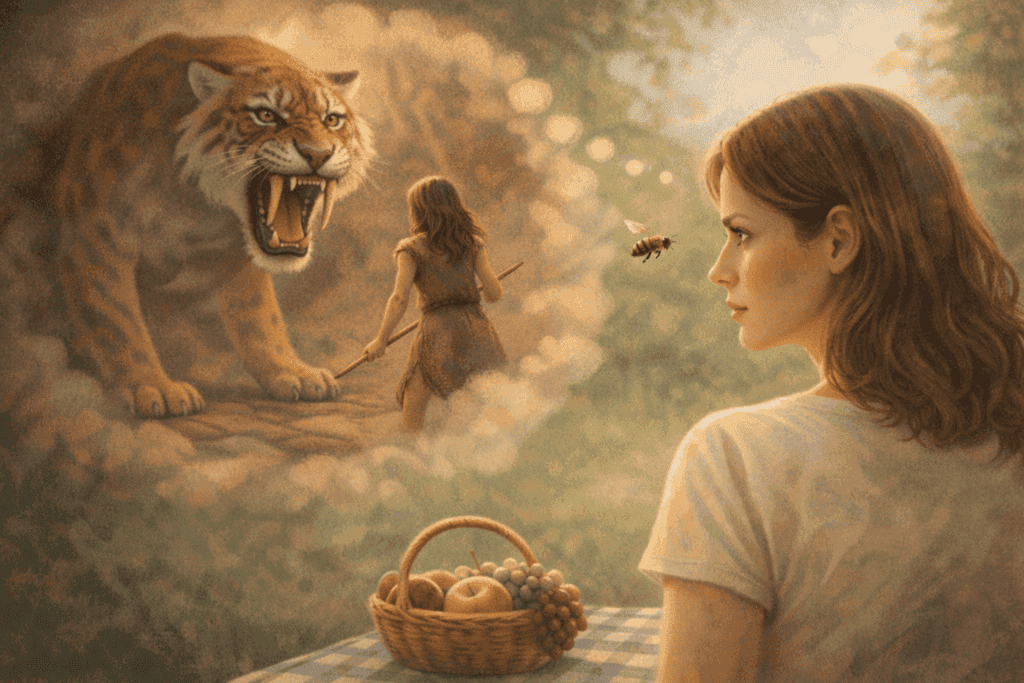
This understanding begins with recognising that your brain has a built-in survival system, often described in psychology as a primitive threat-detection system. At Creature Courage, we refer to this as the "caveman brain" because it provides a simple, memorable way to understand how this ancient survival mechanism operates.
Your caveman brain is constantly scanning your environment for potential danger. When this system becomes overactive, it does not simply influence one specific fear. Instead, it can affect the way you respond to uncertainty, discomfort and perceived risk across many areas of your life.
For example, you may find yourself overthinking everyday situations, avoiding even minor discomfort, feeling on edge without a clear reason, or struggling to tolerate uncertainty. Although these experiences may seem unrelated, they often stem from the same overprotective survival system.
If your brain has difficulty managing smaller moments of uncertainty or discomfort, it will naturally find larger challenges even more overwhelming. This is why a holistic approach aims to calm and retrain the entire threat-detection system rather than focusing solely on one specific fear. By helping the brain respond more appropriately to a wide range of situations, the benefits often extend far beyond the original phobia or anxiety that brought someone to therapy.
You can explore this concept further in our
Caveman Awareness blog
Why Single-Technique Therapy Often Falls Short
Many traditional approaches focus primarily on a single method, whether that is cognitive techniques such as CBT, relaxation strategies, talking-based therapy or hypnotherapy.
These approaches can be extremely valuable and often play an important role in helping people understand and manage their fear.
However, fear is rarely a single-layer problem. It involves the way we think, the emotions we experience, the physical reactions within our body, the behaviours we have learned over time, and the brain's deeply ingrained survival mechanisms.
If only one of these areas is addressed, the others can continue to trigger the fear response. This is one of the reasons why progress can sometimes feel slow, incomplete, or difficult to maintain when people return to everyday situations.
A more integrated, holistic approach recognises that lasting change is most likely to occur when all of these interconnected aspects are considered together rather than in isolation.
The Core of the Holistic Approach at Creature Courage
At Creature Courage, we combine multiple evidence-based techniques into one structured, immersive experience.
This allows us to work on all layers of fear at the same time, rather than addressing them in isolation, creating faster and more complete change.
The approach includes:
1. Caveman Awareness (Anxiety Training)
Understanding how your brain creates and responds to fear across different areas of life.
This builds awareness of your patterns, allowing you to recognise when your “caveman brain” is taking over. You are then given practical tools and techniques to respond more calmly, rather than automatically reacting to fear.
You can find out more about Caveman awareness in our blog: What is Caveman Awareness and How it is Used in Animal Phobia Therapy
2. Animal Education Therapy
Learning the truth about the animal in a clear, engaging, and often surprising way.
This helps to:
- Dispel common myths and misconceptions
- Replace fear-based assumptions with an accurate understanding
- Build curiosity, respect, compassion, and even fascination
This process helps to reframe the animal from something threatening into something more neutral, and often something surprisingly fragile or misunderstood, which naturally reduces fear.
You can learn more about animal education in our blog: What is Animal Education Therapy
3. Cognitive Behavioural Techniques (CBT)
Using cognitive behavioural techniques to help you identify and challenge unhelpful thought patterns, and reframe how you interpret situations.
This creates a greater sense of understanding and control, allowing you to respond more rationally rather than being driven by automatic fear responses, particularly when combined with real-life experience.
You can learn more about CBT in our blog: What is Cognitive Behavioural Therapy? How CBT Helps Animal Phobias
4. NLP Techniques
Using structured psychological techniques to help shift emotional responses and behavioural patterns.
These approaches can support faster changes in how certain situations are perceived, helping to reduce automatic fear reactions and create more flexible, controlled responses.
You can learn more about NLP in our blog: NLP for Animal Phobias
5. Hypnotherapy
Using hypnotherapy techniques to guide you into a deeply relaxed and focused state, where the mind becomes more open to new ways of responding, helping to shift automatic patterns at a deeper level.
This can help reduce automatic fear responses and reinforce a greater sense of calm and control.
You can learn more about hypnotherapy in our blog: Hypnotherapy for Animal Phobias

6. Imagination Exercises
Using guided imagination exercises to mentally rehearse new, calmer responses in a safe and controlled way.
These exercises often involve changing how the animal is perceived, such as imagining it in a more harmless, exaggerated, or even slightly silly way. This helps create emotional distance, make peace with the animal, and build compassion and perspective.
This prepares the brain for real-life situations, making it easier to respond more calmly and confidently when you encounter the animal in reality.
You can explore this further in our
Imagination Exercises for Animal Phobias
7. Art Therapy
Using simple creative exercises to help externalise fear, making it easier to see, understand, and work through.
At Creature Courage, art therapy can also help bring imagination exercises to life, allowing you to explore them more thoroughly through an extra cognitive step. This deepens the learning process and helps new perspectives feel more real and memorable.
It also gives you a physical reminder of the imagination exercise, helping you keep the new perspective vivid and easier to return to after the session.
This allows you to process emotions in a different way, reducing their intensity and helping you feel more in control, rather than overwhelmed by them.
You can explore this further in our blog: Art Therapy for Animal Phobias
8. Exposure Therapy
Using carefully structured, real-life exposure to help the brain learn that the feared animal can be experienced safely and calmly.
This is where new learning becomes fully embodied, because you are no longer just thinking differently about the animal, but experiencing yourself responding differently in real time.
Through gradual, supported interaction, exposure helps reduce fear, build confidence, and retrain the brain’s automatic response.

This also allows you to immediately apply what you have learned, reinforcing new patterns while you are in the situation rather than trying to transfer them later.
This is often where the most powerful shift happens, because the brain directly experiences that what it has been predicting as dangerous is actually safe.
You can learn more in our blog:
Exposure Therapy for Animal Phobias
Why Combining Techniques Works So Powerfully
Different people respond to different approaches.
Some people connect more with logical understanding, while others respond more strongly to emotional experience, visualisations or physical interactions.
By combining multiple techniques, we can engage all of these pathways.
This allows learning to happen more quickly and more effectively, while ensuring that fear is challenged from multiple angles.
As a result, the change is not only faster, but also deeper, more complete, and easier to maintain.
Why We Deliver This in a One-Day Intensive Format
One of the most distinctive aspects of the Creature Courage approach is that much of this work is delivered through a focused, one-day experience.
This is not simply a matter of convenience. It is based on how the brain learns most effectively.
When learning is concentrated, repeated and experienced in real time, the brain has a much greater opportunity to update its existing threat predictions. Rather than revisiting the same fear in short weekly sessions, the day builds continuous momentum, allowing each successful experience to strengthen the next.
Because clients immediately apply what they are learning in carefully guided, real-life situations, new emotional responses are reinforced while the experience is still fresh. This helps the brain replace old fear-based patterns with new, more accurate ones instead of allowing progress to fade between appointments.
Many people also find this format far more practical. It reduces the need for multiple sessions spread over several months and makes therapy more accessible for those travelling longer distances, allowing them to fully immerse themselves in the process during a single visit.
This is one of the reasons why so many people experience significant and lasting change in just one day. The brain is not simply gaining knowledge about fear—it is actively learning through direct experience, which is where meaningful and lasting transformation occurs.
You can explore this further in our
Why One-Day Phobia Therapy Works
How It Fits Into a Broader Approach
A complete approach to overcoming an animal phobia brings together several key elements:
- Education
- Cognitive techniques
- Emotional regulation
- Real-life exposure
Together, these work to retrain both the thinking brain and the automatic fear response.
Rather than simply trying to manage fear in isolated moments, this approach creates a more consistent sense of calm and control across different situations, not just when facing the animal.
Ultimately, the goal is not just to remove fear.
It is to create a calmer, more resilient nervous system overall.

Conclusion
A holistic approach to animal phobias is not about using as many techniques as possible. Instead, it is about selecting the right combination of evidence-based methods to address the way fear actually develops and is maintained within the brain.
Rather than focusing on just one aspect of the problem, a holistic approach considers your overall anxiety patterns, your understanding of the animal itself, and how you respond in real-life situations. As these different elements begin to work together, your confidence gradually increases while the fear response becomes less dominant.
This is why the goal is not simply to reduce fear, but to fundamentally change your relationship with it. Instead of feeling controlled by automatic threat responses, you learn to respond with greater understanding, confidence and choice.
If you are ready to take that step, Creature Courage offers a structured, supportive approach designed to help you move from fear to calm, confident interaction, often within a single day.
You can explore our sessions or get in touch to find out more about how the process works:
FAQ
What does a holistic approach to animal phobias mean?
A holistic approach means looking at the phobia as part of a wider system, rather than treating it as one isolated fear. It involves working on your thoughts, emotions, nervous system responses, wider anxiety patterns, and real-life reactions so that change can happen more fully and last more effectively.
Why is a holistic approach better than using just one technique?
Fear does not operate on just one level. It affects the mind, body, emotions, behaviour, and automatic survival responses. If only one part is addressed, the others can still keep the fear going. A holistic approach works on multiple layers at once, which often leads to faster, deeper, and more lasting results.
Does a holistic approach still include exposure therapy?
Yes. Exposure therapy is still a very important part of the process. However, in a holistic approach, it is supported by other techniques, such as education, imagination exercises, cognitive tools, and emotional regulation strategies, which help make the exposure more manageable and effective.
Can a holistic approach help with wider anxiety as well as the animal phobia?
Yes. Because the approach looks at how your brain responds to fear more generally, it can often help with wider anxiety patterns too. Many people find that as they learn to calm their nervous system and respond differently to fear, they feel more in control in other areas of life as well.
Can this kind of work really happen in one day?
For many people, yes. When learning is focused, repeated, and applied immediately in real-life situations, the brain can update very quickly. This is one of the reasons Creature Courage uses a structured one-day intensive approach, which often creates significant and lasting change in a short period of time.