
Fear of Mice: Musophobia

Understanding, Overcoming, and Appreciating One of Nature’s Most Misunderstood Animals
Have you ever felt that sudden jolt of panic when you see a tiny mouse scurrying across the floor? You might have a fear of mice. The fear of mice, known as musophobia, is one of the most common animal phobias.
For some people, seeing a mouse causes mild discomfort. For others, it can trigger intense fear, panic, disgust, or a powerful urge to escape.
In this article, we'll explore what musophobia is, how fears of mice develop, and why these tiny animals can trigger such powerful reactions. Along the way, you'll discover some surprising facts about mice, challenge common myths, learn how they help humans and the environment, and explore how it is possible to overcome a fear of mice. By the end, you may find yourself seeing mice in a completely different way.
Find out How to Overcome Your Fear with Creature Courage
What Is the Fear of Mice?
Musophobia is a specific phobia involving an excessive and persistent fear of mice. Musophobia, a specific type of rodent phobia that can manifest in various ways. Though it can be used to explain overarching fear of mice, rats and rodents, the correct term for a fear of rats is Murophobia, and for the fear of all rodents, Suriphobia.
While many people feel startled by a mouse unexpectedly appearing in their home, a phobia goes beyond simple dislike. It can create intense anxiety, avoidance behaviours, and emotional distress that interfere with daily life.
People with musophobia may fear:
- Seeing a mouse
- Hearing scratching noises
- Entering areas where mice might be present
- Discovering signs of mice in a home or garden
- The possibility of a mouse running near them
For some people, the fear is primarily about the animal itself. For others, the fear centres around what the mouse represents, such as contamination, disease, infestation, or loss of control.
For balanced information on specific phobias, the UK’s NHS guidance on phobias provides useful information.
Symptoms of Mouse Phobia
Like many animal phobias, musophobia can affect the body, mind, and behaviour.
Common symptoms include:
- Rapid heartbeat
- Sweating
- Trembling or shaking
- Feeling sick or nauseous
- Dizziness
- Panic attacks
- Intense disgust
- Crying
- Difficulty concentrating
- Constant checking for signs of mice
- Avoiding certain locations
- Difficulty sleeping after an encounter
The severity varies greatly from person to person. Some people simply feel uncomfortable around mice, while others experience overwhelming fear.
How Mouse Phobias Are Formed
Most people are not born afraid of mice. Instead, fears tend to develop through a combination of experiences, learning, and the brain's natural survival systems.
Learned Fear
Children often learn fear from the reactions of others. Classical conditioning and observational learning have been shown to play a significant role in the development of phobias.
If a child repeatedly watches adults scream, panic, or jump onto furniture when a mouse appears, they may learn that mice are dangerous before forming their own opinion.

Negative Experiences
A frightening encounter with a mouse can create a powerful emotional memory, particularly during childhood.
Media and Cultural Messages
Television, films, news stories, and pest-control advertising often portray mice as dirty, dangerous, or invasive. These repeated messages can shape how we think about mice long before we encounter one ourselves.
The Avoidance Cycle
Avoidance feels helpful in the short term. The problem is that every time we avoid something, the brain interprets that avoidance as proof that the threat was real.
Over time, the fear often becomes stronger rather than weaker.
Why Do Mice Trigger Such Strong Reactions?
One of the most fascinating aspects of musophobia is that mice are tiny animals, yet they can trigger enormous emotional responses.
Part of the answer lies in neuroscience.
Mice move quickly, appear unexpectedly, and often disappear just as suddenly. The brain dislikes uncertainty. When something darts across the floor without warning, the amygdala—the brain's threat-detection centre—can activate before logical thinking has time to assess the situation.
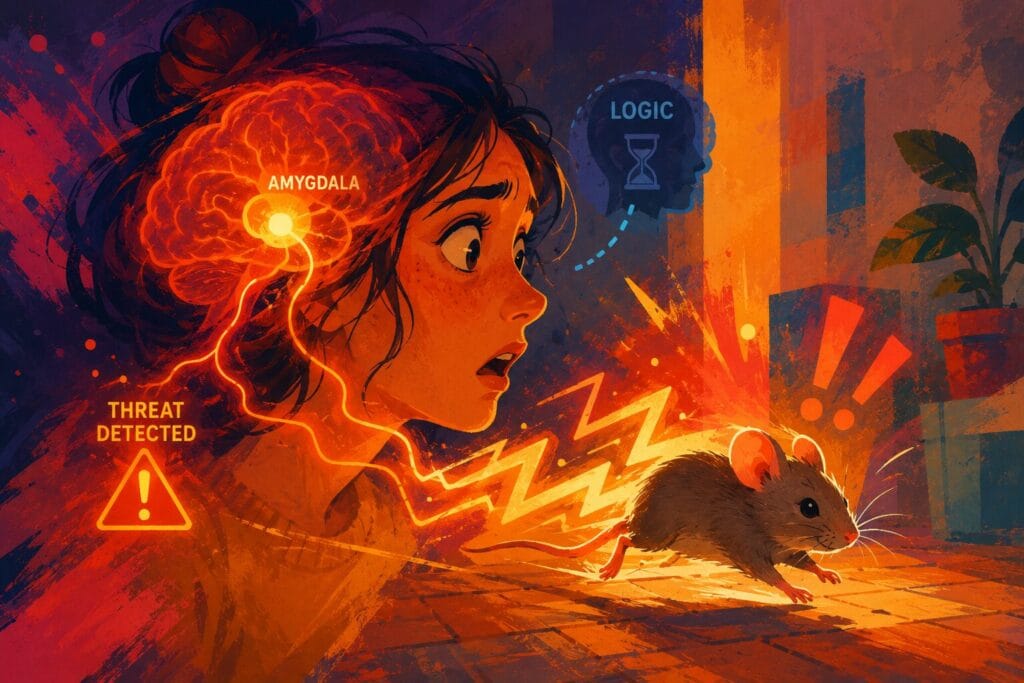
In many cases, people are not truly afraid of the mouse itself.
Instead, they fear:
- Disease
- Contamination
- Infestation
- Losing control of their environment
- Unexpected movement
The anxious brain often magnifies the perceived threat. A tiny mouse can become a giant problem in our imagination. Understanding this distinction is important because it helps separate the actual animal from the story the fear system has built around it.
Why Address Your Fear of Mice?
Avoidance can quietly shrink your world. People with a severe fear of mice may avoid:
- Garages
- Sheds
- Gardens
- Parks
- Countryside walks
- Outdoor activities
- Visiting certain friends or family members
- Moving into certain types of houses
Additionally, a mouse phobia can affect quality of sleep and could cause tension in realtionships.
Overcoming a fear of mice is not about forcing yourself to love mice. It is about reclaiming freedom and living the life you want. Morever, it’s s about teaching your brain that you can remain calm, capable, and in control around something that once felt overwhelming

Fascinating Facts About Mice
The more we understand an animal, the harder it becomes to see it simply as an object of fear.
Mice Have Exceptional Hearing
Mice can hear sounds up to approximately 90 kHz, while humans can usually hear only up to around 20 kHz. This means mice experience an entire hidden soundscape that we cannot perceive.
Mice Sing Love Songs
Male mice produce complex ultrasonic vocalisations when courting females. Scientists often describe these sounds as tiny love songs that humans simply cannot hear.
Mice Are Surprisingly Intelligent
An adult mouse brain weighs only around 0.4 grams.
Despite this, mice can:
- Learn from experience
- Form memories
- Navigate complex environments
- Solve problems
- Recognise familiar individuals
- Adapt their behaviour when circumstances change
Their adaptability is one reason mice are among the world's most successful mammals.
Mice Are Highly Social
Mice are rarely solitary by choice. They often sleep together for warmth, comfort, and security. They communicate constantly through scent, touch, and sound.
Researchers have even described mouse social systems as surprisingly sophisticated.
Mice Can Show Signs of Empathy

Studies have found that mice can respond differently when witnessing another mouse in distress.
Researchers have even observed mice helping trapped companions in certain experiments. This suggests mice may possess primitive forms of empathy and emotional responsiveness.
Mice Never Stop Growing Their Teeth
A mouse's front teeth grow continuously throughout its life.
This is why mice must constantly gnaw on materials to keep them worn down.
The Cheese Myth
Cartoons have convinced many people that mice love cheese.
In reality, mice usually prefer foods such as grains, seeds, nuts, and other carbohydrate-rich foods.
Tiny Animal, Huge Appetite
Despite their small size, mice eat between 15 and 20 times per day due to their incredibly fast metabolisms.
Life as a mouse is a constant balance between finding food and avoiding becoming food.
Common Myths About Mice
Myth: Mice Are Dirty Animals
Reality: Mice are actually very clean animals.
They groom themselves frequently, much like cats.
Wild mice also organise their nests into distinct areas for sleeping, storing food, and toileting.
The real issue is not that mice themselves are inherently dirty. Rather, wild animals living in unsanitary environments may carry bacteria—just as many other wild animals can.
This distinction is psychologically important.
Myth: Mice Are Aggressive
Reality: Mice are prey animals, not predators.
Their entire nervous system is designed around avoiding danger and escaping larger animals.
Humans are terrifying to them.
If a mouse appears to run towards someone, it is usually confused, frightened, or searching desperately for an escape route.
Myth: Mice Deliberately Invade Homes

Reality: Mice are not targeting people personally.
Human homes provide:
- Warmth
- Shelter
- Nesting material
- Food sources
- Protection from predators
A mouse entering a home is simply making a survival decision. If your quality and length of life could be improved by moving to a safer place, wouldn’t you also do it?
Myth: Seeing a Mouse Means You Will Get a Disease
Reality: The risk is often exaggerated by the anxious brain.
While mice can carry diseases under certain circumstances, serious illness from casual mouse encounters is relatively uncommon in developed countries. Importantly, disease transmissions is rare. Simply seeing a mouse briefly in a garden, garage, shed, or even inside a home does not automatically place someone in serious danger.
The reality is that disease transmission usually requires specific conditions, such as:
- Prolonged and direct exposure to droppings or urine
- Large unmanaged infestations over time
- Poor sanitation
- Enclosed dusty environments
- Direct handling without hygiene precautions
Modern hygiene, food storage, sanitation systems, and public health awareness dramatically reduce risks in most developed countries.
In most modern developed countries, serious illness from casual mouse encounters is actually relatively uncommon.
How Mice Help Humans and the Environment
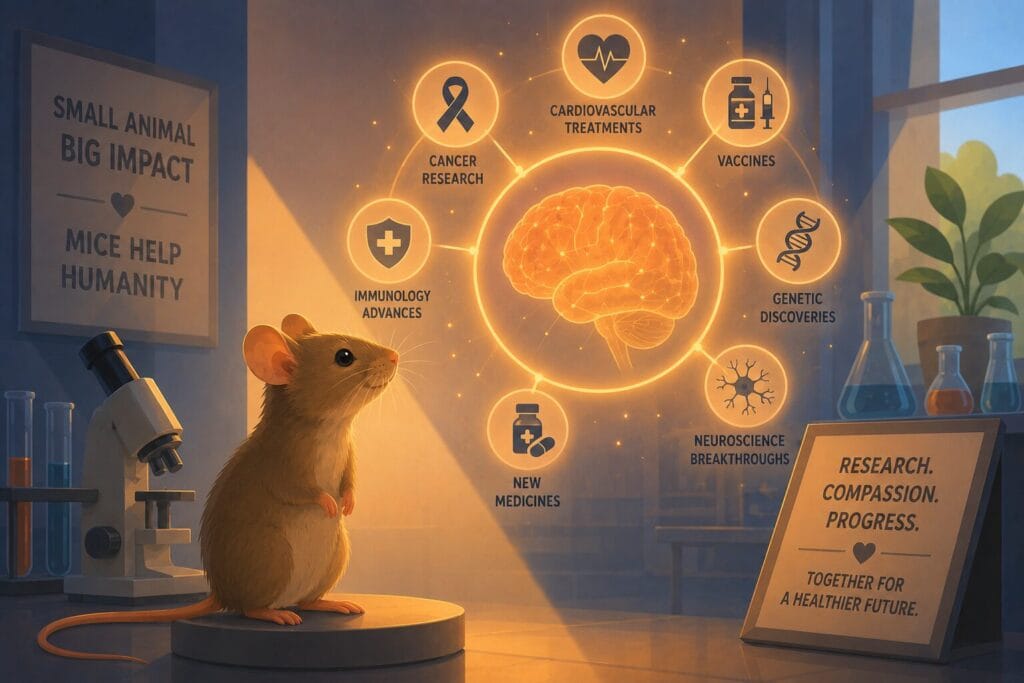
Mice Have Contributed to Medical Science
Many of the medicines and treatments humans benefit from today came at a significant cost to small animals like mice.
Research involving mice has contributed to advances in:
- Cancer treatment
- Diabetes research
- Vaccines
- Genetics
- Neuroscience
- Organ transplantation
- Infectious disease research
- COVID-19 vaccine development
The 2007 Nobel Prize in Physiology or Medicine recognised discoveries involving genetically modified mice that transformed medical research. Nobel Prize research overview
Regardless of personal views on animal testing, it is difficult to deny the enormous contribution mice have made to human health. Mice have saved literally billions of human lives by sacrficing their own.
Mice Support Entire Ecosystems
Mice are one of the most important prey animals on Earth.
They help support countless predators including:
- Owls
- Foxes
- Snakes
- Hawks
- Kestrels
- Wildcats
- Weasels
- Badgers
Without mice, many predator populations would struggle to survive. If mouse populations disappeared suddenly, many predator species would decline, causing ripple effects throughout entire ecosystems.

Mice Help Shape the Environment
As mice dig tunnels and burrows, they help:
- Aerate soil
- Move nutrients
- Improve water penetration
They also collect and bury seeds while foraging. Some of these forgotten seeds later grow into plants and trees.
In this way, mice unintentionally act as tiny ecosystem gardeners.
How Humans and Mice Can Peacefully Coexist
Mice spend almost their entire lives afraid of being hunted, trapped, poisoned, or eaten.
Despite being tiny and vulnerable, they still build nests, care for their young, and try to survive in a dangerous world.
Humans often see mice as pests, yet mice do not understand hatred or disgust. They are simply following survival instincts.
If mice are causing problems around a home, there are often humane ways to reduce unwanted activity:
- Seal entry points
- Store food securely
- Reduce nesting opportunities
- Keep kitchens clean
- Use humane live-capture traps where appropriate
It is also worth considering the welfare implications of glue traps, poisons, and some lethal control methods, which can cause significant suffering.
The RSPCA's guidance on rodent control provides further information on humane approaches.

How to Overcome Your Fear of Mice
The good news is that animal phobias are highly treatable.
At Creature Courage, we use a holistic and neuroscience-informed approach that may include:
- Exposure Therapy: To allow the brain to update its fear response
- CBT: (Cognitive Behavioural Therapy): To give powerful thought awareness
- Guided Imagination Exercises: To transform how you see the animal
- NLP Techniques: (Neuro-Linguistic Programming) Changes how you understand the animal and anchors courage
- Hypnotherapy: To make changes in the deep subconscious and create relaxation
- Art Therapy: To help strengthen other techniques and make them memorable
- Animal Education:To build fascination and compassion, and to dispel myths
Creature Courage: The Expert Mouse Phobia Specialists
At Creature Courage®, we specialise in helping people overcome animal phobias through a unique combination of neuroscience, education, experiential learning, and carefully structured exposure.
Our approach focuses on training the nervous system rather than simply teaching information.
Many clients are surprised by how quickly meaningful change can occur when fear is approached in a supportive, evidence-based way.
You can learn more through our Animal Phobia Testimonials, discover the science behind Why One-Day Phobia Therapy Works, or contact us directly to discuss your situation.
Get Help with Your Fear of Mice
You do not have to spend the rest of your life controlled by a fear of mice.
Whether your fear is mild or severe, change is possible.
The first step is often understanding both the animal and the brain's response to it.
With the right support, many people discover they are capable of far more calm, confidence, and courage than they ever imagined.
If you would like support overcoming musophobia, visit our Contact Page to discuss how Creature Courage may be able to help.
Take the First Step in Overcoming Your Fear

FAQs - Fear of Mice
Is it normal to be afraid of mice?
It's perfectly normal to be afraid of mice, most people have some level of fear to a great many animals and many people experience Musophobia - it's a common phobia. There's no need to feel ashamed or embarrassed, the important thing is that it's not something you have to live with any longer, it can easily be treated
How can I tell if I have Musophobia?
If you experience intense fear or anxiety around mice, avoid situations where you might encounter them, or have physical symptoms like sweating, trembling, or rapid heartbeat, you probably have some form of Musophobia
What causes Musophobia?
The exact causes of Musophobia can vary, but it often stems from traumatic experiences, learned behaviours, or evolutionary factors
Are mice dangerous?
While mice can carry diseases, the risk of contracting a serious illness from a mouse is very low. Most mice are harmless and simply trying to survive
Can I overcome Musophobia on my own?
It's possible to overcome Musophobia on your own, but seeking professional help can significantly increase your chances of success and guide you in the right way, step-by-step. A therapist should also provide you with tools and strategies to manage your fear
What kind of therapy is best for Musophobia?
Cognitive-behavioural therapy (CBT) and exposure therapy are often the most effective approaches for treating Musophobia. However, our workshops are specifically designed to work you through in an appropriate pattern (at the right pace) to bring you life-long, lasting relief from your animal phobia
How long does it take to overcome Musophobia?
The length of time it takes to overcome Musophobia varies depending on the severity of the fear and your commitment to the therapy. However, with consistent effort, the majority of people make significant progress in a relatively short period
Is it safe to have a pet mouse if I have Musophobia?
If you have a strong desire to have a pet, working with a therapist can help you gradually overcome your fear to be able to safely and confidently interact with mice. You know what, you'll probably enjoy it, too!
Where can I get help for Musophobia?
Creature Courage offers specialised therapy for Musophobia and other phobias. Our experienced therapists will provide you with personalised support and guidance.