

Workplace Phobias: The Invisible Corporate Challenge
Most organisations understand that poor mental health can affect productivity. However, one important issue often goes unnoticed: workplace phobias and avoidance behaviour.
In Great Britain, 22.1 million working days were lost to work-related stress, depression, or anxiety in 2024/25. This makes mental health one of the largest contributors to workplace absence and disruption.
At the same time, research from Deloitte estimates that poor mental health costs UK employers £51 billion every year. A large proportion of this cost comes from presenteeism, where employees continue working while struggling mentally.
Taken together, these figures reveal a major challenge for organisations.
Yet within these statistics sits a quieter issue that is rarely discussed openly: phobia-driven avoidance in the workplace.
When employees begin avoiding certain tasks, environments, or responsibilities because of fear, the effects can quietly ripple through teams, workflows, and organisational performance. This article aims to explore how this overlooked mental health issue can cost companies thousands and offer a simple yet effective solution.
Workplace Phobias Are More Common Than Many Employers Realise
A phobia is more than simple discomfort or dislike.
The NHS describes a phobia as an overwhelming and debilitating fear of an object, situation, place, feeling, or animal. In severe cases, people may organise their lives around avoiding the feared trigger or situation.
This avoidance behaviour is what often creates difficulties at work.
Importantly, workplace-relevant phobias are not limited to animals. Many different fears can interfere with professional responsibilities.
Common examples include:
Fear of public speaking or presenting
Fear of flying or travelling for work
Fear of confined spaces or heights
Fear of medical procedures such as injections or blood
Fear of germs or contamination
Fear of certain animals encountered in occupational settings
The Adult Psychiatric Morbidity Survey for England (2023–2024) found that around one in five adults experienced a common mental health condition in the previous week.
Within this group, phobias affected roughly 2.6% of adults overall, rising to 3.3% among working-age individuals.
However, a particularly important finding is that only 3.3% of people meeting the criteria for a phobia had ever received a professional diagnosis.
As a result, phobias often remain hidden inside organisations, even when they are influencing performance.

Why Workplace Phobias Become a Hidden Operational Cost
Phobias influence behaviour in predictable ways.
They trigger anticipatory anxiety, physiological stress responses, and avoidance behaviour. In many cases, the anxiety can even be triggered simply by thinking about the feared situation.
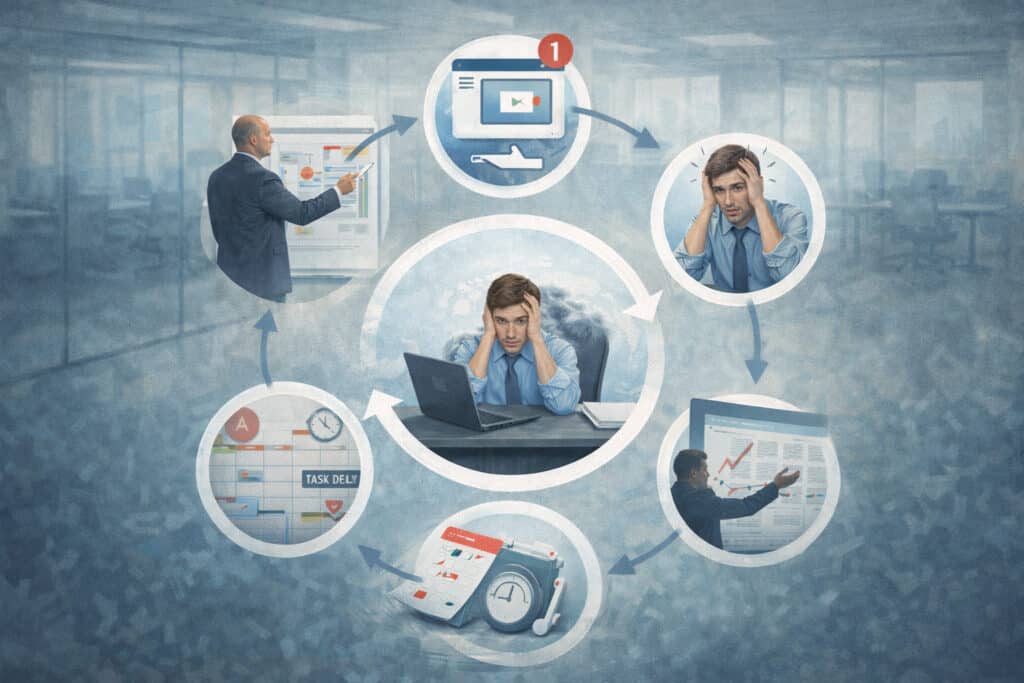
In a workplace environment, this can create what might be described as task-blocking anxiety loops.
These loops interfere with everyday responsibilities such as:
collaboration
training and learning
travel requirements
communication and presentations
decision-making under pressure
working safely in certain environments
Because avoidance behaviour is rarely disclosed openly, its effects often appear indirectly.
Managers may notice missed opportunities, delayed projects, or reluctance to take on responsibilities. However, these patterns are frequently interpreted as personality traits or performance issues.
In reality, anxiety may be the underlying cause.
The Five Operational Costs of Workplace Phobias
When viewed from an organisational perspective, phobia-driven avoidance tends to create several types of operational costs.
Capability Costs
Employees may avoid responsibilities that trigger anxiety.
For example, someone may decline presentations, resist travel, or avoid tasks involving confined spaces or medical environments.
Over time, this can limit role flexibility and restrict career development.
Throughput Costs
Avoidance often slows workflows.
Tasks may need to be reassigned, travel plans reorganised, or training repeated. Decisions may also be delayed if someone is dreading a particular responsibility.
Although each delay may appear small, these disruptions accumulate over time.
Quality and Error Costs
High anxiety increases cognitive load.
When the brain is focused on perceived threats, attention and working memory can narrow. As a result, mistakes, missed details, or customer friction can occur.
Safety and Risk Costs
In certain environments, anxiety responses can increase safety risks.
Roles involving heights, confined spaces, animals, or emergency situations require calm thinking and clear judgment.
The Health and Safety Executive (HSE) recognises stress as a workplace risk factor that should be addressed through structured risk assessment.

People and Culture Costs
Because phobias are frequently undisclosed, the wider team often absorbs the impact silently.
Colleagues may become frustrated by perceived avoidance. Managers may feel unsure how to respond.
Over time, this can affect morale, communication, and trust within teams.
The Scale of Mental Health Costs in the Workplace
When phobia-related avoidance is considered alongside broader mental health trends, the scale of the issue becomes clearer.
For example:
40.1 million working days were lost in Great Britain due to work-related ill health and injuries in 2024/25.
964,000 workers were suffering work-related stress, depression, or anxiety.
The average absence for these conditions was 22.9 days per case.
Research also shows that organisations benefit financially from addressing these issues early.
Deloitte estimates that every £1 invested in workplace mental health support returns around £4.70 in productivity gains.
Meanwhile, the CIPD Health and Wellbeing at Work Report 2025 identifies mental ill health as the leading cause of long-term workplace absence.
Globally, the World Health Organization estimates that depression and anxiety lead to the loss of 12 billion working days each year.
These statistics highlight how workplace anxiety is not only a wellbeing issue but also a significant operational challenge.
Why Avoidance Reinforces Phobias Over Time
Avoidance may reduce anxiety temporarily, but it strengthens fear in the long term.
According to the Tavistock and Portman NHS Foundation Trust, avoiding a feared situation creates short-term relief. However, this relief reinforces the behaviour and increases the likelihood of future avoidance.
Over time, avoidance behaviours can expand.
An employee might begin avoiding presentations, travel opportunities, leadership responsibilities, or even promotions.
This can occur even when the individual is highly capable.
Evidence-Based Strategies for Managing Workplace Phobias
Research shows that phobias can be addressed effectively through a combination of clinical and organisational approaches.
Clinical treatments often include cognitive behavioural therapy (CBT) and exposure-based interventions, which help individuals gradually face feared situations in a safe and structured way.
Studies comparing single-session and multi-session exposure therapy have found similar effectiveness between the approaches, suggesting that focused interventions can be highly efficient.
At the organisational level, the World Health Organization recommends three key workplace actions:
Prevent mental health risks within the work environment
Improve mental health literacy among managers and staff
Provide supportive systems and reasonable adjustments
Evidence also suggests that manager mental health training can improve knowledge, reduce stigma, and increase supportive behaviour toward employees.
Another controlled trial found that manager training reduced sick leave and produced a positive return on investment.
Workplace mental health programmes have also been shown to reduce absenteeism in systematic reviews.
Professional Development Workshops: Building Fear-Management Skills
Professional development programmes can help employees understand and manage anxiety responses.
For example, professional development workshops on courage and anxiety management can teach teams practical strategies for recognising and regulating fear responses.
Participants may learn how the brain processes threat, how stress affects decision-making, and how to respond more calmly in challenging situations.
Over time, these skills can improve confidence, communication, and adaptability across the organisation.
Team Building Workshops: Strengthening Psychological Safety
Team environments strongly influence how employees respond to fear and anxiety.
Experiential team building workshops focused on courage and resilience can help teams develop supportive peer behaviours and stronger psychological safety.
When employees feel safe discussing challenges early, avoidance behaviour becomes easier to address constructively.
As a result, teams often experience improved trust, communication, and collaboration.
Motivational Keynote Speaking: Shifting Organisational Culture
Sometimes, the most important first step is changing how organisations think about fear.
Motivational keynote speaking on courage, fear, and resilience can introduce teams to the science behind anxiety and avoidance behaviour.
By normalising these experiences and explaining how the brain’s threat system works, organisations can create a shared language around courage and psychological safety.
This cultural shift often makes it easier for organisations to introduce deeper training and development initiatives.
 Conclusion: Addressing the Hidden Cost of Workplace Phobias

Workplace phobias are rarely discussed openly, yet they can quietly influence productivity, safety, and employee wellbeing.
Avoidance behaviours may appear as missed opportunities, delayed projects, or communication challenges. However, the underlying issue is often anxiety rather than capability.
When organisations invest in awareness, leadership development, and supportive workplace cultures, they create environments where employees can address fear earlier and perform more confidently.
If these patterns are already emerging within your organisation, early intervention can make a significant difference.

FAQ
What are workplace phobias?
Workplace phobias are intense fears that interfere with an employee’s ability to perform certain tasks, environments, or social situations at work. These fears can lead to avoidance behaviour that affects productivity and communication.
Can anxiety and phobias affect workplace productivity?
Yes. Anxiety can affect concentration, decision-making, and communication. Over time, this can reduce productivity, increase errors, and contribute to absenteeism or presenteeism.
How can employers support employees with phobias?
Employers can provide supportive leadership, mental health awareness training, and professional development programmes that help employees understand and manage fear responses.
Are workplace phobias treatable?
Yes. Research shows that therapies such as cognitive behavioural therapy (CBT) and exposure-based approaches can be highly effective in treating specific phobias.