
Why Experiential Learning Works: What the Brain Learns Faster Through Doing, Not Listening
Why We Remember Experiences More Than Lectures
Think back to something you learned years ago that you still remember clearly.
For many people, it isn’t a lecture. It’s an experience.
Maybe it was the first time you rode a bike without stabilisers.
It could have been your first presentation at work.
Or perhaps it was holding a snake, stepping onto a stage, or tackling a difficult challenge with a team.
Those moments stay with us.
Not because someone explained them in a PowerPoint slide — but because we did something.
Experiences activate curiosity, emotion, movement, and decision-making all at once. The brain pays attention. Memory systems engage. Learning becomes something the body and mind experience together.
The Science Behind Experiential Learning
Over the past two decades, neuroscience and education research have increasingly shown that experiential learning — learning through doing, practising, and reflecting — produces stronger understanding, longer retention, and better real-world performance than passive listening alone.
Large meta-analyses comparing teaching methods have found that active and experiential approaches improve learning outcomes by roughly half a standard deviation on average, a meaningful improvement across many fields and settings.
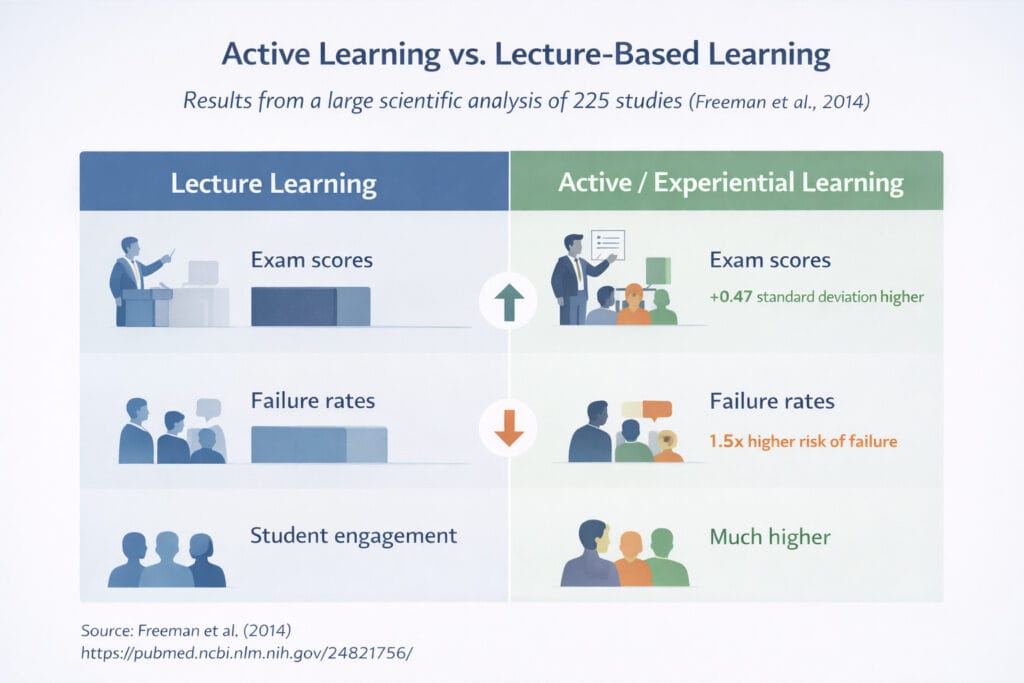
One widely cited study analysing 225 experiments comparing active learning with lectures found that students in active learning environments achieved significantly higher exam scores and were nearly twice as likely to fail when taught primarily through lectures (Freeman et al. (2014).
In simple terms:
The brain remembers experiences better than explanations.
Why the Brain Learns Faster Through Doing
This difference is not just about attention or entertainment. It reflects something deeper about how the brain actually learns.
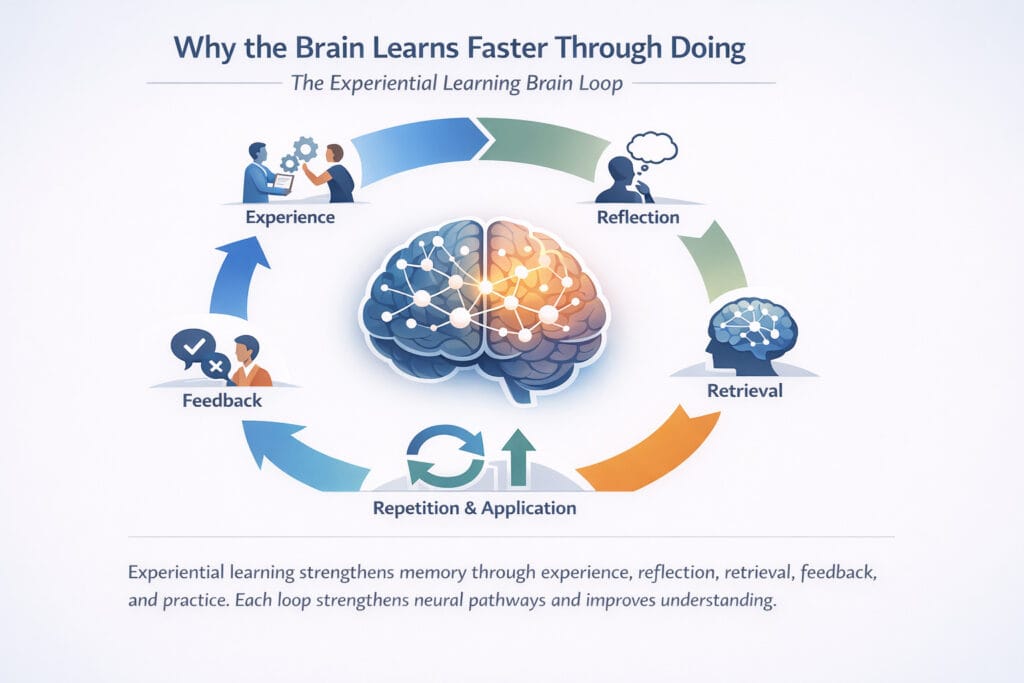
When people are required to make decisions, solve problems, retrieve information, and receive feedback, the brain strengthens the neural networks responsible for learning.
Passive listening rarely activates these systems as strongly.
Research shows that actively retrieving information from memory strengthens learning more effectively than simply re-reading or hearing it again.
Large meta-analyses examining retrieval practice show substantial improvements in long-term learning when learners actively recall information. (Adesope et al., 2017).
This is why interactive experiences — simulations, practice, challenges, and real-world activities — often create much stronger and longer-lasting learning than lectures.
Why Real Experience Changes the Brain
We can see this principle clearly in real life.
For example, many people watch videos about spiders, dogs, or insects for years while still feeling anxious around them. Watching something on a screen does not teach the brain what it actually feels like to be near the animal.
The experience remains abstract and distant.
However, when someone safely interacts with an animal in a controlled environment, the brain receives new sensory and emotional information. The person can see that the situation is manageable. The nervous system begins updating its expectations.
Gradually, the fear response reduces because the brain learns that the situation is predictable and controllable.
This is why real exposure experiences can transform fear far more effectively than simply watching or reading about the situation. (Craske et al., 2014).
The same principle applies to almost every form of learning.
Whether someone is learning leadership skills, teamwork, communication, or resilience, the brain learns fastest when knowledge is experienced, tested, and reflected upon rather than simply explained.
To understand why experiential learning is so powerful, we need to look more closely at the underlying mechanisms in the brain.
Why Passive Learning Often Fails
Have you ever attended a lecture, seminar, or training session that felt clear and informative at the time — only to realise a week later that you remember very little of it?
This experience is surprisingly common.
In passive learning environments, people mainly listen while someone else explains ideas. Although the information may seem easy to understand in the moment, the brain is not doing very much active work.
Without the need to make decisions, solve problems, or retrieve information, attention gradually drifts.
Researchers studying lectures have repeatedly found that mind-wandering increases when learners are not actively required to participate. (Szpunar et al., 2013).
The brain simply struggles to maintain strong focus when it is only receiving information rather than interacting with it.
Working memory also plays a role. Human working memory — the mental system that temporarily holds and processes information — has limited capacity.
When too much information is delivered without opportunities to apply or discuss it, the brain quickly becomes overloaded.
As a result, much of the information never becomes a stable long-term memory.
Experiential learning solves this problem by repeatedly asking the learner to do something with the information.
When people must apply ideas, explain them, test them, or use them in a realistic situation, the brain becomes actively involved in building memory.
Learning becomes a process of participation rather than observation.
The Illusion of Learning
One of the most surprising discoveries in learning science is that passive lectures can sometimes feel more effective than active learning, even when they produce worse results.
In controlled classroom experiments comparing lecture-based teaching with active problem-solving, students often reported feeling that they learned more from lectures. However, when their knowledge was tested, the students who participated in active learning consistently performed better. (Deslauriers et al., 2019).
Why does this happen?
Listening to a clear explanation can create a sense of familiarity. The information feels smooth and easy to follow, which gives the impression that learning has occurred.
Psychologists sometimes describe this as fluency — when information feels easy to process.
However, fluency is not the same as learning.
Real learning requires effort. The brain strengthens memory when it struggles slightly to retrieve information, solve a problem, or apply knowledge in a new context.
This concept is sometimes called “desirable difficulty.”
Although active learning may feel more demanding in the moment, the effort helps the brain build stronger and more durable knowledge.
This is one of the key reasons experiential learning is so powerful.
How the Caveman Brain Influences Learning
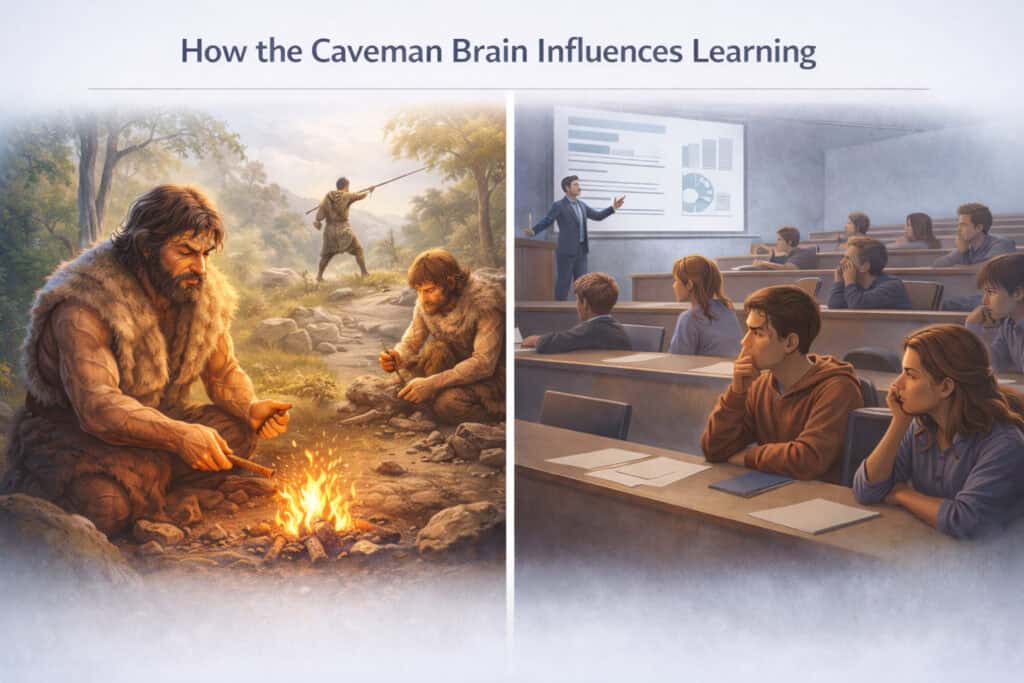
To understand why experiential learning works so well, it helps to remember that the human brain did not evolve in classrooms.
For most of human history, our ancestors learned through direct experience. They learned how to hunt, build tools, navigate landscapes, and cooperate in groups by doing things in the real world, not by listening to extended explanations.
This environment shaped the brain systems that support learning.
The emotional centres of the brain — particularly structures such as the amygdala — play an important role in determining which experiences are remembered. When something is surprising, challenging, or emotionally meaningful, the brain gives that moment higher priority for long-term memory formation. (McGaugh, 2004).
This is sometimes described informally as the “caveman brain” effect.
Experiences that involve action, uncertainty, curiosity, and problem-solving activate ancient survival systems that evolved to help humans learn from real-world situations.
By contrast, passive listening provides far fewer signals that something important is happening.
Experiential learning works so well because it aligns with the way the human brain originally evolved to learn: through exploration, challenge, and direct interaction with the world.
The Neuroscience of Experiential Learning
To understand why experiential learning works so well, we need to look at how the brain actually builds knowledge.
Learning is not simply about receiving information. It involves a series of processes in the brain that encode, strengthen, and stabilise memory over time.
When people actively engage with a task — making decisions, testing ideas, or solving problems — the brain repeatedly activates networks involving the hippocampus and prefrontal cortex, two regions that play a central role in learning and memory.
Each time knowledge is used or recalled, the repeated use strengthens neural pathways.
By contrast, when information is only heard once in a lecture, the brain may encode it briefly but never revisit the memory trace again. Without further activation, the memory fades quickly.
Experiential learning naturally creates multiple cycles of activation.
A person listens to an idea, applies it in practice, reflects on what happened, and then tries again. Each of these steps strengthens the neural representation of the concept.
Research examining the neurobiology of learning suggests that repeated activation of neural pathways plays an important role in strengthening long-term memory (Smolen, Zhang & Byrne, 2016).
Over time, the brain becomes more efficient at recognising patterns, recalling knowledge, and applying skills in new situations.
This is why learning that involves doing, reflecting, and repeating tends to produce deeper understanding than learning that involves listening alone.
Retrieval Practice: Why Remembering Strengthens Memory
One of the most powerful discoveries in modern learning science is the testing effect, also known as retrieval practice.
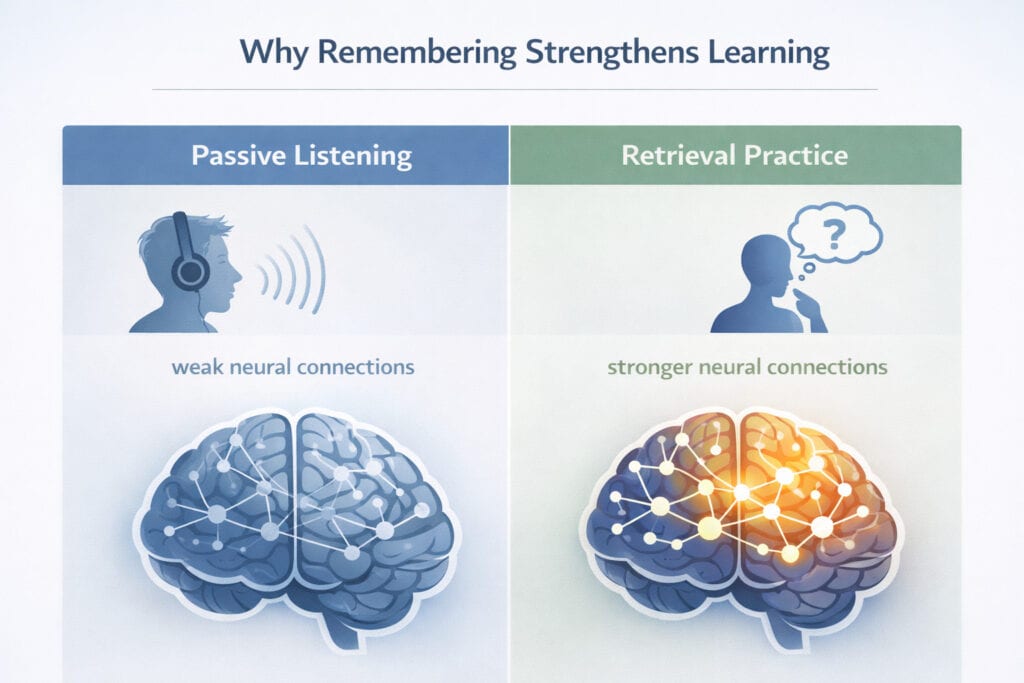
Research consistently shows that people remember information better when they actively retrieve it from memory rather than simply re-reading or hearing it again.
In large meta-analyses, practice testing has been shown to produce substantial improvements in long-term learning compared with passive study methods (Adesope et al., 2017).
When someone attempts to recall information — even if the attempt is imperfect — the brain reactivates the neural networks associated with that memory. This reactivation strengthens the connections between brain regions involved in learning.
In practical terms, this means that learning improves when people are asked to:
explain an idea in their own words
answer questions about a concept
teach the idea to someone else
apply the knowledge in a new situation
Experiential workshops naturally include these processes.
Participants are constantly retrieving ideas, testing their understanding, and receiving feedback. Each retrieval strengthens the memory trace, making the knowledge easier to recall later.
Passive lectures rarely create these opportunities.
Why Spacing and Repetition Strengthen Learning
Another well-established principle of learning science is the spacing effect.
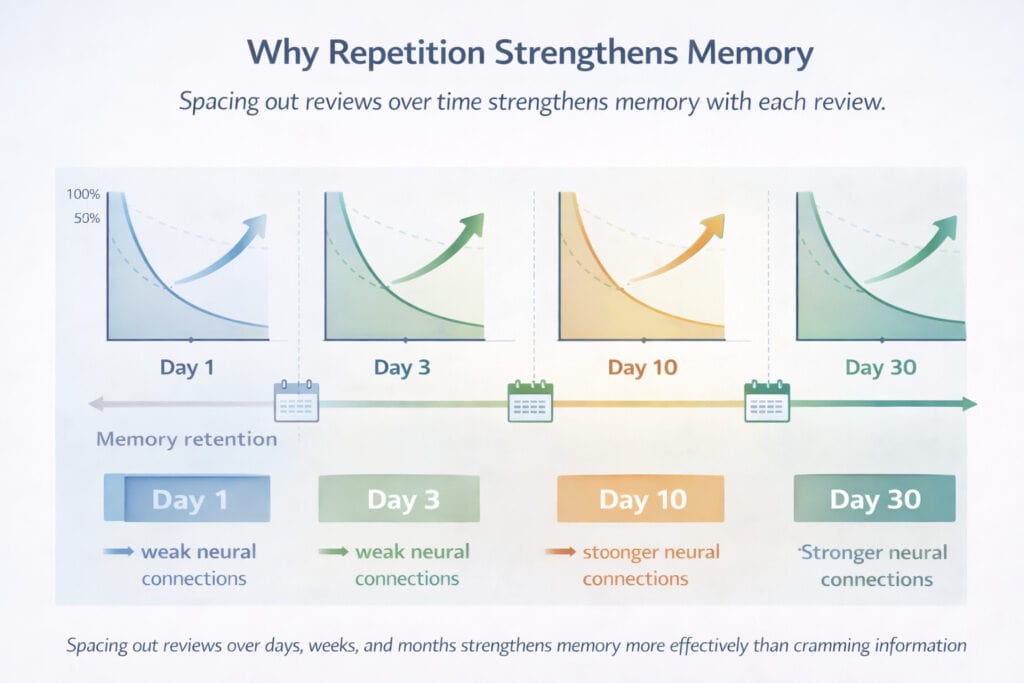
Studies across hundreds of experiments show that information is remembered far better when learning sessions are spaced over time rather than concentrated in a single block. (Cepeda et al., 2008).
When the brain revisits a concept after a delay, it must work harder to retrieve the information. This effort strengthens the neural connections involved in memory.
Researchers have even identified patterns in how spacing works. The optimal gap between learning sessions tends to depend on how long the information needs to be remembered.
For example:
Short retention goals may benefit from review within days
Long-term retention may benefit from longer gaps between learning sessions
Experiential learning often uses this principle naturally.
A workshop might introduce an idea, then revisit it through exercises, reflection, and follow-up practice. Each repetition reactivates the memory trace and strengthens consolidation in the brain.
This process transforms fragile short-term knowledge into durable long-term understanding.
Embodied Learning: Why the Body Helps the Brain Understand
Another fascinating area of research is embodied cognition.
This theory suggests that thinking is not purely abstract. Instead, the brain often uses sensory and motor systems — the same systems involved in movement and physical interaction — to understand ideas.
Experiential learning frequently engages these systems.
When people interact with objects, move through an environment, or physically simulate a situation, the brain adds sensorimotor information to the learning process.
Studies have shown that even brief physical experiences can improve understanding of complex concepts. (Wilson, 2002).
In one experiment, students who physically interacted with demonstrations of physics principles performed better on later tests than students who only observed explanations.
The physical experience created additional neural pathways that supported reasoning.
This is one reason experiential workshops can be so memorable.
Instead of learning purely through abstract explanation, participants engage their senses, movement, and emotions. The body becomes part of the learning process, making the knowledge easier to understand and recall.
Emotion and the “Caveman Brain”
Emotion also plays a powerful role in learning.
When an experience feels surprising, exciting, or slightly challenging, the brain prioritises that moment for memory. This process involves the amygdala, a brain structure that helps regulate emotional responses and influences how memories are consolidated.
In evolutionary terms, this makes perfect sense.
For early humans, remembering emotionally significant experiences could be the difference between survival and danger. As a result, the brain evolved to give priority to events involving uncertainty, challenge, or strong emotional signals.
Research has shown that emotional arousal can significantly enhance memory consolidation (McGaugh, 2004).
This is sometimes described informally as the “caveman brain.”
When learning experiences involve curiosity, challenge, and real interaction with the environment, these ancient systems become active.
The brain recognises the situation as meaningful and important.
Experiential learning takes advantage of this natural mechanism by creating environments where people actively explore ideas rather than simply hearing about them.
In doing so, it aligns modern education with the way the human brain has always learned best: through experience, exploration, and discovery.
What Large Scientific Studies Reveal About Experiential Learning
The idea that experiential learning improves understanding is not just a theory. It is supported by a large body of research across education, psychology, and workplace training.
One of the most influential studies analysed 225 separate experiments comparing traditional lectures with active learning approaches in university science courses.
The results were striking.
Students in active learning environments achieved significantly higher exam scores, improving performance by almost half a standard deviation on average. Even more importantly, students taught primarily through lectures were nearly twice as likely to fail their courses (Freeman et al., 2014).
Other meta-analyses examining experiential learning across multiple disciplines have found similar results, with learning outcomes typically improving by around 0.43 standard deviations compared with traditional instruction (Burch et al., 2019).
In research terms, this is considered a meaningful improvement.
These findings appear consistently across different contexts, including schools, universities, professional training programmes, and organisational learning environments.
The evidence suggests that experiential learning is not simply an engaging teaching style.
It is a method that aligns closely with how the brain actually processes and retains information.
Why Active Participation Improves Learning
To understand why these results appear so consistently, it helps to think about what happens during an experiential learning activity.
Participants are rarely passive.
They might be:
solving a problem
discussing ideas with others
making decisions
testing solutions
receiving feedback
reflecting on the outcome
Each of these steps activates important cognitive processes.
Instead of simply hearing information, learners must generate ideas, retrieve knowledge, evaluate outcomes, and adapt their understanding.
Research shows that this process of generation — producing answers rather than receiving them — significantly improves memory formation. (Kornell, Hays & Bjork, 2009).
The brain effectively treats the knowledge as something it has discovered, rather than something it has merely been told.
This deeper engagement strengthens learning and makes it far easier to apply knowledge later in real-world situations.
Why Experiences Are Easier to Remember
Another reason experiential learning is so effective is that experiences create richer memories.
When something happens in the real world, the brain records multiple layers of information at the same time:
sights and sounds
physical sensations
emotions
decisions and consequences
social interaction
These multiple signals create a more complex memory trace than listening alone.
As a result, the brain has many different pathways it can use to retrieve the memory later.
This is why people often remember experiences vividly years later.
For example, many adults can clearly recall their first driving lesson, their first public presentation, or the moment they overcame a personal fear.
The memory remains strong because it was associated with action, emotion, and meaning.
Experiential learning deliberately uses this principle to make learning more memorable and transferable.
From Knowledge to Behaviour Change
One of the biggest challenges in education and professional development is turning knowledge into real behaviour.
Many people attend training sessions, take notes, and agree with the ideas being presented — yet little changes afterwards.
Experiential learning addresses this gap by allowing participants to practise behaviours during the learning process itself.
Instead of hearing advice about communication, teamwork, leadership, or resilience, participants experience situations where those skills must be applied.
This creates an important shift.
The brain begins associating the new behaviour with a real experience, rather than an abstract concept.
Because the behaviour has already been practised once, it becomes far easier to repeat later.
This is why experiential learning is widely used in leadership development, team-building programmes, professional skills training, and resilience workshops.
Learning becomes something people do, not something they simply hear about.
How Experiential Learning Is Used in the Workplace
As organisations face increasingly complex challenges, many are rethinking how employees learn new skills.
Traditional training methods often rely heavily on presentations, slides, and long explanations. While these formats can deliver information efficiently, they do not always produce the behavioural changes that organisations actually need.
Experiential learning approaches aim to close this gap.
Instead of focusing only on knowledge transfer, experiential training encourages participants to actively practise new skills in realistic scenarios. Learners make decisions, solve problems, receive feedback, and reflect on the results.
This process mirrors the way the brain naturally strengthens knowledge through retrieval, repetition, and real-world context.
For organisations, the benefits can be substantial. Experiential learning programmes have been linked to improvements in problem solving, teamwork, confidence, and skill transfer into the workplace.
As a result, experiential approaches are increasingly used in professional development, leadership training, team-building workshops, resilience programmes, and interactive conference events.
Below are several examples of how experiential learning is applied in real-world environments.

Experiential Professional Development Workshops
Professional development programmes are often most effective when participants can practise skills rather than simply hear about them.
Experiential professional development workshops frequently use scenario-based learning, simulations, and group challenges to help participants apply ideas immediately.
For example, instead of listening to a lecture about leadership communication, participants may practise handling a difficult conversation with a colleague or responding to a challenging workplace scenario.
These exercises create opportunities for learners to retrieve knowledge, test their understanding, and receive immediate feedback.
Each cycle of practice strengthens the neural pathways involved in learning, making the skill easier to recall and apply later.
Research on training and development consistently shows that learning improves when people have opportunities to apply knowledge during the learning process, rather than only hearing explanations. (Salas et al., 2012).
Experiential professional development programmes are therefore designed to transform ideas into practical capabilities.
Instead of leaving a workshop with notes, participants leave with experience using the skills themselves.
Learn more about Professional Development Workshops.
Experiential Team Building Workshops
Team-building programmes are another area where experiential learning can be particularly effective.
Strong teams rely on more than shared goals. They require trust, communication, role clarity, and effective collaboration.
Experiential team-building workshops often involve group challenges, problem-solving tasks, or simulations that require participants to work together under realistic conditions.
These activities encourage teams to practise communication, decision-making, and coordination while experiencing the consequences of their choices.
Research examining team-building interventions has found moderate positive effects on team outcomes, including improvements in interpersonal relationships and team processes (Klein et al., 2009).
When designed well, experiential team activities help participants develop shared understanding, improve trust, and strengthen collaborative problem-solving.
The learning happens not through explanation, but through shared experience.
Learn more about Corporate Team Building Workshops.
Experiential Event Workshops
Many conferences and corporate events still rely heavily on lecture-style presentations.
While these talks may inspire audiences in the moment, the information can quickly fade if participants remain passive listeners.
Experiential event workshops aim to create more interactive learning environments.
Sessions may include short problem-solving exercises, group discussions, live demonstrations, or interactive challenges that encourage participants to engage with the ideas being presented.
Research on attention in lectures has shown that inserting brief interactive moments — such as short quizzes or discussion prompts — can significantly improve focus and learning outcomes (Szpunar et al., 2013).
These activities reduce mind-wandering and encourage participants to actively retrieve and apply information.
By transforming an audience into active participants, experiential event workshops can create memorable learning experiences that continue to influence behaviour long after the event has finished.
Learn more about Experiential Event Workshops.
Student Anxiety and Resilience Workshops
Experiential learning is also widely used in programmes designed to support mental wellbeing and resilience.
Students experiencing anxiety or stress often benefit from learning practical coping strategies that can be practised in realistic situations.
Experiential resilience workshops may involve guided exercises, role-playing scenarios, or structured challenges that allow students to rehearse emotional regulation and problem-solving strategies.
These experiences help transform abstract advice into practical skills.
Research examining social-emotional learning programmes in schools has found measurable improvements in both emotional skills and academic outcomes when students practise these abilities in structured activities (Durlak et al., 2011).
By actively rehearsing coping strategies, students become more confident in their ability to manage difficult situations.
The brain learns not only what to do, but how it feels to successfully handle a challenge.
Learn more about Student Anxiety and Resilience Workshops.
Motivational Keynote Speaking
Motivational keynotes are often designed to inspire audiences, but inspiration alone does not always lead to long-term change.
Experiential keynote formats aim to combine inspiration with action.
Speakers may invite participants to reflect on personal challenges, discuss ideas with those around them, or create simple plans for applying new behaviours in their daily lives.
One technique supported by psychological research involves implementation intentions — specific plans that link a situation to a particular action, such as:
“If this situation occurs, I will respond in this way.”
Studies show that forming these structured intentions can significantly improve the likelihood that people will follow through on their goals (Gollwitzer & Sheeran, 2006).
By integrating reflection and action into the keynote experience, speakers can transform motivation into practical behavioural change.
This approach aligns closely with the principles of experiential learning, where ideas are reinforced through participation and personal reflection.
Learn more about Britain Stelly Motivational Keynote Speaker.
Why Experiential Learning Represents the Future of Training
Across education, business, and leadership development, one message is becoming increasingly clear: people learn best when they are actively involved in the learning process.
The traditional lecture still has value for introducing ideas, but research consistently shows that listening alone rarely produces lasting understanding or behavioural change.
Experiential learning takes a different approach.
Instead of simply delivering information, it creates opportunities for people to explore ideas, test solutions, and reflect on the results. Each interaction strengthens the brain’s learning networks through retrieval, feedback, and repetition.
These experiences are often more memorable because they engage multiple aspects of human learning at once: cognition, emotion, physical interaction, and social collaboration.
From a neuroscience perspective, experiential learning aligns closely with how the brain evolved to learn in the real world.
For organisations, educators, and event organisers, this has important implications.
Training programmes that combine explanation with active participation, challenge, and reflection are far more likely to produce meaningful outcomes than those based entirely on passive listening.
Whether the goal is professional development, stronger teams, improved resilience, or lasting motivation, experiential learning offers a powerful way to turn knowledge into real-world capability.

Frequently Asked Questions About Experiential Learning
What is experiential learning?
Experiential learning is a learning approach where people develop knowledge and skills through direct experience, reflection, and application. Instead of only listening to explanations, participants actively practise ideas in realistic situations.
Why is experiential learning more effective than lectures?
Experiential learning encourages learners to retrieve knowledge, make decisions, and receive feedback. These processes strengthen neural pathways involved in memory and problem-solving, which improves long-term retention and real-world application.
Does experiential learning work in professional environments?
Yes. Experiential learning is widely used in leadership development, professional training, team-building programmes, and corporate workshops because it helps employees practise skills in realistic scenarios.
Research shows that active learning approaches can significantly improve performance compared with lecture-based training alone. (Freeman et al. (2014).
Why do experiences create stronger memories?
Experiences activate multiple brain systems at the same time, including emotional, sensory, and cognitive networks. This creates richer memory traces, which makes the information easier to recall later. (McGaugh, 2004).
Is experiential learning suitable for anxiety and resilience training?
Yes. Many resilience and wellbeing programmes use experiential exercises that allow participants to practise coping strategies in supportive environments. Repeated practice helps the brain learn that challenging situations can be managed successfully.