
What Is a Keynote Speaker?
A keynote speaker is the main speaker at a conference or event, typically invited to open or close the programme while setting the central theme for the entire gathering.
So what do keynote speakers actually do?
Keynote speakers often:
• introduce the main theme of the conference
• inspire audiences with new perspectives
• share expertise or research insights
• energise attendees for the rest of the event
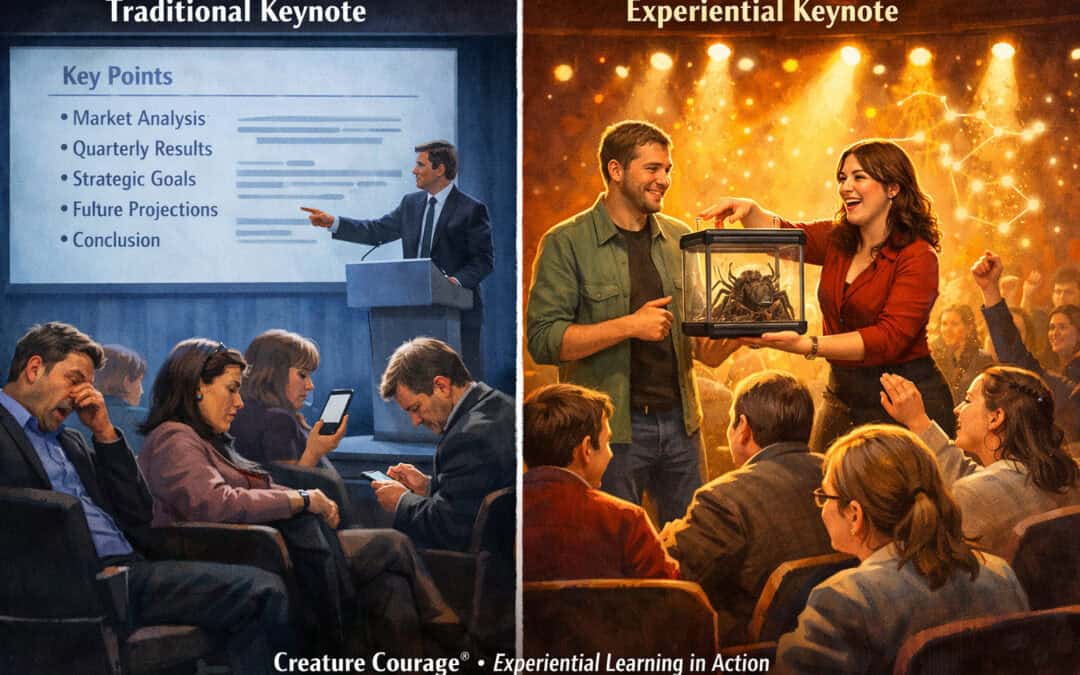
At corporate conferences, leadership events, and professional development days, keynote speakers help audiences focus on the big idea behind the gathering. They introduce themes, spark curiosity, and energise the room.
For conference organisers and event planners, choosing the right keynote speaker is one of the most important decisions for the success of an event. The keynote often sets the emotional tone for the entire conference and shapes how audiences engage with the rest of the programme.
However, while keynote speaking is common, truly memorable keynote presentations are surprisingly rare.
Many audiences leave an event inspired for a short time. Yet a few weeks later, they struggle to remember what was actually said.
The most powerful keynote speakers understand something important about how the human brain learns.
People rarely remember lectures.
They remember experiences.
Why Many Keynote Speeches Are Quickly Forgotten
Many keynote speeches follow a familiar format.
The speaker shares inspiring stories, shows slides, and offers advice.
Audiences often enjoy the talk in the moment. But research on memory suggests that much of what we hear in lectures is forgotten surprisingly quickly.
The German psychologist Hermann Ebbinghaus demonstrated this phenomenon in the late nineteenth century through what became known as the forgetting curve.
His experiments showed that people forget large portions of newly learned information within days unless it is reinforced through meaningful engagement (Ebbinghaus, 1885).
When audiences sit passively and listen for long periods, the brain may treat the information as low priority.
As a result, even motivational messages that feel powerful in the moment may fade once people return to their normal routines.
This is one reason many conferences now look for speakers who create stronger engagement with their audiences.
Why Experiences Are More Powerful Than Lectures
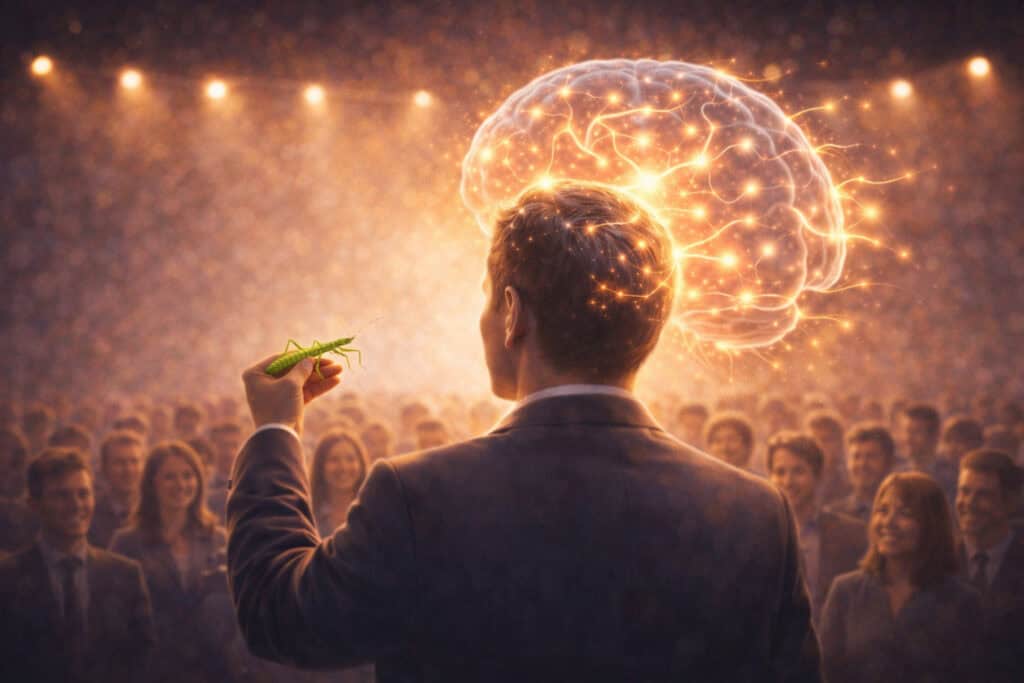
Modern neuroscience helps explain why experiences tend to create stronger learning than lectures.
For most of human history, humans learned through direct interaction with the environment. Early humans developed survival skills by exploring landscapes, solving problems, and responding to challenges in real time.
These experiences shaped the way the brain processes information.
Emotion, attention, and curiosity play major roles in determining which moments become long-term memories.
Research by neuroscientist James McGaugh has shown that emotionally meaningful experiences are more likely to be remembered because they activate brain systems involved in memory consolidation (McGaugh, 2004).
When something is surprising, challenging, or personally meaningful, the brain treats the experience as important.
This is why people often remember:
• The first time they rode a bike
• A powerful moment on stage
• A difficult challenge they overcame
• An unusual experience shared with others
In contrast, long explanations delivered through slides may not activate the same emotional and sensory systems.
Experiences engage more of the brain at once.
They involve movement, decision-making, emotion, and social interaction.
Because of this, experiential learning often creates stronger and longer-lasting memories than passive listening alone. Because of this, experiential learning often creates stronger and longer-lasting memories than passive listening alone, a principle widely discussed in experiential learning theory (Kolb, 1984).
The Rise of Experiential Keynote Speaking
As understanding of learning and memory has evolved, some keynote speakers have begun to move beyond traditional lecture formats.
Instead of relying only on stories or slides, experiential keynote speakers involve audiences directly in demonstrations, exercises, or shared moments of discovery.
These moments can include:
• Audience participation
• Live demonstrations
• Interactive challenges
• Experiential exercises
When audiences participate, the message becomes something they experience, not just something they hear.
This shift can transform a keynote talk from a passive presentation into a shared event.
And shared experiences tend to stay with people far longer than explanations alone.

Proving Courage Live on Stage
In some keynote presentations, courage and fear transformation are not only discussed.
They are demonstrated live.
During one event, a woman volunteered to participate in a live demonstration about fear and the brain.
She explained that she had been afraid of spiders for most of her life.
The irony was that her husband actually made a career from selling exotic spiders and tarantulas. Despite living around them for years, the fear had never faded. Additionally, the fear kept increasing as she kept avoiding actually facing her fear.
Before the demonstration began, the audience briefly explored what happens in the brain when we experience fear.
The amygdala, a small structure deep in the brain, plays an important role in detecting potential threats. This system evolved to help early humans survive dangerous environments.
Sometimes, however, the brain’s ancient survival system can react strongly to situations that are not truly dangerous.
When people understand this “caveman brain” response, something interesting often happens.
The fear starts to feel less mysterious.
Instead of seeing fear as weakness, people begin to recognise it as an ancient protective system doing its job.
After hearing this explanation, the volunteer became curious.
She decided she wanted to challenge the fear that had followed her for years.
Moments later, she gently held a tarantula in her hands while the audience watched.
What happened next surprised many people in the room.
The fear dissolved into curiosity and amazement.
For the volunteer, the moment was not just a lesson.
It was an experience.
And experiences can change how the brain interprets fear.
The Caveman Courage™ Framework
The approach used in my keynote presentations and workshops often follows a simple three-stage process. I call this the Caveman Courage™ framework, which helps people understand fear, break the avoidance cycle, and experience courage in real time.
1. Understanding the Caveman Fear Brain
The first stage involves understanding how fear works in the brain.
When people learn about the brain systems involved in threat detection, the experience of fear becomes far less confusing. Awareness creates the possibility of choice. Instead of automatically accepting the negative thinking patterns that fear can produce, people can begin to recognise what is actually happening in their brain.
Fear is not a sign that something is wrong with a person. It is a natural survival response.
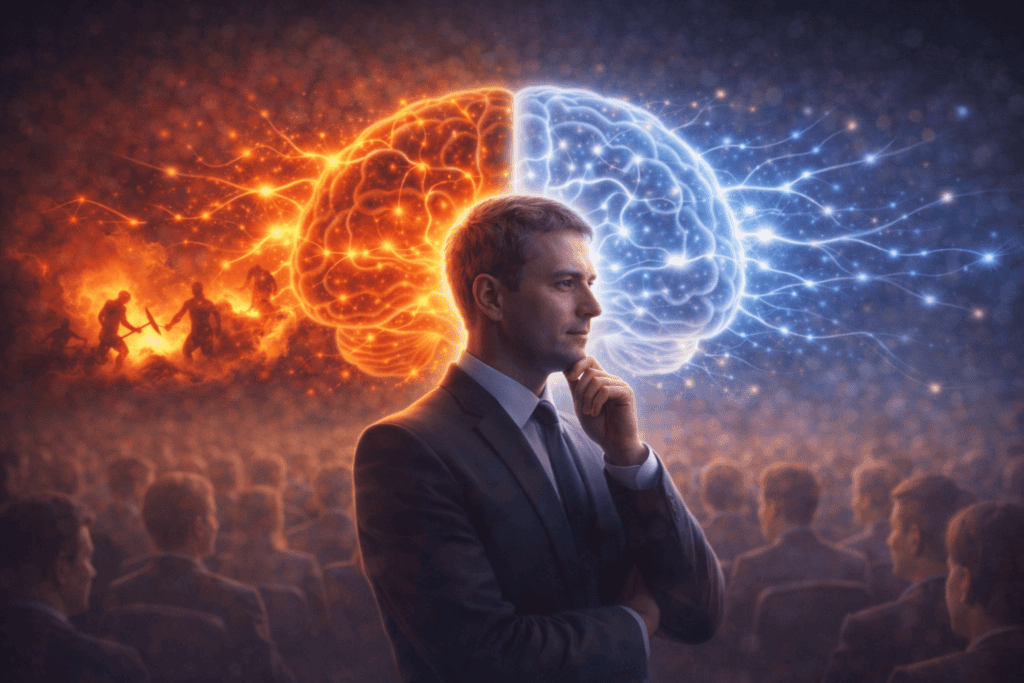
Much of this response comes from what I often describe as the “caveman brain” — ancient neural systems that evolved to protect humans from danger in the wild. These systems are still active today, even though many modern situations do not involve real threats.
When people understand this, something important shifts. They realise that the fearful voice in their mind does not define who they are. It is simply an ancient survival mechanism trying to keep them safe.
Their personality, reasoning, and values exist in other parts of the brain that are capable of making more thoughtful decisions.
This knowledge can be incredibly empowering. It removes shame, replaces confusion with understanding, and often sparks a sense of curiosity about how the brain really works.
2. Interrupting the Avoidance Pattern
The second stage involves recognising the role of avoidance and learning the tools needed to overcome it effectively.
Avoidance can reduce anxiety in the short term, but over time, it strengthens and reinforces the fear response. Each time a person avoids something that triggers fear, the brain learns that the situation must have been dangerous.
Over time, this pattern can make fears grow stronger rather than weaker.
When people learn techniques that help them stay present with uncomfortable sensations and move through them rather than retreating, they begin to interrupt this cycle.
Simple but powerful strategies can help with this process. Techniques such as controlled breathing, reframing fearful thoughts, and shifting attention toward curiosity instead of threat can gradually weaken avoidance patterns.
At this stage, people also learn how to face worry and anxiety more effectively. Not all fears involve a physical object such as an animal or situation. Sometimes the challenge is a thought, a worry, or a feeling of uncertainty.
Learning how to respond to these internal experiences gives people practical tools they can use in everyday life.
By this point, the person no longer has only awareness and understanding. They are also equipped with practical techniques that help them respond to fear more effectively. These tools are supported by psychological research and neuroscience, giving people a reliable way to face challenges rather than avoid them.
3. Experiencing Courage in Real Time
The final stage is experience — facing fears and proving the concept in real life.
Courage rarely develops through explanation alone. It develops through action.
When people face a challenge in a supportive environment and realise they are safe, the brain has an opportunity to update its threat response. Instead of reinforcing fear, the brain begins forming new memories that show the situation is manageable.
Each time a person faces a fear effectively and nothing harmful happens, the brain gathers evidence that the intense fight-or-flight response may not be necessary.
Experiential moments are powerful because they create new reference points for the brain. A fresh memory of success can be far more influential than years of anxious anticipation.
Instead of remembering fear, the brain begins to remember success.
And once people experience that shift, they realise something important: courage is not the absence of fear — it is learning how to move forward despite it.

When a Keynote Becomes an Experience
The most memorable keynote talks often share one thing in common.
They transform ideas into experiences.
When audiences participate in demonstrations, experiments, or challenges, the message becomes something they personally encounter.
This kind of engagement activates attention, emotion, and social connection at the same time.
As a result, the lesson is far more likely to stay with the audience long after the conference ends.
In an age where attention is constantly divided and information is everywhere, experiences stand out.
They create moments people talk about long after the event.
If you are interested in keynote talks that demonstrate courage and fear transformation live, you can learn more about motivational keynote speaking on courage and fear transformation here:
Conclusion
Keynote speakers play an important role in shaping the tone and energy of conferences, leadership events, and professional gatherings.
But the most powerful keynote presentations go beyond storytelling and advice.
They create experiences.
When audiences see ideas demonstrated live, participate in challenges, or witness moments of transformation, the message becomes something far more memorable.
In those moments, a keynote is no longer just a talk.
It becomes an experience that audiences remember long after the event is over.

FAQ

What is the purpose of a keynote speaker?
The purpose of a keynote speaker is to introduce the main theme of an event and inspire the audience around a central idea. Keynote speakers often open or close conferences to set the tone and provide a memorable message for attendees.
What makes a keynote speech memorable?
Keynote speeches tend to be most memorable when they include emotion, storytelling, and audience engagement. Experiences, demonstrations, and interactive moments help audiences retain the message more effectively than passive listening.
Are interactive keynote speeches more effective?
Interactive keynote speeches can be more effective because they engage attention, emotion, and participation at the same time. When audiences experience ideas directly, the brain is more likely to form strong and lasting memories.