

Training the Nervous System: Vital for Healthy Work Life
Modern professional development is evolving. Traditional training programmes often focus on knowledge, strategy, or leadership skills. However, many organisations now recognise that performance problems are rarely caused by a lack of knowledge.
Instead, the real barrier is often the human nervous system under pressure.
Stress, anxiety, fear of failure, and uncertainty can influence decision-making, creativity, and communication. Even highly skilled professionals can struggle when their nervous system enters a threat state.
As a result, organisations are increasingly exploring training the nervous system as part of professional development. Rather than simply teaching people what to do, this approach focuses on helping individuals respond differently to pressure.
Training the nervous system can therefore improve resilience, leadership performance, and workplace wellbeing.
Understanding the Nervous System in the Workplace
The nervous system constantly evaluates whether a situation is safe or threatening. Neuroscientists sometimes refer to this process as neuroception, a term introduced by Stephen Porges in his work on Polyvagal Theory.
Neuroception describes how the brain automatically scans the environment for signs of safety or danger (Porges, 2009).
When the brain perceives safety, the prefrontal cortex functions effectively. This region supports:
- Rational decision-making
• Creativity
• Problem solving
• Communication
• Emotional regulation
However, when the nervous system detects a threat, control shifts toward more primitive brain structures such as the amygdala.
Research by neuroscientist Joseph LeDoux has shown that the amygdala plays a central role in detecting threats and activating fear responses.
When people live with persistent stress and uncertainty, the brain’s alarm system can become overstimulated. The amygdala and wider limbic system stay on constant alert, which keeps the nervous system stuck in a heightened state of vigilance and makes it harder for the brain to relax and think clearly.
As a result, focus, decision-making, and communication can suffer, which may negatively affect workplace performance and productivity.
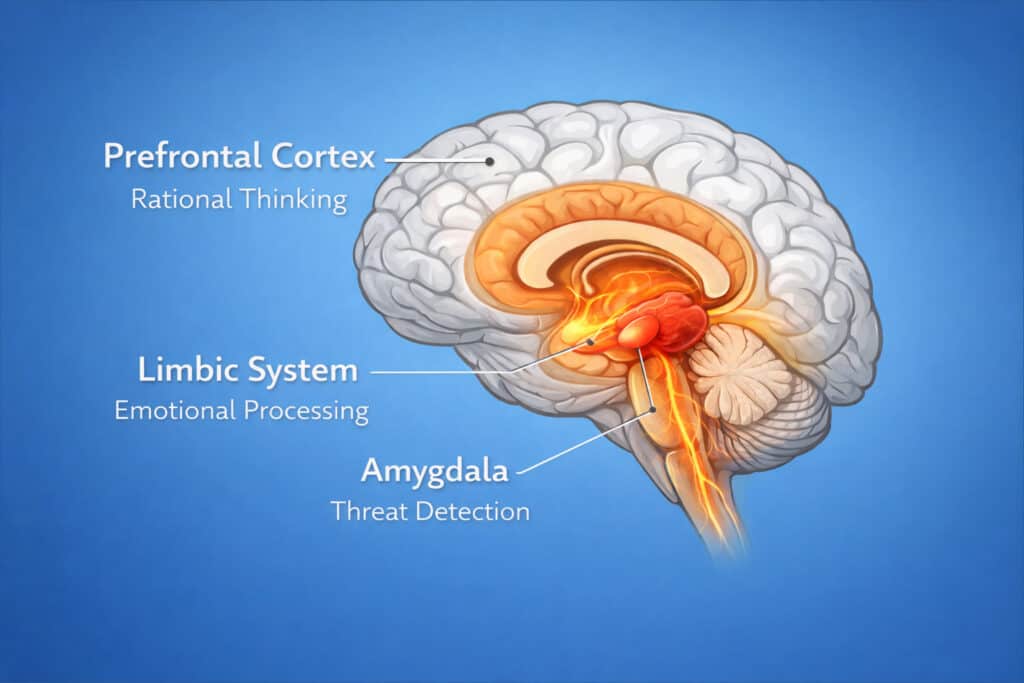
When the amygdala becomes highly active, behaviour becomes more reactive. People may:
- Avoid challenges
• Become defensive during conversations
• Struggle to think clearly under pressure
• Lose confidence in their abilities
This explains why knowledge alone does not guarantee performance. Even skilled professionals may struggle when the nervous system perceives danger.
For this reason, training the nervous system is becoming an important focus in workplace resilience programmes.
Why Stress Management Training Often Falls Short
Many workplace stress programmes focus on surface-level strategies. Employees may learn breathing techniques, time management strategies, or mindfulness exercises.
These tools can certainly help. However, they often fail to address the underlying neurological mechanisms behind stress responses.
The human brain evolved to prioritise survival. When the brain perceives danger, the amygdala activates the body’s threat response.
Heart rate increases. Muscles tense. Attention narrows.
In modern workplaces, threats are rarely physical. Instead, common triggers include:
- Public speaking
• Difficult conversations
• Performance pressure
• Organisational change
• Fear of making mistakes
Even though these situations are not physically dangerous, the nervous system may still react as if they are.
As a result, people may experience avoidance, hesitation, or reduced performance.
Simply telling employees to “stay calm” rarely changes this response. Instead, a more effective strategy is training the nervous system to interpret these situations differently.

What Does Training the Nervous System Mean?
Training the nervous system means gradually teaching the brain that previously stressful situations are manageable.
This approach is closely related to exposure learning, one of the most effective psychological methods for reducing fear and anxiety.
Exposure therapy works by gradually introducing individuals to the situations they fear. Over time, the brain learns that the expected danger does not occur.
A major review by Craske and colleagues explains that exposure therapy helps the brain form new “inhibitory learning” that competes with the original fear response.
Instead of eliminating fear completely, the brain learns a new message:
“This situation may feel uncomfortable, but it is not dangerous.”
Through repeated experience, training the nervous system allows individuals to approach challenging situations with increasing confidence. The uncomfortable feelings become less and less intense.
The Science Behind Training the Nervous System
Neuroscience research consistently shows that the brain changes through experience. This process is known as neuroplasticity, meaning the brain can reorganise and form new neural pathways. Repeated exposure to manageable stressors helps recalibrate the brain’s threat detection system.
For example, imagine someone who feels anxious about speaking during team meetings.
Initially, they may stay silent to avoid judgment. However, with guidance, they might begin by sharing a short comment or asking a question during a meeting.
When nothing negative happens, the nervous system begins to update its prediction.
Over time, the same person may feel comfortable sharing ideas or presenting to colleagues.

The fear response gradually weakens because the brain learns that participation is safe.
A similar process occurs during difficult conversations. When individuals practise discussing disagreements respectfully, the nervous system becomes more tolerant of conflict.
Studies published in Behaviour Research and Therapy demonstrate how repeated exposure helps create new safety associations in the brain.
Although this research often focuses on clinical anxiety, the same neurological principles apply to everyday workplace stress.
For this reason, training the nervous system is increasingly recognised as a powerful resilience strategy.
Nervous System Regulation Techniques That Support
While exposure learning is essential, individuals also benefit from techniques that regulate the nervous system during stressful moments.
These strategies help keep the body within an optimal performance zone while training the nervous system.
Controlled Breathing
Slow breathing activates the parasympathetic nervous system, which supports relaxation and emotional regulation.
Research shows that controlled breathing can reduce physiological stress responses and improve emotional regulation.
Posture and Body Language
Body posture influences how the brain interprets a situation.
Research in embodied cognition shows that body position can influence emotional states and cognitive performance.
Standing upright and relaxing the shoulders can signal safety to the nervous system.
Attention and Thought Training
Catastrophic thinking often amplifies fear responses. Cognitive strategies that challenge unhelpful thoughts can reduce unnecessary threat signals.
Cognitive behavioural approaches are widely supported by evidence in anxiety research.
Over time, these techniques make training the nervous system easier in real-world situations.

Training the Nervous System in Professional Development
When organisations incorporate training the nervous system into professional development, learning becomes more experiential.
Traditional training often focuses on information. However, behaviour under pressure changes primarily through experience.
Participants therefore benefit from structured exercises where they practise real-world challenges.
For example:
- Practising difficult conversations
• Presenting ideas in group environments
• Managing pressure during simulated scenarios
• Reflecting on how fear influences behaviour
These experiences allow participants to apply nervous system regulation techniques while facing manageable challenges.
As the nervous system adapts, participants develop genuine confidence rather than temporary motivation.
Benefits of Training the Nervous System for Organisations
Organisations that focus on training the nervous system often see improvements in several areas.
Improved Decision Making
When the nervous system remains regulated, the prefrontal cortex can operate effectively. This supports clearer thinking and better decision-making.
Stronger Communication
When employees feel psychologically safe, they communicate more openly and collaborate more effectively.
Increased Innovation
Innovation requires risk-taking. However, fear of failure often discourages experimentation. Training the nervous system helps employees tolerate uncertainty and explore new ideas.
Greater Leadership Confidence
Leaders who understand their nervous system responses can remain calmer under pressure and guide teams more effectively.

Why Training the Nervous System Is the Future of Workplace Resilience
Modern professional development is moving beyond simple skills training.
Organisations are beginning to recognise that human performance is closely linked to nervous system regulation.
When individuals learn how fear and stress operate within the brain, they can develop sustainable resilience.
Training the nervous system does not remove stress entirely. Instead, it teaches people how to work with stress in a more adaptive way.
Over time, situations that once felt threatening begin to feel manageable.
Professional Development Workshops at Creature Courage
At Creature Courage, professional development workshops are designed around the principle of training the nervous system.
Rather than focusing solely on theory, programmes combine neuroscience education, behavioural psychology, and experiential learning.
Participants learn how fear responses operate within the brain and practise techniques that regulate those responses in real time.
Through structured experiences, individuals gradually approach situations that would normally trigger avoidance. As the nervous system adapts, participants develop genuine confidence.
You can learn more about these Professional Development Workshops and how they help organisations build resilient teams. Get in touch today to find out more.

Frequently Asked Questions
What does training the nervous system mean?
Training the nervous system involves gradually teaching the brain that previously stressful situations are manageable. This often includes exposure learning, nervous system regulation techniques, and repeated experiences that recalibrate the brain’s threat response.
Can the nervous system be retrained?
Yes. Neuroscience research shows that the brain is highly adaptable through neuroplasticity. With repeated experience and regulation techniques, the nervous system can become less reactive to stress.
Why is nervous system training useful in professional development?
Many workplace challenges involve psychological pressure rather than technical skill. Training the nervous system helps employees remain calm, communicate effectively, and make better decisions under stress.
References and Further Reading
The following research and scientific publications provide further insight into the neuroscience of fear, stress regulation, and behavioural learning.
Craske, M. G., Treanor, M., Conway, C. C., Zbozinek, T., & Vervliet, B. (2014).
Maximizing exposure therapy: An inhibitory learning approach. Behaviour Research and Therapy.
https://doi.org/10.1016/j.brat.2014.04.006
This influential paper explains how exposure learning helps the brain develop new safety associations that compete with existing fear responses.
LeDoux, J. (2012).
Rethinking the emotional brain. Nature Reviews Neuroscience.
https://doi.org/10.1038/nrn3241
Joseph LeDoux’s research explores the role of the amygdala and fear circuitry in the brain.
Porges, S. W. (2009).
The polyvagal theory: New insights into adaptive reactions of the autonomic nervous system. Cleveland Clinic Journal of Medicine.
https://www.ncbi.nlm.nih.gov/pmc/articles/PMC3108032/
This work introduced the concept of neuroception, explaining how the nervous system continuously scans for safety and threat.
Yerkes, R. M., & Dodson, J. D. (1908).
The relation of strength of stimulus to rapidity of habit formation. Journal of Comparative Neurology and Psychology.
https://doi.org/10.1002/cne.920180503
This research describes the Yerkes-Dodson Law, which demonstrates how moderate levels of stress can improve performance while excessive stress reduces effectiveness.
Zaccaro, A., et al. (2018).
How breath-control can change your life: A systematic review on psychophysiological correlates of slow breathing. Frontiers in Human Neuroscience.
https://doi.org/10.3389/fnhum.2018.00353
This review explores how controlled breathing techniques influence the nervous system and emotional regulation.
Hofmann, S. G., Asnaani, A., Vonk, I. J., Sawyer, A. T., & Fang, A. (2012).
The efficacy of cognitive behavioural therapy: A review of meta-analyses. Cognitive Therapy and Research.
https://doi.org/10.1007/s10608-012-9476-1
This research summarises strong evidence supporting cognitive behavioural approaches for anxiety and stress management.