
Why Student Anxiety Is Rising And What Schools Can Actually Do About It
Student anxiety is no longer a marginal issue in UK education. It is now one of the most significant challenges affecting learning, attendance, and wellbeing across schools, colleges, and universities.
Our ever-demanding and changing circumstances put more and more pressure on young people.
Recent data shows that 1 in 5 children and young people aged 8–25 in England now have a probable mental health disorder (NHS England, 2023)
That means in a typical classroom of 30 students, around 6 students are likely to be struggling.
Even more concerning, demand for support is accelerating rapidly.
In 2023–24 alone, there were 204,526 new NHS referrals for children with anxiety, which is more than double pre-pandemic levels (Children’s Commissioner, 2024 )
That equates to over 500 children per day being referred for anxiety support in England. Source: Royal College of Psychiatrists (2024)
So the question is no longer whether student anxiety is rising.
The real question is:
Why is it happening — and what actually works to reduce it inside schools?
University Student Anxiety Statistics
The trend continues beyond school into higher education.
- Nearly 75% of university students report feelings of loneliness
- 17% report having no close friends. Source: Oxford CBT (2024)
- Mental health challenges among students have tripled since 2018
Source: TASO (2025)

The Rising Student Anxiety Crisis in the UK
Student anxiety is not increasing in isolation.
It is being driven by multiple overlapping pressures, many of which are stronger than at any previous point in modern education.
Unlike previous generations, today’s students are navigating a combination of constant digital exposure, increased academic accountability, and reduced opportunities for psychological recovery. There is less separation between school, social life, and external pressures — meaning the brain has fewer moments to fully switch off.
At the same time, expectations have shifted. Students are not only expected to perform academically, but also to make early decisions about their future, maintain social identity online, and meet increasingly visible standards of success.
From a neuroscience perspective, this creates a more persistent activation of the brain’s stress response systems, rather than short, manageable bursts of challenge. Over time, this can make everyday situations feel more intense, more urgent, and harder to regulate.
Below is a more in-depth look at the common reasons why students are feeling so much pressure these days.
1. Academic Pressure and Performance Culture
Students today are under continuous assessment and performance tracking.
This creates a sustained pressure environment rather than a short-term challenge.
Instead of pressure building and releasing around key moments, many students experience a constant sense of being evaluated. This can reduce opportunities for recovery and increase baseline stress levels over time.
At the same time, mental health vulnerability is increasing.
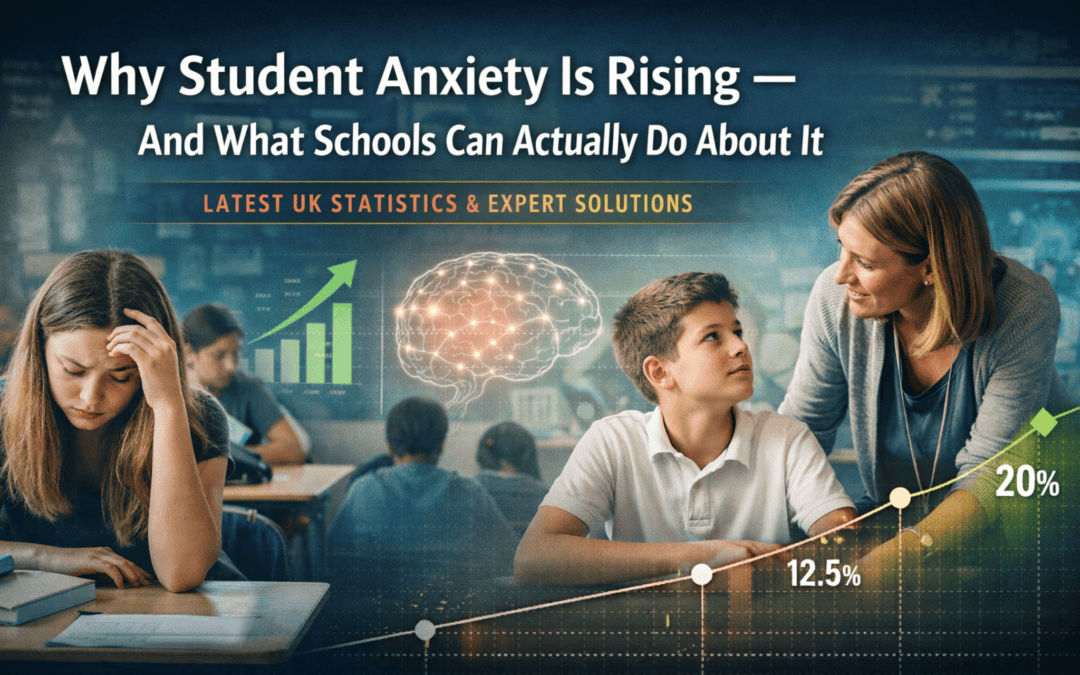
Research shows that the proportion of children with probable mental disorders has risen from 12.5% in 2017 to over 20% in 2023 (NHS Digital)
2. Social Media and Constant Comparison

Modern students are growing up in a digitally saturated environment.
Research indicates that around 60% of teenagers use social media for 2–4 hours daily, with some spending up to 8 hours (Oxford-led study)
This constant exposure contributes to:
- Comparison and self-doubt
- Fear of judgment
- Reduced self-esteem
Unlike previous generations, this comparison is not occasional — it is continuous and unavoidable.
Students are not just comparing themselves within their school environment, but against a much wider and often unrealistic digital standard. This can distort perceptions of success, appearance, and social status, increasing internal pressure.
Over time, this can heighten sensitivity to social evaluation, making everyday interactions feel more intense and more difficult to navigate.
3. School Avoidance Linked to Anxiety
One of the clearest behavioural indicators of rising anxiety is school avoidance.
A UK survey found that 28% of secondary school pupils have avoided school due to anxiety in the past year (stem4 via The Guardian)
Students are not avoiding school because they are disengaged. They are avoiding school because they feel overwhelmed. This distinction is critical for how schools respond.
Students are not avoiding school because they are disengaged. They are avoiding school because they feel overwhelmed. This distinction is critical for how schools respond.
This is not disengagement.
It is a stress response.
4. Loneliness and Social Disconnection
Even when surrounded by peers, many students report feeling isolated.
Studies show that nearly three-quarters of university students report loneliness, with 17% saying they have no close friends (Oxford CBT, 2024)
This lack of connection increases vulnerability to anxiety and depression.
Human beings are wired for social connection, and a lack of meaningful relationships can increase the brain’s sensitivity to stress. Without strong peer support, challenges can feel more overwhelming and harder to manage.
In school environments, this can mean that students appear socially engaged on the surface, but still experience significant internal anxiety.
5. Long-Term Trends Are Worsening
The trend is not temporary.
It is accelerating.
Mental health challenges in university students have tripled since 2018 (TASO, 2025)
Among young adults (16–24), mental health conditions have risen from 17.5% in 2007 to 25.8% in 2023–24 (Centre for Mental Health)
This is a system-wide shift, not a short-term spike.

The consistency of this upward trend across multiple age groups suggests that underlying environmental and societal factors are changing. This reinforces the need for proactive, skill-based approaches rather than relying solely on reactive support systems.
Why These Statistics Matter for Schools & Universities
These figures are not just data points.
They represent:
- Reduced classroom engagement
- Increased behavioural challenges
- Higher pastoral demand
- Growing pressure on staff
Understanding the scale of the issue is the first step.
Responding effectively is the next.
Why Traditional School Support Often Falls Short
Despite increased awareness, many schools are still relying on approaches that do not fully match how anxiety develops — or how it is reduced.
1. Awareness Without Action
Many schools provide assemblies, talks, or PSHE sessions about mental health.
These improve understanding.
But research consistently shows that knowledge alone does not reliably change behaviour. For example, studies in health psychology have demonstrated that increasing knowledge or awareness does not necessarily lead to behavioural change without practical application and experience (Webb & Sheeran, 2006)
Students may understand anxiety — yet still feel overwhelmed by it.
2. Reactive Support Systems
Support is often introduced after anxiety becomes severe.
Yet early intervention matters.
Research shows that half of all mental health problems develop before the age of 14 (Place2Be)
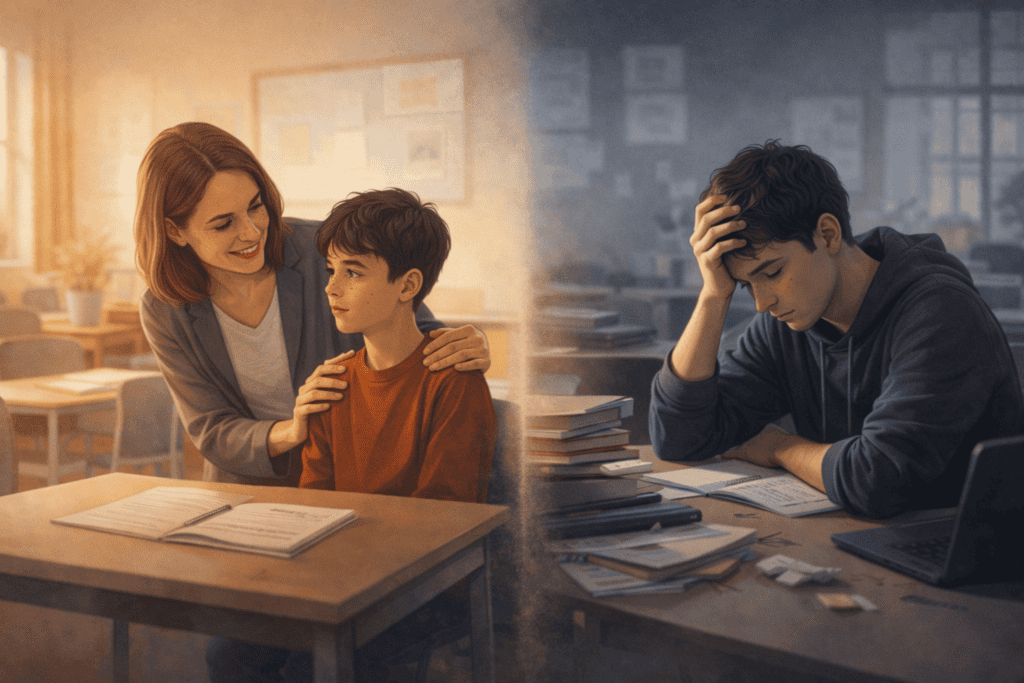
By the time students reach a crisis point, patterns are already established. This means it becomes more difficult for students to break bad habits around anxiety.
3. Lack of Experiential Skill Development
Many approaches focus on:
- Talking about anxiety
- Analysing emotions
- Providing reassurance
But resilience is not built through explanation.
It is built through experience.
Why Experiential Learning Builds Real Resilience
While the statistics highlight the scale of the problem, they also point toward a key insight:
👉 Awareness alone is not enough
Schools need approaches that:
- Build resilience early
- Provide practical coping tools
- Help students experience confidence in real time
To reduce anxiety, the brain must learn something new:
“I can handle this.”
This learning does not happen through information.
It happens through direct experience.
Resilience Is Built Through Action
Students develop resilience when they:
- Face manageable challenges
- Experience discomfort safely
- Succeed in real time
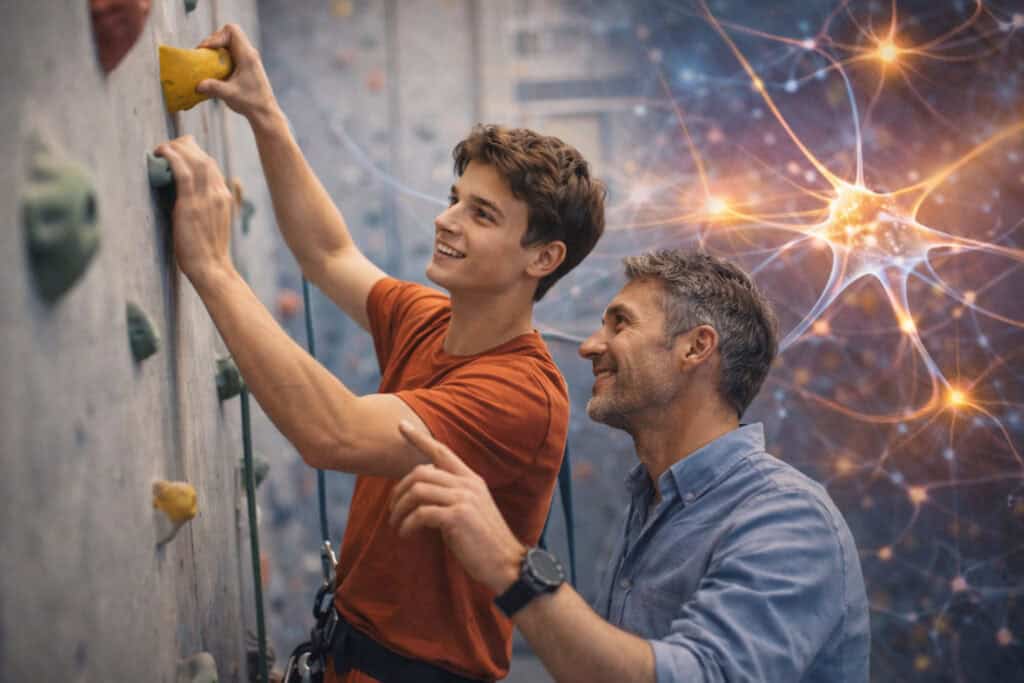
This creates new neural associations between challenge and safety.
The Science Behind It
Anxiety is driven by the brain’s threat system.
When students repeatedly avoid challenges, the brain strengthens the belief:
“This situation is dangerous.”
Experiential learning interrupts this cycle by providing corrective experiences.
Students face the challenge → remain safe → update their response.
From a neuroscience perspective, this process involves key brain structures such as the amygdala, which detects threat, and the prefrontal cortex, which helps regulate and reinterpret that threat. Research has shown that the amygdala plays a central role in fear processing and emotional learning (LeDoux, 2000), while the prefrontal cortex helps inhibit and regulate fear responses over time (Milad & Quirk, 2012).
When a student avoids a situation, the amygdala’s alarm response remains unchallenged, reinforcing the fear pathway. However, when a student approaches a situation and experiences safety, the brain begins to form new associations — a process known as fear extinction learning.
This mechanism has been widely studied in both neuroscience and clinical psychology as a core process in reducing anxiety (Myers & Davis, 2007).
Over time, repeated safe exposure can reduce the intensity of the threat response and strengthen regulatory pathways in the brain. Emotional arousal also plays a key role in memory formation, meaning that emotionally significant experiences are more likely to be retained (McGaugh, 2004).
This is why experiential approaches are so powerful. They do not just help students understand anxiety — they help retrain the brain’s response to it, creating lasting changes in how challenges are perceived and handled.
From Avoidance to Confidence
So, in simple terms, Avoidance increases anxiety over time.
Action reduces it.
This is why approaches based on guided exposure, nervous system regulation, and real-time experience are significantly more effective for long-term resilience.
How Student Resilience Workshops Help in Practice
This is where structured, neuroscience-informed workshops provide a clear advantage.
Creature Courage delivers neuroscience-informed Student Anxiety & Resilience Workshops designed specifically to help students move from understanding anxiety to actively managing it.
Rather than focusing only on discussion, these workshops combine education with practical nervous system regulation techniques and guided experiential challenges. Through carefully structured interactions with large and unusual invertebrates, students are supported in facing fear in a safe and controlled way — often transforming anxiety into curiosity and even fascination.

These moments become powerful, memorable experiences of success, helping students shift their response to fear in real time and build lasting confidence that extends far beyond the session. Below are some of the skills that students can gain from an experiential learning resilience workshop:
1. Immediate Emotional Regulation Skills
Students learn practical tools to manage anxiety in real time.
2. Increased Confidence Through Experience
Instead of being told they are capable, students experience capability directly.
3. Improved Focus and Learning Capacity
When anxiety decreases, cognitive performance improves.
Students are better able to concentrate and retain information.
4. Reduced Avoidance Behaviours
Students begin to approach challenges rather than avoid them.
5. Stronger Peer Connection
Shared experiences reduce isolation and normalise emotional responses.
What Schools Can Do Next
The goal is not to remove stress from education.
The goal is to help students develop the ability to navigate it.
Schools that integrate experiential resilience training are better positioned to:
- support student wellbeing
- improve engagement
- reduce disruption linked to anxiety

Final Thought
The data is clear.
Student anxiety is rising — quickly, consistently, and across all age groups.
But the solution is also becoming clearer.
When schools move beyond awareness and provide practical, experience-based resilience training, students do not just feel supported.
They become stronger. Courage is grown naturally. Self belief and image is nurtured
They build courage.
And that changes how they learn — and how they live.