

A Different Approach to Corporate Team Building
Corporate team building has been around for decades. Many organisations have tried activities such as trust falls, icebreakers, escape rooms, and problem-solving games. While these exercises can be enjoyable, they do not always create the deep, lasting impact companies hope for.
Employees often participate politely, but the experience may feel scripted or artificial. Once the workshop ends, the lessons quickly fade.
Modern neuroscience suggests that the most powerful learning experiences happen when people are emotionally engaged. This is where fear-based experiential learning can make a significant difference.
When a challenge activates the brain’s attention systems, learning becomes more memorable, teamwork becomes more authentic, and people often discover new strengths in themselves and their colleagues.
The Problem With Traditional Team Building
Many traditional team building exercises focus on cooperation or communication. However, they often take place in environments that feel predictable and low stakes.
Activities such as trust falls, group puzzles, or structured icebreakers can be useful for initiating conversation. Yet they rarely create the level of emotional engagement needed to produce lasting behavioural change.
When an experience feels routine, the brain processes it as another ordinary event. As a result, employees may enjoy the activity in the moment but struggle to remember the lessons weeks later.
For team building to have a meaningful impact, the experience needs to be memorable, emotionally engaging, and shared.

Some Team Building Already Uses Challenge
It is important to recognise that many organisations already include challenge in their team building programmes.
Activities such as rock climbing, high-ropes courses, obstacle challenges, or outdoor adventure experiences often involve an element of adrenaline or fear. These experiences can encourage teamwork and help participants step outside their comfort zones.
However, these activities typically focus on physical challenge rather than psychological learning.
Participants may feel the adrenaline of the moment, but they are rarely taught:
How fear works in the brain
How the nervous system responds to challenge
How to regulate their fear response
How to transform anxiety into curiosity and courage
Without this understanding, the experience may remain an exciting activity rather than a deeper learning opportunity.
The Missing Ingredient: Understanding Fear
Fear is one of the most powerful emotional signals in the human brain.
When the brain detects a potential threat, the amygdala, a small structure within the limbic system, quickly activates the body’s alarm response. This process sharpens attention, increases heart rate, and prepares the body to respond to challenge.
Research has shown that the amygdala plays a critical role in emotional learning and memory formation. You can read more about this in this neuroscience overview from the National Institutes of Health.
When emotionally significant events occur, the amygdala interacts with memory systems in the hippocampus, strengthening memory formation and increasing the likelihood that the experience will be remembered later. A review published in Nature Reviews Neuroscience explains this process in more detail.
In simple terms, when something feels emotionally important, the brain pays closer attention and stores the experience more strongly.
This principle helps explain why experiential learning can be so powerful.
Why the Brain Learns Best Through Experience
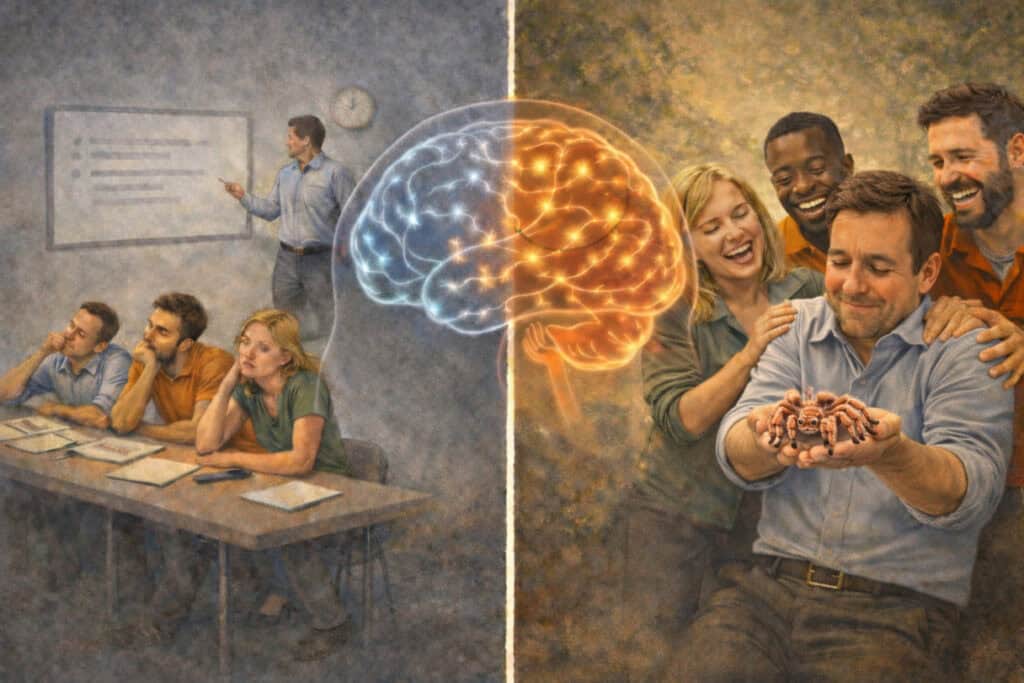
Many workplace training programmes rely heavily on presentations, slides, or discussion.
While these approaches can communicate useful information, they do not always engage the brain’s emotional learning systems.
Experiential learning works differently. Instead of simply hearing about a concept, participants experience it directly.
Educational theorist David Kolb developed one of the most influential models of experiential learning, which emphasises learning through concrete experience and reflection. An overview of this framework can be found here.
When people are actively involved in a challenge, several things happen simultaneously:
attention increases
emotional engagement rises
focus improves
learning becomes more memorable
People may forget a presentation within days, but powerful experiences can stay with them for years.
The Power of Facing Fear Together
One of the most powerful aspects of fear-based experiential learning is the social dynamic it creates.
When people face a challenge together, they naturally begin to support one another.
Colleagues may offer encouragement, share advice, or celebrate each other’s progress. In these moments, team members often see new sides of one another.
For example:
A quiet employee may show unexpected bravery
A confident leader may reveal vulnerability
A supportive colleague may step forward to help others
Shared experiences like these can strengthen team bonds and create a sense of collective identity.
Research into team development shows that structured team-building interventions can significantly improve communication, cooperation, and overall team performance (Klein et al., 2009).
The Creature Courage Difference
Many team building activities involve challenge, but few combine challenge, education, and teamwork in a structured learning experience.
Creature Courage workshops are designed to bring these elements together.
Participants do not simply face a challenge. They first learn how fear works in the brain and how to manage their nervous system during stressful situations.
This combination transforms the experience into a powerful learning environment.
Creature Courage team building workshops include three key elements.
1. Neuroscience-Informed Education
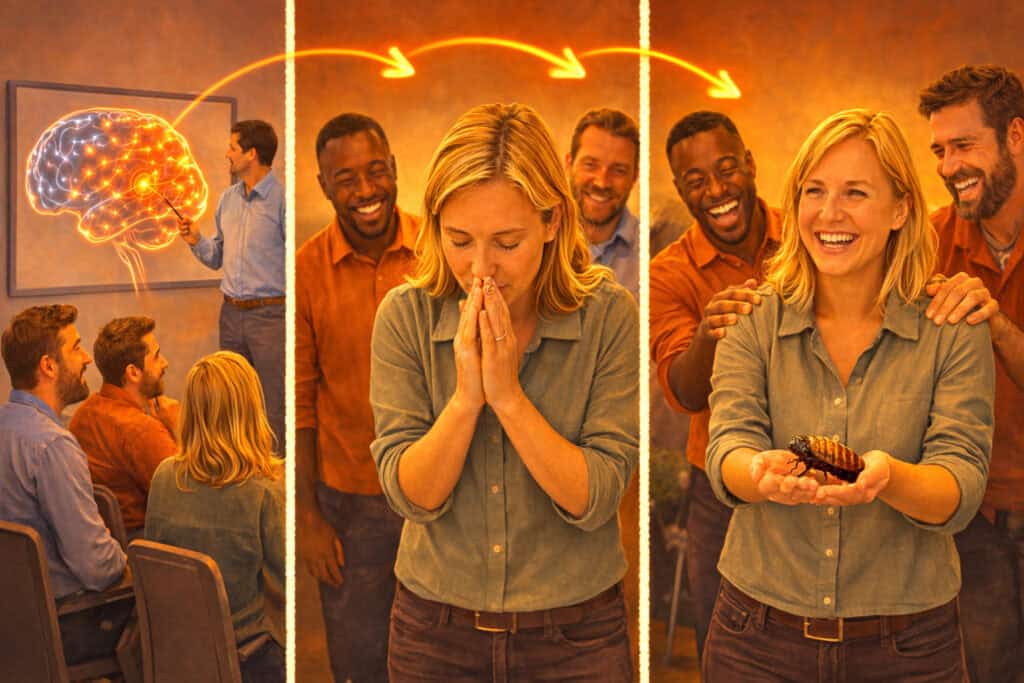
At the beginning of the workshop, participants learn how the brain processes fear.
They are introduced to concepts such as the amygdala, the limbic system, and the body’s natural alarm response. Understanding how the nervous system reacts to uncertainty helps participants recognise what is happening when they feel nervous or challenged.
This knowledge gives participants practical tools to regulate their breathing, posture, and mindset. It also helps them understand that fear is a natural biological response that can be managed and redirected.
By learning the science first, participants feel more prepared and confident when they later face a challenge.
2. Fear-Based Experiential Challenge
After learning about the neuroscience of fear, participants apply this knowledge during carefully guided animal encounters.
Participants interact with unusual animals or unfamiliar creatures that may initially trigger curiosity or nervousness. Instead of avoiding the feeling, they practise the techniques they have just learned to remain calm and present.
Facing something unfamiliar activates the brain’s attention systems and encourages participants to step outside their comfort zones.
As confidence grows, many participants experience a powerful shift from hesitation to curiosity and courage.
3. Guided Team Support
Throughout the experience, the workshop is structured so that participants encourage and support one another.
Colleagues often help each other build confidence, celebrate moments of bravery, and share the excitement of trying something new together.
This supportive environment creates genuine moments of trust and cooperation.
Why Unusual Animal Encounters Create Powerful Experiences
One of the most unique aspects of Creature Courage workshops is the opportunity to interact with fascinating and unusual animals, including exotic invertebrates.
For many participants, these creatures are completely unfamiliar. This novelty creates a strong sense of curiosity.
Psychological research shows that novelty increases attention and engagement in learning environments (Schomaker & Meeter, 2015).
When participants encounter creatures they have never seen before, curiosity often begins to compete with fear.
As people learn about the animals and gradually interact with them, many experience a shift from hesitation to fascination.
These moments often become the most memorable parts of the workshop.

Planning Courage as a Team
One of the most powerful aspects of fear-based team building is that teams actively plan how they will face the challenge together.
After learning about the neuroscience of fear and practising techniques to regulate the nervous system, participants begin discussing which animals they personally find most intimidating.
As a group, they decide the order in which they will interact with them.
Some participants may choose to start with animals they find less challenging, while others may decide to face a bigger fear first.
During these conversations, participants often begin discussing wider fears they face in everyday life and work.
They talk about which tools and techniques from the workshop they believe will work best for them and how they can use these strategies beyond the experience.
This process encourages individuals to share both their strengths and vulnerabilities, helping the group develop a deeper understanding of how they can support one another.
Trust and Teamwork in Real Time
Once the plan is in place, the group begins the experiential part of the workshop.
Participants encourage each other, demonstrate techniques for staying calm, and celebrate each step of progress.
Someone who feels hesitant may be supported by a colleague who volunteers to go first and model the process.
Instead of simply discussing teamwork, participants actively apply the tools they learned earlier.
They remind each other to breathe, stay present, and approach the challenge with curiosity rather than avoidance.
As confidence grows, the atmosphere often shifts from nervous anticipation to excitement and laughter.
Celebrating these moments together creates a powerful sense of shared achievement.
The Psychology of Shared Courage
When people face a challenge together, something powerful happens psychologically.
Moments of vulnerability and uncertainty can strengthen social bonds and build trust within groups.
Research in social psychology suggests that shared challenges can increase cooperation, communication, and emotional connection between team members (Klein et al., 2009).
When participants step outside their comfort zones while receiving encouragement from others, the brain begins to associate the experience with both challenge and support.
Instead of facing uncertainty alone, individuals experience the challenge as a team.
These shared experiences often become stories that teams remember and refer back to long after the workshop ends.

Why Courage Is an Important Workplace Skill
Modern workplaces are constantly evolving. Employees often face uncertainty, rapid change, and increasing levels of pressure.
In this environment, the ability to manage fear and step outside one’s comfort zone becomes an important professional skill.
Learning how to regulate the nervous system, stay calm under pressure, and approach challenges with curiosity can benefit both individuals and teams.
Courage is not the absence of fear. It is the ability to move forward despite uncertainty.
The Future of Team Building
Corporate learning is evolving.
Many organisations are moving away from traditional training formats and exploring more engaging approaches.
Experiential learning, neuroscience-informed training, and emotionally engaging workshops are becoming increasingly popular.
By combining fear-based experiential challenge, neuroscience education, and unique animal encounters, Creature Courage offers a team building experience unlike anything most organisations have experienced before.
For companies seeking something memorable, meaningful, and genuinely transformative, courage-based experiential learning may represent the future of team development.
Ready to Experience a Different Kind of Team Building?
If your organisation is looking for something more memorable than traditional team building activities, Creature Courage offers a truly unique approach.
Our workshops combine experiential learning, neuroscience education, and fascinating animal encounters to create powerful shared experiences that build trust, resilience, and teamwork.
Each event can be tailored to suit your organisation’s goals.
Contact Creature Courage today to explore how a courage-based team building experience could inspire your team.

Frequently Asked Questions About Fear-Based Team Building
What is fear-based team building?
Fear-based team building involves carefully designed activities that encourage participants to step outside their comfort zones in a supportive environment. These challenges activate the brain’s attention systems and create memorable shared experiences.
When delivered in a structured and educational way, fear-based team building can help teams develop stronger trust, resilience, and cooperation while learning how the brain responds to challenge.
Is fear-based team building safe?
Yes. Well-designed fear-based team building experiences are always conducted in a controlled and supportive environment.
Participants are never forced to take part in any activity they are uncomfortable with. Instead, they are gradually encouraged to explore challenges at their own pace with guidance and support from the facilitator and their colleagues.
The goal is not to overwhelm participants, but to create a positive experience where people feel proud of stepping slightly beyond their comfort zone.
How does fear-based team building improve teamwork?
When people face a challenge together, they naturally begin to support one another.
Colleagues often encourage each other, celebrate successes, and share moments of vulnerability during the experience. These shared challenges can strengthen trust and create a sense of unity within the team.
Because the experience is emotionally engaging, the lessons learned during the workshop are often remembered far longer than traditional team building exercises.
What makes Creature Courage team building workshops unique?
Creature Courage workshops combine several elements that are rarely found together in traditional team building activities.
Participants experience carefully guided challenges involving fascinating animals while also learning about the neuroscience of fear and how the brain responds to uncertainty.
This combination of experiential learning, neuroscience education, and teamwork creates a powerful environment for building confidence, trust, and resilience within teams.
What types of animals are involved in Creature Courage workshops?
Creature Courage workshops often include fascinating and unusual animals such as exotic invertebrates, including stick insects, millipedes, and other remarkable creatures.
These animals are carefully handled in a safe and controlled setting. Many participants discover that curiosity quickly replaces fear as they learn more about the animals and interact with them in a supportive group environment.
The unusual nature of these encounters makes the experience highly memorable for participants.
Do participants have to hold the animals?
No. Participation is always voluntary.
Some participants prefer to observe at first, while others quickly become curious and eager to interact. As confidence grows, many people choose to hold or interact with the animals with guidance and support.
The goal is to create a positive and empowering experience where individuals feel comfortable progressing at their own pace.
Why are experiential team building activities more memorable?
Research in psychology shows that emotionally engaging experiences are more likely to be stored strongly in memory.
When people participate in a challenge that activates curiosity, excitement, or nervousness, the brain becomes more attentive and the experience becomes easier to remember.
This is why experiential learning activities often leave a lasting impression compared with traditional workshops or presentations.
Can Creature Courage create customised team building workshops?
Yes. Creature Courage can design tailored workshops based on the needs and goals of your organisation.
Workshops can be adapted for corporate teams, leadership groups, conferences, or professional development events. The focus can include building teamwork, improving communication, developing resilience, or encouraging employees to step outside their comfort zones.
Each workshop is designed to create a memorable shared experience that supports team growth.
References
Phelps, E. A., & LeDoux, J. E. (2005). Contributions of the amygdala to emotion processing. Neuron.
LaBar, K. S., & Cabeza, R. (2006). Cognitive neuroscience of emotional memory. Nature Reviews Neuroscience.
Kolb, D. A. (1984). Experiential Learning: Experience as the Source of Learning and Development.
Klein, C., et al. (2009). Does team building work? Human Resource Development Review.
Schomaker, J., & Meeter, M. (2015). Short- and long-lasting consequences of novelty. Neuroscience & Biobehavioral Reviews.