
Fear of Sharks: Understanding and Overcoming Shark Phobia
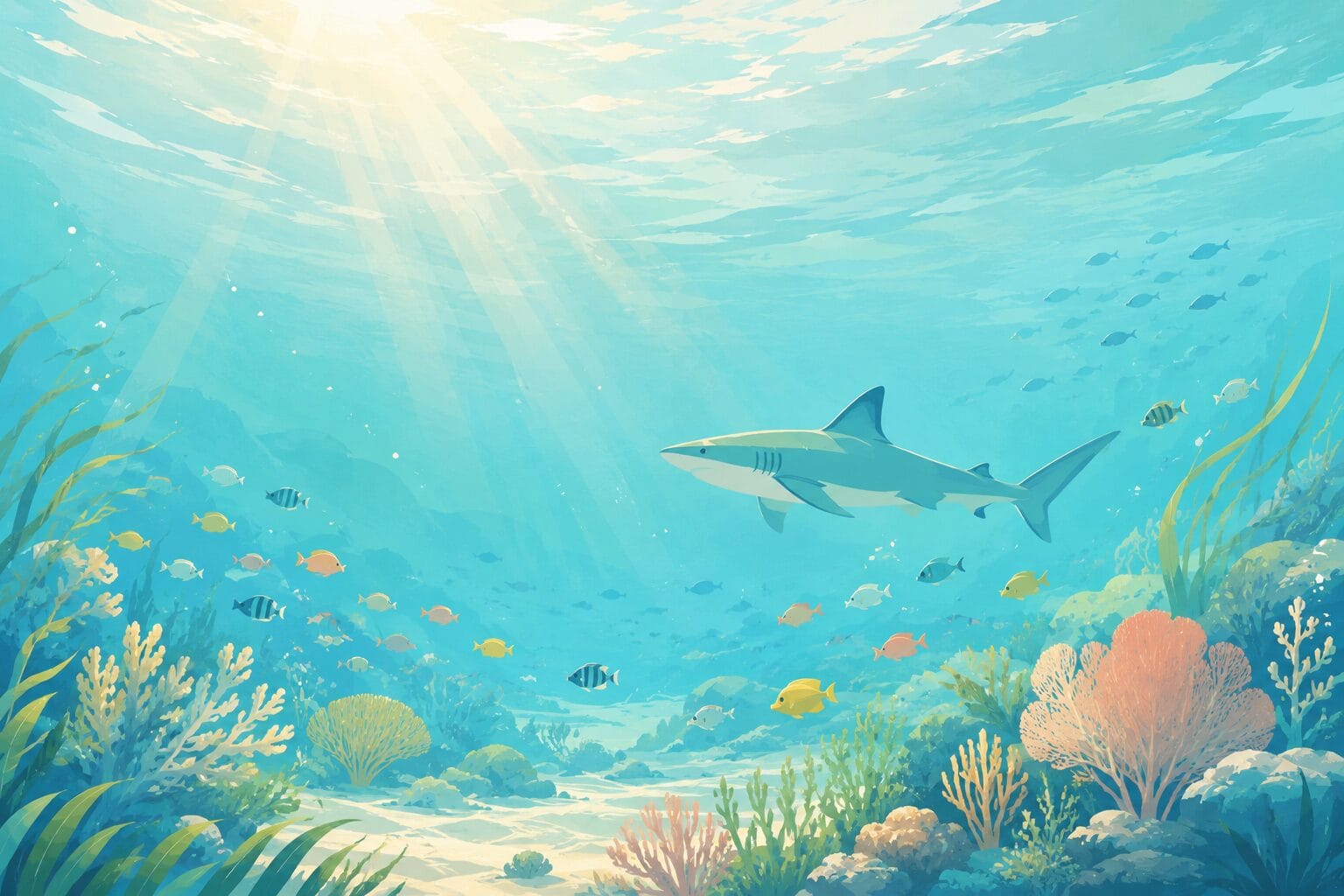
Understanding the Fear of Sharks
The fear of sharks, sometimes called galeophobia or selachophobia, can feel powerful even when a shark is nowhere nearby. For some people, the fear appears during beach holidays, aquarium visits, nature documentaries, conversations about the sea, or even when seeing a still image of a shark. Because sharks are often presented as symbols of danger, the imagination can fill the water with threat long before real life has had a chance to speak.
At Creature Courage, we understand that animal phobias are not simply about the animal itself. They are often about anticipation, stories, memories, uncertainty and the body’s protective alarm system. This profile explores the fear of sharks with calm, accurate information, practical reassurance and respect for both human anxiety and marine life.
What Is the Fear of Sharks?
The fear of sharks is an intense anxiety response connected to sharks, the sea, deep water, shark images, shark films, or situations where a person worries a shark might be present. The fear may be specific to certain species, such as great white sharks, or it may apply to sharks in general. Some people are frightened only by realistic footage, while others may feel unsettled by cartoons, toys, aquarium displays, social media clips or even the word “shark”.
Although many people feel cautious around large wild animals, a phobia tends to go further. It can create a response that feels out of proportion to the situation, difficult to reason with in the moment, and strong enough to shape choices. Someone may avoid swimming, snorkelling, diving, aquariums, boat trips, seaside holidays or programmes about ocean wildlife. In more severe cases, the fear can affect family plans, travel confidence and everyday enjoyment of water.
There is no shame in this. Sharks occupy a very unusual place in the human imagination. They are real animals, yet they have also become cultural symbols. As a result, a person may not only be responding to a biological creature, but to decades of dramatic stories, warning images and sensational headlines.

Why Sharks Can Feel So Frightening
Sharks can feel frightening because they combine several fear triggers at once. They live in an environment humans cannot fully see into. They move silently. Their bodies are streamlined and unfamiliar. In open water, people can feel exposed, and the mind may treat that uncertainty as evidence of danger. For someone with galeophobia or selachophobia, the brain may act as though the sea itself is hiding a threat.
Another reason the fear can feel so strong is that sharks are often imagined before they are understood. A person may picture a fast attack, a fin cutting through water, or a dramatic film scene rather than a real animal going about its life. This matters because the nervous system responds vividly to mental pictures. Even when someone knows they are safe, the image can still trigger the body’s alarm response.
Fear also grows when there is a lack of control. On land, we can step away from a dog, close a window near a wasp, or leave a room with a spider. In the ocean, people may feel there is nowhere to go quickly. This feeling of vulnerability can become attached to sharks, even though most oceans, beaches and swimming situations do not involve shark encounters.
Common Symptoms of Shark Phobia
Symptoms of a shark phobia can affect the body, thoughts, feelings and behaviour. They may appear when a person sees a shark, imagines a shark, hears about an incident, watches a film, visits the coast, or prepares for a water-based activity. Some people experience mild unease, while others feel sudden panic.
Physical symptoms
Physical symptoms can include a racing heartbeat, tight chest, shortness of breath, shaking, sweating, nausea, dizziness, stomach discomfort or a sudden urge to escape. These sensations can feel alarming, yet they are part of the body’s protective system switching on too strongly. The body is trying to help, but it has misread the situation.
Emotional and thought-based symptoms
Emotionally, the fear may bring dread, helplessness, embarrassment, frustration or a sense of being trapped. Thoughts may rush towards worst-case scenarios. A person may repeatedly imagine an attack, scan the water for movement, replay news stories, or feel unable to believe reassurance from others.
Behavioural symptoms
Behavioural symptoms often involve avoidance. Someone may avoid the sea, deep water, aquariums, shark documentaries, boat trips, snorkelling, diving, surf lessons or beach holidays. Avoidance is understandable because it provides short-term relief. However, it can also teach the brain that the avoided situation must have been dangerous, which keeps the fear alive.
What Causes a Fear of Sharks?
The fear of sharks can have more than one cause. Sometimes it begins after a frightening experience in water, such as being caught by a wave, swimming out of depth, or seeing something unexpected beneath the surface. Even if no shark was involved, the mind may later attach the feeling of danger to sharks because they represent hidden threat.
For many people, the fear comes from media exposure. Films, documentaries, news reports, online clips and dramatic images can create a mental library of danger. When these images are repeated over time, they can feel more common than they really are. The brain does not always separate entertainment from likelihood, especially when the emotional impact is strong.
Learning from others can also play a role. A child who grows up hearing that sharks are monsters, or watching adults become anxious around the sea, may absorb that fear as a safety lesson. In other cases, the fear develops gradually through imagination, anxiety sensitivity, general fear of deep water, fear of injury, or discomfort with large animals. As with other animal phobias, there is rarely one single explanation. The important thing is that the fear can change.
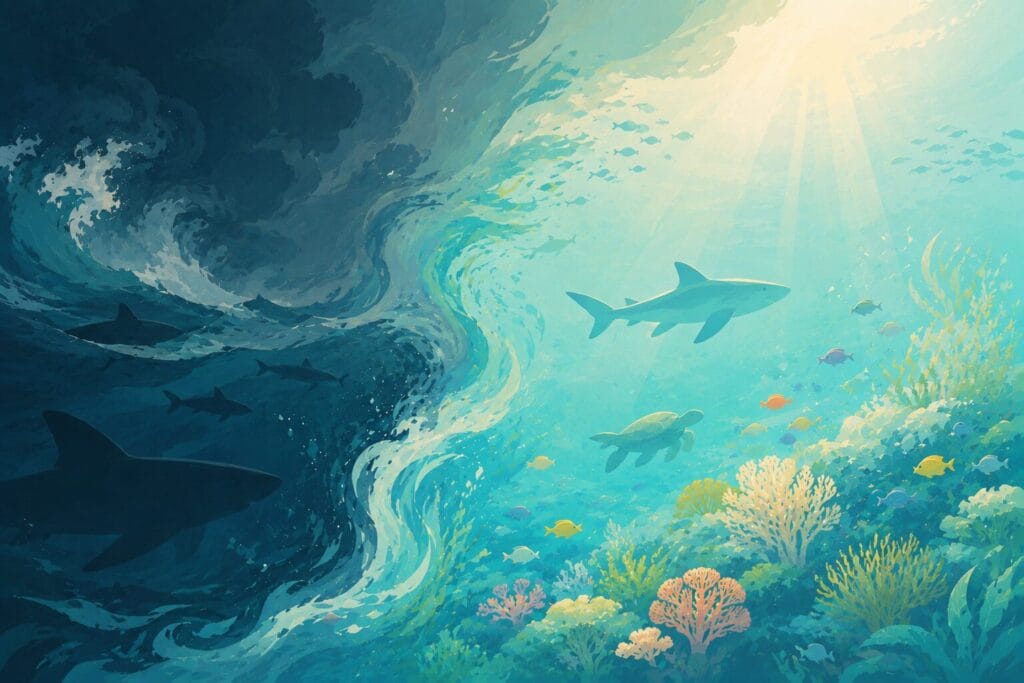
Sharks, the Media and the Problem of Villainisation
Few animals have been given such a dramatic public image as sharks. In films, headlines and online clips, sharks are often framed as deliberate hunters of people. The camera angle, music, language and editing all point in the same direction: fear first, understanding later. Over time, that story can become difficult to shake.
This matters because repeated stories shape emotional expectation. If every shark image is paired with danger, the nervous system learns the pairing. A calm reef shark swimming through its habitat may then feel frightening, not because of what it is doing, but because of what the viewer has been taught to expect. The animal becomes less of an animal and more of a floating symbol.
In reality, sharks are diverse, complex marine animals. Many species are small, shy, deep-water, plankton-feeding or uninterested in humans. NOAA explains that humans are not part of sharks’ normal diets, and only a small number of shark species have been involved in incidents with people. That does not mean people should behave carelessly around wildlife. It does mean the cultural picture is often far louder than the biological one.
Common Shark Myths Debunked
Shark myths are sticky because they are simple, dramatic and easy to remember. However, they often flatten hundreds of species into one frightening stereotype. A more accurate view can help reduce fear without dismissing sensible respect for wild animals.
Myth: All sharks are dangerous to people
This is not accurate. There are more than 500 living shark species, and they vary enormously in size, diet, habitat and behaviour. Some are large predators, while others are small, bottom-dwelling or filter-feeding species. The American Museum of Natural History notes that living sharks range from tiny dwarf lantern sharks to huge whale sharks, which feed mainly on plankton and small organisms.
Myth: Sharks hunt humans
Sharks evolved long before humans entered the ocean for recreation, and people are not part of their natural diet. When shark bites do happen, they are often linked to investigation, mistaken identity, murky water, bait fish activity or other environmental factors. This does not make an incident harmless, but it does challenge the idea of sharks as purposeful human hunters.
Myth: A fin always means danger
A fin can belong to different marine animals, and even when it belongs to a shark, it does not mean an attack is about to happen. Sharks move through their habitat as part of daily life. A distant fin is often a sign of an animal travelling, feeding naturally, or moving through coastal waters.
Myth: The only good shark is a dead shark
This myth is harmful to oceans. Sharks are part of marine ecosystems, and many species are already under serious pressure. Removing them can disturb food webs and damage the balance of ocean life. Fear becomes more manageable when we can see sharks not as villains, but as wildlife with ecological value.
Interesting Facts About Sharks
Sharks become less mysterious when we understand them as animals rather than symbols. Fascination can replace fear. They are ancient, varied and biologically remarkable. The Natural History Museum describes sharks as an ancient group that appeared in the fossil record hundreds of millions of years ago, long before many familiar modern animals existed.
Not all sharks look or behave alike. Hammerheads have wide, flattened heads that help with sensory perception. Whale sharks are the largest fish in the world, yet they are gentle filter feeders. Some deep-sea sharks glow faintly in the dark, while others live close to the seabed and rarely come near people. This variety matters because fear often imagines “the shark” as one single creature. Biology tells a much richer story.
Sharks also have impressive senses. Many can detect vibrations in water and some can sense tiny electrical signals from other animals. These abilities are not supernatural hunting powers; they are adaptations for living in a complex underwater world. When viewed through curiosity, the same features that once seemed frightening can become fascinating.
Why Sharks Matter to Ocean Health
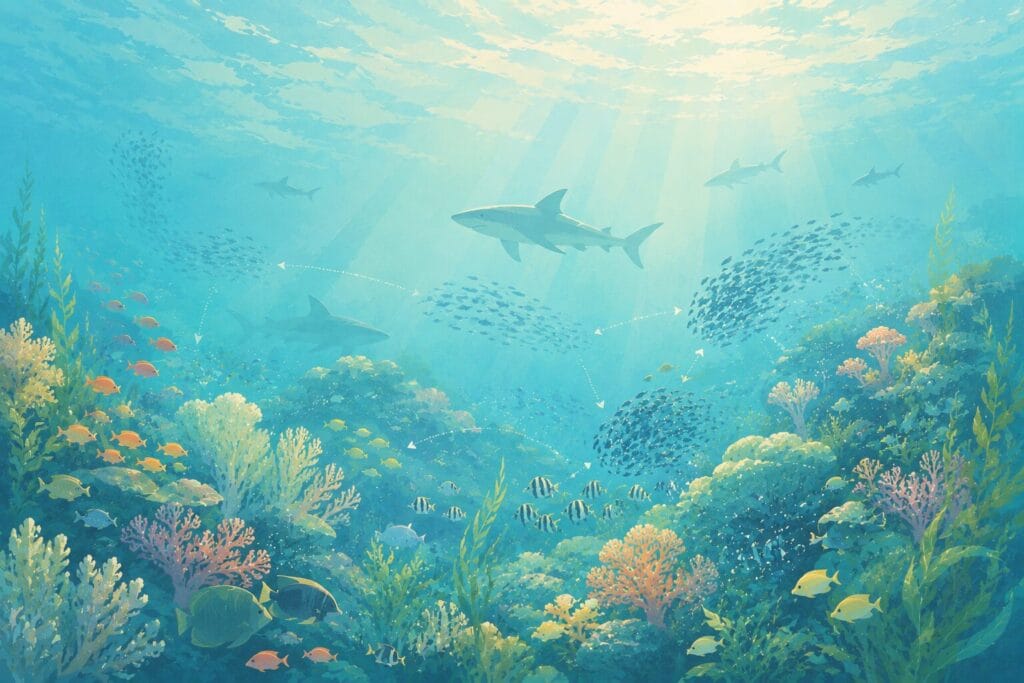
Sharks are not just dramatic animals at the edge of human imagination. They are part of the living machinery of the ocean. Many shark species help regulate marine food webs by influencing the behaviour and numbers of other animals. This can support healthier habitats, more balanced populations and stronger ecosystems.
NOAA describes sharks as important to ocean balance, with roles that can include regulating populations, supporting habitat health and contributing to local economies through responsible ecotourism. This does not mean every shark has the same role, or that ecosystems are simple. However, it does show that sharks are woven into wider marine systems.
When people fear sharks only as threats, it becomes harder to care about their protection. Yet a healthy ocean needs predators, grazers, filter feeders, reef builders, plankton, plants and countless relationships between them. Sharks belong within that web. They are not outside nature, circling it like monsters in a story. They are part of nature’s grammar.
Shark Conservation: Why Protection Matters
Many sharks face serious threats, and those threats usually come from people rather than the other way around. Overfishing, bycatch, habitat damage, climate change and demand for shark products have placed pressure on shark and ray populations around the world. Some species reproduce slowly, which makes recovery difficult once populations decline.
The IUCN has reported that more than a third of sharks, rays and chimaeras are threatened with extinction. This is sobering, but it is also a reason for action rather than despair. Better fisheries management, protected habitats, responsible trade controls, public education and well-designed conservation projects can all make a difference.
For someone with a shark phobia, conservation may feel emotionally complicated at first. It can be difficult to protect something that triggers fear. However, fear and compassion can coexist during recovery. You do not need to adore sharks overnight. A gentle first step might simply be recognising that they are animals trying to survive in their own home.
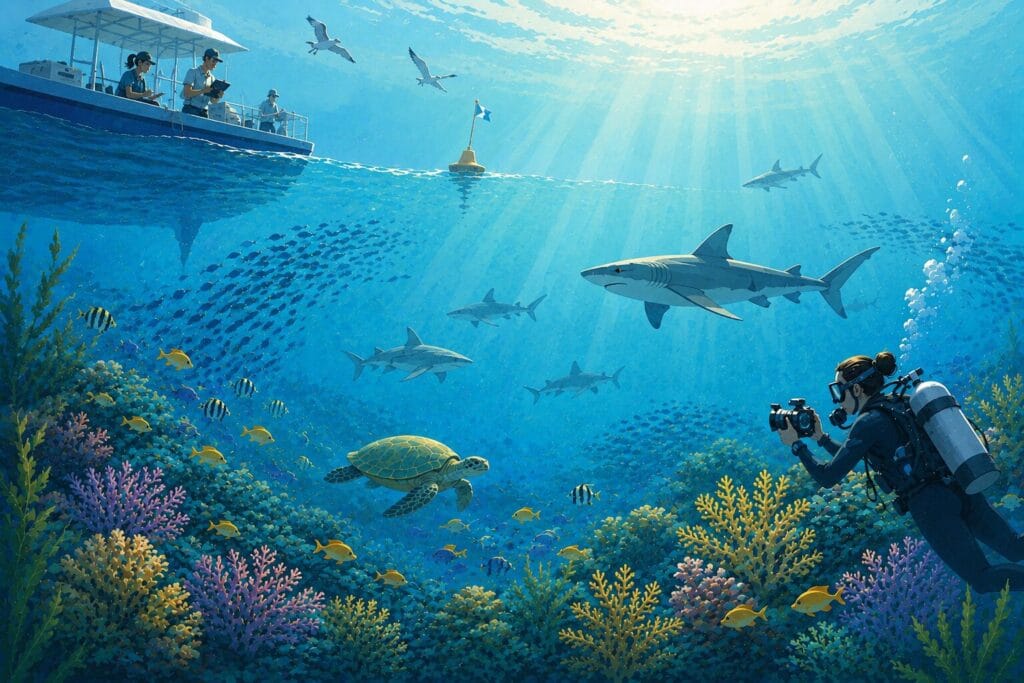
Coexistence With Sharks
Coexistence does not mean pretending there is no risk in the natural world. It means understanding risk clearly, behaving responsibly and allowing wildlife to exist without turning every encounter into conflict. People share coastlines with many animals, from seals and seabirds to jellyfish, fish, dolphins and sharks. Most of this sharing happens quietly.
Practical coexistence begins with respect for local guidance. Beaches, lifeguards, tour operators and marine authorities may provide information about swimming conditions, seasonal wildlife activity and safe behaviour. People can also reduce risk by avoiding swimming near fishing activity, bait balls, seal colonies or murky water when advised. These are sensible choices, not fear-driven rituals.
It also helps to remember that coexistence is not the same as closeness. A person can respect sharks without wanting to swim beside them. They can support conservation without seeking dramatic encounters. Recovery from a fear of sharks should never require proving bravery through risky behaviour. The goal is not to become reckless. The goal is to feel more free.
How a Fear of Sharks Can Affect Daily Life
Because sharks are strongly linked with the sea, this fear can reach beyond the animal itself. It may affect holidays, family days out, swimming lessons, school trips, aquariums, beach walks, cruise plans, diving opportunities, surfing, paddleboarding or even films watched at home. Some people feel embarrassed because they live far from shark habitats, yet the fear still feels intense. However, phobias are not measured by geography. They are measured by the impact they have on your life.
A person may avoid booking a seaside holiday because they worry they will disappoint others. They may stand on the shore while friends swim, or feel anxious when children enter the water. They may scroll past ocean videos quickly, tense up during wildlife documentaries, or feel unable to relax near deep water. Over time, avoidance can shrink experiences that once felt joyful.
The good news is that these patterns can change. With patient support, clear information and gradual confidence-building, many people learn to separate the real animal from the imagined threat. They may still choose sensible caution around the ocean, but their choices become guided by values rather than panic.
The Link Between Shark Phobia and Deep Water Fear
For many people, the fear of sharks is tangled with a fear of deep water, dark water or not knowing what is beneath them. The shark becomes the shape that uncertainty takes. A swimming pool may feel safe because the bottom is visible, while the sea can feel frightening because the mind keeps asking what might be hidden below.
This link is important because treatment may need to address both the animal fear and the water-related anxiety. Someone may benefit from learning about sharks, but also from practising body calming, water confidence and safer mental imagery. If the nervous system is reacting to depth, distance from shore or lack of visibility, shark facts alone may not be enough.
That does not mean recovery is harder; it simply means it should be more tailored. A good approach considers the whole fear landscape. It looks at images, thoughts, body sensations, memories, avoidance habits and the person’s hopes for change. Creature Courage’s wider work in animal phobia treatment is built around that kind of personal, practical understanding.
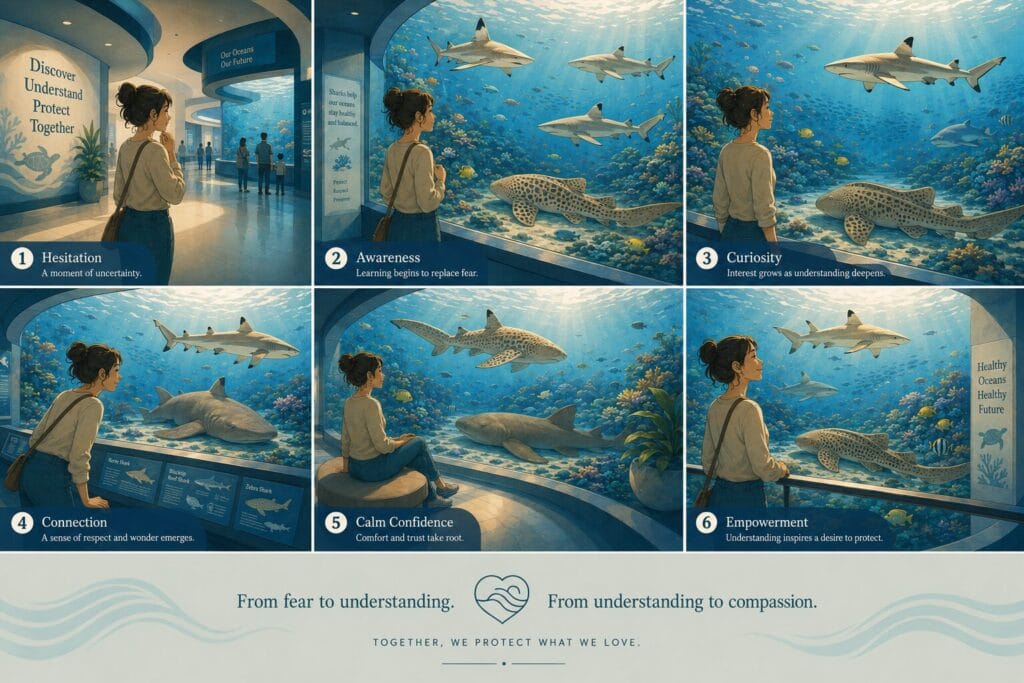
How Learning Can Reduce Shark Fear
Education is not a magic switch, but it can soften fear by replacing vague threat with clearer understanding. When a person learns how different shark species behave, where they live, what they eat and how rarely most people encounter them, the imagination has less empty space to fill with danger.
Learning works best when it is gradual and emotionally safe. A person with a strong fear does not need to begin with intense footage or dramatic documentaries. They might start with gentle illustrations, calm written information, conservation articles or aquarium displays viewed from a comfortable distance. The aim is not to flood the fear system. It is to teach the brain that curiosity can exist beside caution.
This is why Creature Courage often focuses on turning fear into fascination. Fascination gives the mind something new to do. Instead of scanning for disaster, the person begins noticing behaviour, habitat, movement, colour, ecological role and scientific wonder. The animal becomes more detailed, and fear tends to prefer blur.
Practical Steps for Managing Shark Anxiety
Managing shark anxiety usually begins with calming the body. Slow breathing, grounding exercises and gentle movement can remind the nervous system that it is not currently in danger. It can also help to name the response: “This is my fear system reacting to an image,” rather than “I am unsafe.” That small shift gives the thinking mind room to re-enter the conversation.
Another helpful step is reducing avoidance in a carefully paced way. This might begin with reading a calm article about sharks, then looking at a soft illustration, then watching a gentle conservation clip, then visiting an aquarium, then standing near the sea. The order depends on the person. Progress should feel challenging but manageable, like stepping onto a sturdy bridge rather than being pushed into deep water.
It is also useful to change the mental story. Instead of rehearsing attack scenes, the person can practise imagining a wide, peaceful ocean where sharks are distant wildlife moving through their habitat. Imagination can maintain fear, but it can also help recovery. Creature Courage explores this idea further in its article on imagination exercises for animal phobias.
Professional Support for Shark Phobia
If the fear of sharks is limiting your life, professional support can help you work through it in a structured and compassionate way. Effective support may draw on education, coaching, cognitive behavioural approaches, hypnotherapy, guided imagery, gradual exposure and practical anxiety tools. The best approach should feel respectful, not forceful.
At Creature Courage, animal phobia work is designed to help people feel calmer, more informed and more in control. The aim is not to shame the fear or rush the person into something overwhelming. Instead, the work helps the brain update its sense of threat. You can learn more about the wider method on the animal phobia therapy page and the Creature Courage unique approach page.
Some people want to enjoy beach holidays again. Others want to watch documentaries with their family, visit an aquarium, go snorkelling, support conservation, or simply stop feeling hijacked by shark images. A good recovery plan begins with the life you want back.

The Creature Courage® Approach
At Creature Courage®, we understand that overcoming an animal or insect phobia requires more than being told there is nothing to fear. Logic alone rarely reaches the parts of the nervous system that panic when a moth enters the room.
Founded by Britain Stelly, Creature Courage specialises in animal phobia therapy using psychology, neuroscience, animal education, and carefully guided exposure experiences. Through our Animal Phobia Therapy programme, clients learn how fear develops, how the nervous system responds to perceived threats, and how confidence can be rebuilt step by step.
Many clients are surprised to discover why one-day phobia therapy can work so effectively for specific animal fears. Others may benefit from a more gradual approach, especially when disgust, sleep disruption, night-time anxiety, or wider insect fears are involved.
Creature Courage also uses a holistic approach to animal phobias, recognising that fear is not only about the animal itself but also about attention, memory, imagination, body sensations, and nervous system habits.
For younger clients, our children's animal phobia therapy provides age-appropriate support designed to build confidence without pressure.
Our goal is not to make you love sharks. Our goal is to help you feel calmer, safer, and more in control when sharks appear.
Therapeutic Techniques Used to Treat Shark Phobias
At Creature Courage, we use a holistic and neuroscience-informed approach that may include:
- Exposure Therapy: To allow the brain to update its fear response
- CBT: (Cognitive Behavioural Therapy): To give powerful thought awareness
- Guided Imagination Exercises: To transform how you see the animal
- NLP Techniques: (Neuro-Linguistic Programming) Changes how you understand the animal and anchors courage
- Hypnotherapy: To make changes in the deep subconscious and create relaxation
- Art Therapy: To help strengthen other techniques and make them memorable
- Animal Education:To build fascination and compassion, and to dispel myths
Rather than relying on a single technique, we combine approaches to create a personalised experience that works with both the mind and body.
When Shark Fear Affects Children
Children can develop shark fears after films, stories, online videos, playground conversations, family warnings or a frightening experience in water. Because children are still learning how to judge risk, a dramatic image can feel completely real. They may avoid swimming, become anxious before holidays, or ask repeated reassurance questions about whether sharks are nearby.
It helps to respond with calm honesty. Telling a child “there is nothing to be scared of” may be well meant, but it can make them feel misunderstood. A more useful response might be, “Your brain has learned a scary story about sharks. Let’s learn the real story slowly.” This validates the feeling without confirming the feared danger.
Parents can also model balanced language. Sharks do not need to be described as monsters, killers or villains. They can be described as wild sea animals that deserve distance and respect. If a child’s fear is becoming disruptive, Creature Courage provides information about support for children on its animal phobia therapy FAQ page.
Building Respect Without Forcing Love
One of the gentlest truths about phobia recovery is that you do not have to love the animal to feel better. You do not have to become a shark enthusiast, book a cage dive, or cover your notebook in hammerhead stickers. Respect is enough. Curiosity is enough. Feeling less trapped by fear is enough.
For some people, the journey does grow into admiration. They discover shark conservation, ancient evolution, extraordinary senses or the quiet beauty of reef ecosystems. For others, the outcome is simpler: they can walk along the beach, watch a film, take their children to an aquarium, or enjoy a holiday without the fear taking centre stage. Both outcomes matter.
Recovery is not about pretending sharks are cuddly. It is about seeing them accurately. They are wild animals, not villains. Powerful, not malicious, and are worthy of caution, not panic. That distinction can be life-changing.
Final Thoughts: From Fear to Perspective
The fear of sharks can feel ancient, cinematic and enormous. Yet sharks themselves are not the story fear has often made them into. They are diverse marine animals, shaped by evolution and embedded in ocean ecosystems. Some are powerful predators. Some are gentle giants. Many are threatened. All are more complex than the villain role they have been handed.
You do not need to force yourself into instant fascination. A calmer relationship with sharks can begin with one small change: seeing them more accurately. From there, the sea can become less of a stage for imagined danger and more of a living world, full of movement, balance and possibility.
If shark fear is affecting your choices, Creature Courage can help you take the next step. Visit Animal Phobia Treatment to learn how tailored support can help you feel safer, steadier and more in control.
FAQ About the Fear of Sharks
What is galeophobia?
Galeophobia is commonly used to describe an intense fear of sharks. Some people also use the term selachophobia. Both terms refer to fear or anxiety connected to sharks, shark imagery or situations where sharks might be imagined.
Is fear of sharks common?
Many people feel cautious or uneasy about sharks because of their size, reputation and media portrayal. A phobia is more intense than ordinary caution. It may cause panic, avoidance or significant distress even when the person is not in real danger.
Are sharks trying to hunt people?
No. Humans are not part of sharks’ normal diets. Shark incidents can happen, but they are rare when compared with the number of people who enter the sea each year. Understanding this can help separate realistic caution from fear-driven expectation.
Can I overcome a fear of sharks without going near sharks?
Yes. Many people begin with education, calming techniques, imagery, conversation and carefully chosen visual material. If real-world exposure is useful, it should be gradual and appropriate. Recovery does not need to begin with direct contact or intense experiences.
Can shark documentaries make the fear worse?
They can, especially if they use dramatic music, attack-focused editing or sensational language. Calmer conservation material is often a better starting point. Choose resources that present sharks as wildlife rather than horror characters.
Is shark phobia linked to fear of the sea?
Often, yes. Some people fear sharks specifically, while others fear the hiddenness of deep or open water. If both fears are present, support should address the wider pattern rather than focusing only on shark facts.
How can Creature Courage help?
Creature Courage offers animal phobia support that combines understanding, evidence-based techniques and practical confidence-building. You can explore support options through the animal phobia treatment page.
Further Reading About Sharks and Animal Phobias
If you would like to learn more, start with resources that are calm, credible and conservation-minded. The Shark Trust offers accessible information about shark species and conservation. NOAA provides science-led marine education, while the Natural History Museum has useful material on shark evolution and biodiversity. For conservation status, the IUCN Shark Specialist Group is a valuable source.
For support with phobias more broadly, you may also find Creature Courage’s pages on animal phobias, animal phobia therapy, hypnotherapy for animal phobias and imagination exercises helpful. If your fear overlaps with fish or water-based animals, the fear of fish profile may also provide useful context.