
The Fear of Ants:
Understanding and Overcoming Ant Phobia

Understanding the Fear of Ants
A fear of ants, sometimes called myrmecophobia, can be far more disruptive than people realise. Ants are small, but they rarely feel psychologically small when they appear in a line across the kitchen, gather around food, emerge from a crack, or suddenly cover a patch of ground. One ant may create discomfort. A trail of ants can make the situation feel organised, spreading and difficult to control.
For some people, the fear centres on being crawled on, bitten or surrounded. Others are most distressed by contamination, infestation, flying ants, nests, or the thought of ants hidden inside walls and floors. The anxiety may begin before an ant is even seen. A tiny dark speck, a movement near the skirting board, or a warm summer day can be enough to start the nervous system scanning.
This profile explains why ant phobia develops, how it affects daily life, what makes ants biologically remarkable, and how fear can be reduced. It also explores colony behaviour, flying-ant swarms, common myths, ecological value, practical coexistence and treatment. If your first thought is that you would rather keep ants off the kitchen counter, that is entirely reasonable. The aim here is to help everyday encounters feel more manageable, with clearer understanding and calmer choices.
If ants make you avoid gardens, picnics, kitchens, patios, parks, food cupboards or summer travel, your reaction deserves support rather than ridicule. Specific phobias are learned responses, and learned responses can change.
Get In Touch With Creature Courage
What Is the Fear of Ants?
The fear of ants is commonly known as myrmecophobia. It is a specific insect phobia in which ants trigger intense anxiety, panic, disgust or avoidance. Some people experience it as part of a broader fear of insects, while others are comfortable around most insects but find ants uniquely distressing.
It is reasonable to be concerned about ants entering food cupboards or nesting in a building. Ant phobia goes beyond that everyday concern. Practical caution is proportionate and usually settles once the problem is addressed. A phobia is different because the fear response becomes much larger than the immediate situation. The body reacts as if urgent danger is present, even when the ants are outside, behind glass, in a photograph or too far away to make contact.
The trigger may be visual, such as a moving trail, a dense cluster or the segmented body of an ant. It may be sensory, including the imagined feeling of legs on the skin. It may also be conceptual: the idea that ants are reproducing, communicating, entering unseen spaces or bringing contamination into the home.
Creature Courage explores this broader pattern in its guide to animal phobias and zoophobia, including why the brain can treat a particular animal as an automatic warning signal.
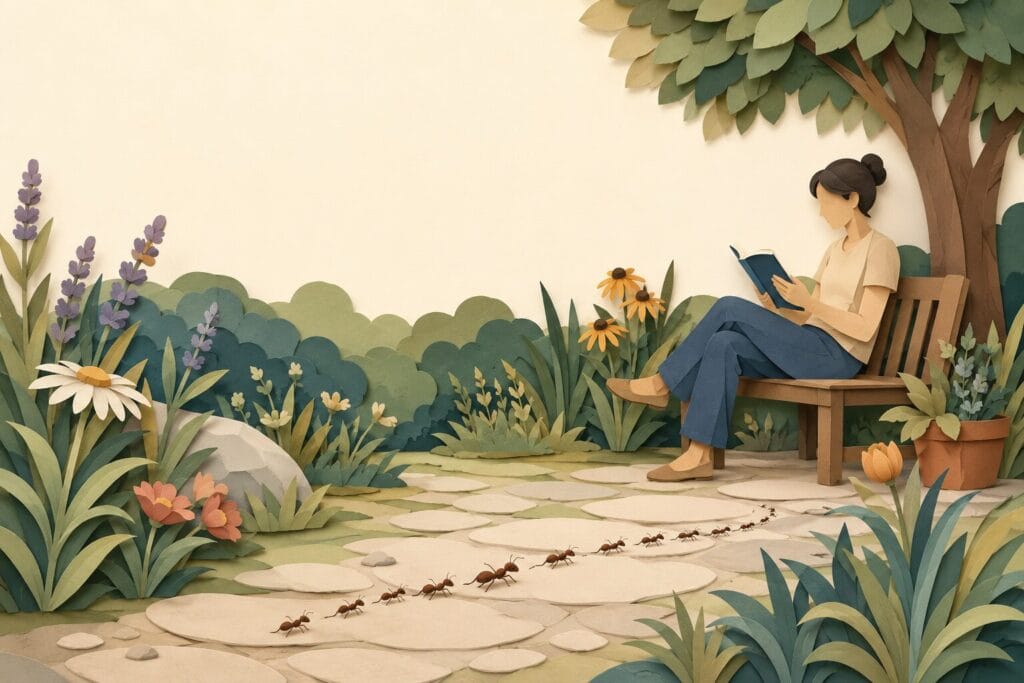
Fear of Ants: Symptoms and Common Triggers
Myrmecophobia can affect the body, emotions, thinking and behaviour. Symptoms may appear during a direct encounter, while anticipating ants, or after discovering signs of a nest or trail.
Physical Symptoms of the Fear of Ants
The body may respond with a racing heartbeat, sweating, trembling, nausea, dizziness, tightness in the chest, rapid breathing or a strong urge to escape. Some people experience itching or crawling sensations even when no ant is touching them. This is sometimes described as feeling as though ants are still on the skin after the encounter has ended.
How Ant Phobia Affects Thoughts and Feelings
Emotionally, ant phobia may create panic, disgust, helplessness, anger or a sense that the environment has become unsafe. Thoughts can accelerate quickly. One ant may become evidence of a hidden colony; a trail may feel impossible to contain; an outdoor swarm may be interpreted as an attack rather than a reproductive event.
You might feel embarrassed, especially if someone says, “But they are only ants.” Small animals can still bring very big feelings. Your distress deserves to be taken seriously; an animal’s size does not decide how strongly your nervous system responds.
Avoidance and Checking With Ant Phobia
Some people stop eating outdoors, avoid sitting on grass, refuse to enter sheds, check beds and clothing repeatedly, or keep windows closed during warm weather. At home, they may inspect skirting boards, cupboards and worktops long after the original sighting. Cleaning can become excessive, while food is thrown away even when there has been no direct contact.
Common Ant Phobia Triggers
Common triggers include ant trails, clusters around food, nests, soil movement, ants emerging through cracks, winged ants, large ants, red ants, images of magnified ant faces and the idea of ants crawling beneath clothing. For many people, the strongest trigger is not a single insect but the sense of multiplication and coordinated movement.
Fear of Ants: Why Ant Trails Feel Overwhelming
If one ant feels manageable but a whole trail makes your stomach drop, you are not alone. The way ants move together can make this fear feel particularly intense.
A single insect can usually be tracked as one object. A line of ants feels different because it suggests a system. Ants move with direction, follow one another, disappear into small gaps and return with more workers. To a fearful brain, this can look purposeful in a way that feels unsettling.
The mind may interpret the trail as evidence that the situation is already spreading. It can create the impression that there is no clear beginning or end. Even after the visible ants are removed, the person may continue imagining activity inside walls, soil or cupboards.
Yet the trail is not a military campaign against the household. Ants often follow chemical scent paths called pheromone trails. A worker that finds food can leave a chemical route that helps nestmates reach the same source. The resulting line is a form of communication rather than an intention to frighten or invade a person.
Knowing how a trail works may not stop the flutter of anxiety straight away, and that is fine. It does offer a different story: these small animals are following information about food and shelter. You can return to that explanation as your confidence grows.

What Causes a Fear of Ants?
You may remember exactly when your fear began, or it may seem to have been there for as long as you can remember. There is no single story behind ant phobia. Unpleasant experiences, reactions learned from others, disgust, media messages and avoidance can all play a part.
Frightening Encounters With Ants
A childhood encounter with an ant nest, a sudden swarm, ants in food, or being bitten can leave a powerful memory. A person may have stood on a nest, found ants in a bed, or watched a large number emerge inside the home. Even when physical harm was limited, the feeling of being surrounded or unable to stop them can become the emotional centre of the phobia.
Learning a Fear of Ants From Others
Children closely observe how trusted adults respond to animals. If a parent reacts with panic, intense disgust or repeated warnings, the child may learn that ants require emergency action. Creature Courage discusses how family fear can shape a child’s response in its article on parent anxiety and child phobia therapy.
Ant Phobia, Disgust and Contamination Worries
Ants frequently appear near crumbs, bins, spilled drinks and food cupboards. This creates a strong association with contamination. Sensible hygiene matters, but in a phobia the disgust system can become overactive. A person may feel that an entire room, meal or surface has become unsafe because an ant was nearby.
How Close-Up Images Can Amplify Ant Phobia
Close-up photographs reveal mandibles, compound eyes and segmented bodies that are almost invisible during an ordinary encounter. These images are scientifically interesting, but they can make a tiny insect feel enormous. Films and dramatic documentaries may also present colonies as invading armies, reinforcing the idea of unstoppable numbers.
How Avoidance Keeps a Fear of Ants Going
Avoidance reduces fear quickly, which makes it tempting. However, every avoided picnic, garden or cupboard teaches the brain that escape was necessary. Over time, the alarm becomes more sensitive. Creature Courage explains this survival pattern in its article on caveman brain awareness.
Understanding Ant Colonies: How Ants Work Together
Ant colonies can appear almost uncanny because thousands of individuals produce organised behaviour without one ant directing every action. The queen is not a commander issuing instructions. Her main role is reproduction. Workers respond to local information, chemical signals, temperature, food availability and the actions of nearby ants.
This creates what scientists sometimes describe as collective or distributed intelligence. No individual ant understands the entire colony, yet the group can locate food, regulate nest conditions, care for young, defend entrances and adapt routes around obstacles.
If the thought of an organised colony makes you uneasy, that is understandable. It may help to remember that each worker responds to simple signals around it. Together, those responses create impressive patterns, without a plan directed at you.
The Natural History Museum’s guide to flying ants notes that the UK has around 60 ant species and that they live in complex colonies. Learning about that complexity can shift the animal from a symbol of invasion to a subject of genuine natural-history interest.
How Overcoming a Fear of Ants Can Help Daily Life
Ants are common, especially during warmer months. This can make avoidance exhausting. Gardens, parks, patios, cafés, campsites, beaches and holiday accommodation may all become places to monitor rather than enjoy.
At home, a single ant sighting can lead to hours of checking and cleaning. Some people stop storing certain foods, avoid ground-floor rooms or feel unable to sleep until every possible entry point has been inspected. Others become distressed during flying-ant season or refuse outdoor activities with children and friends.
Addressing the fear is not about abandoning hygiene or allowing an infestation to grow. It is about regaining proportion. You can take practical action without panic, tolerate ordinary outdoor ants, and make decisions based on the actual situation rather than the most frightening possibility.

Fascinating Ant Facts: Bringing Curiosity to a Fear of Ants
When ants frighten you, fascination may feel a long way off. You do not have to find them charming, and curiosity is not a test you need to pass. However, learning something interesting about an animal can give you another way to look at it: alongside the worry, there may be a small question about how it lives. This can support a gentler, more balanced understanding as part of working on your fear. Facts alone will not resolve every phobia, but they can offer a useful starting point.
So, at your own pace, here are a few things that make ants worth a second look.
Ants Communicate Through Chemistry
Ants use chemical signals to identify nestmates, mark routes, raise alarms and share information. Pheromone trails help workers locate food efficiently, although the trail weakens when it is no longer reinforced.
The Different Roles Within an Ant Colony
Depending on the species, a colony may contain queens, workers, males and specialised individuals. Workers care for larvae, forage, maintain the nest and respond to threats. These roles emerge through biology and local conditions rather than a human-style chain of command.
Ants Can Form Unexpected Partnerships
Some ants have mutualistic relationships with other species. The Natural History Museum’s guide to mutualism describes how certain ants protect aphids and receive sugary honeydew in return. What can look like ants “farming” aphids is an ecological partnership shaped over evolutionary time.
How Ants Improve Soil and Move Nutrients
Nest-building can aerate soil, move organic material and affect how water travels through the ground. Ants also transport seeds and food fragments, contributing to nutrient movement within habitats.
Ant Behaviour Can Be Flexible
When a route is blocked, workers can explore alternatives and establish a new trail. The colony adapts because individual ants respond to changing information. This flexibility is one reason ants thrive in so many environments.
Fear of Flying Ants: Understanding Flying Ant Day
Flying-ant events can be particularly difficult for people with ant phobia because a familiar ground-dwelling insect suddenly appears in the air and in large numbers.
Winged ants are reproductive males and new queens leaving established colonies to mate and begin the next stage of the life cycle. The event is called a nuptial flight. Warm, humid and relatively calm weather can trigger many colonies across an area to release winged ants around the same time.
The Natural History Museum explains that black garden ants account for a large proportion of winged ants recorded in UK flying-ant surveys. Their sudden abundance can feel like an invasion, but it is a temporary reproductive event rather than a coordinated attack on people.
Many winged ants are eaten by birds, and most will not establish new colonies. Once mating has taken place, queens shed their wings and search for suitable nesting sites, while the males have short adult lives.
If flying ants catch you by surprise, it helps to have an explanation ready. These are ants taking part in a brief reproductive event. Understanding that moment can make it feel less mysterious, even if you still prefer to give them some space.
Fear of Ants: Common Myths Explained
Myth: Ants Deliberately Target People
Why People Believe It
An ant trail may repeatedly appear near a person’s food, chair or belongings, creating the impression that the insects are pursuing them.
The Reality
Ants are following scent, food, moisture, shelter and chemical trails. Their behaviour is directed towards resources, not towards frightening a particular person.
Why Understanding Matters
Recognising that the behaviour is not personal can reduce the feeling of being chased or selected.
Myth: One Ant Always Means a Major Infestation
Why People Believe It
Ants are social, so the mind quickly imagines a large colony hidden nearby.
The Reality
A lone worker may be scouting. Repeated trails indoors deserve practical attention, but one ant does not automatically prove a serious structural problem.
Why Understanding Matters
This distinction helps prevent one sighting from becoming a mental catastrophe.
Myth: All Ants Bite or Sting People
Why People Believe It
Some ant species can bite or sting, and painful encounters receive more attention than uneventful ones.
The Reality
Ant species vary greatly. Many common UK ants pose little threat during ordinary encounters. It remains sensible not to disturb nests or handle unfamiliar insects.
Why Understanding Matters
Risk becomes easier to judge when ants are not treated as one identical, universally dangerous group.
Myth: Ants Are Dirty Animals
Why People Believe It
Ants often discover crumbs, waste and spilled food, making them seem associated with poor hygiene.
The Reality
Ants follow available resources. Their presence can indicate accessible food or entry points, but it does not reflect a moral quality in the animal.
Why Understanding Matters
Practical prevention becomes easier when the focus shifts from disgust to attractants, routes and habitat.
Why Ants Matter: Their Role in Nature
Ants influence ecosystems far beyond their size. They move soil, recycle organic matter, disperse seeds, prey on other invertebrates and provide food for birds, reptiles, amphibians, spiders and mammals.
Some plants rely on ants to carry seeds into protected places. This process, known as myrmecochory, can help seeds escape predators and reach suitable soil. Ant nests also alter the physical structure of the ground by creating tunnels and chambers.
Ants are predators as well as scavengers. By feeding on other insects and small invertebrates, they take part in regulating local populations. At the same time, they form a substantial food source for many other animals.
Their ecological impact is not always simple or beneficial in every location. Invasive ant species can disrupt native ecosystems, while indoor colonies can create practical problems. A balanced understanding allows both truths to exist: ants can matter greatly to nature, and particular ant activity may still need humane management.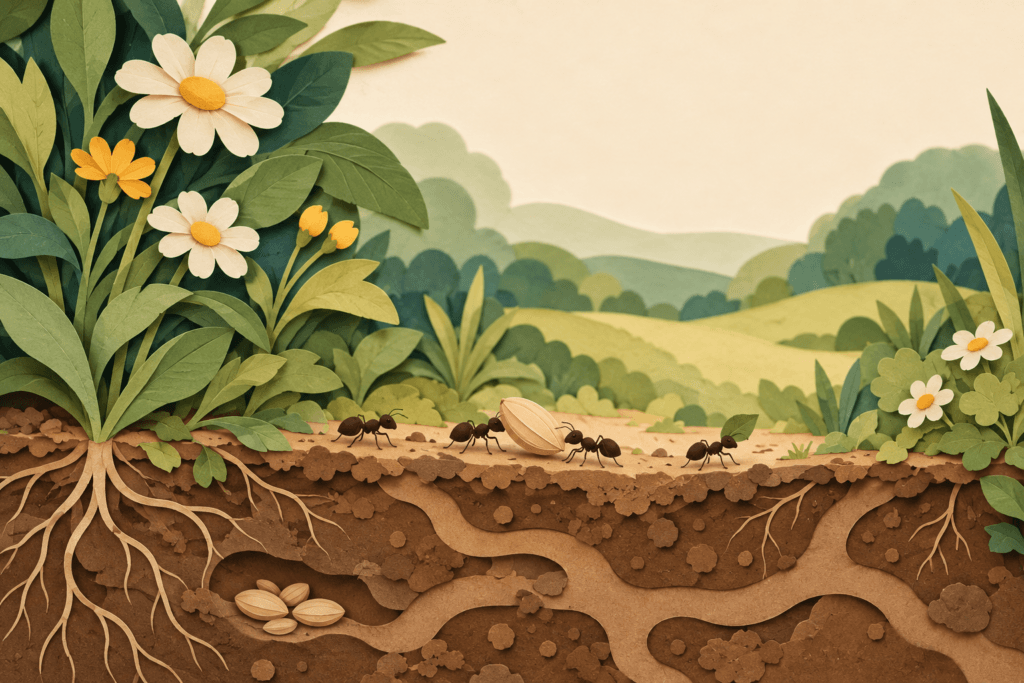
Softening a Fear of Ants Through Compassion
It can be difficult to feel sympathy for something that makes you anxious. That is understandable. Still, looking at the life of one small ant, rather than an advancing mass, can offer a gentler perspective.
A worker ant is small, vulnerable and usually short-lived. It spends its life responding to the needs of the colony, searching for food, caring for developing young, maintaining the nest and avoiding countless predators. Birds, spiders, beetles and other insects consume ants in enormous numbers.
An ant that enters a kitchen does not understand human ownership. It has detected a food source and followed information left by another worker. An ant crossing a patio is not plotting a takeover. It is navigating a landscape in which a paving slab is a vast plateau and a raindrop can be a serious obstacle.
You can feel a little compassion for an ant and still keep your food cupboards ant-free. Seeing a small animal going about its life can soften the story you tell yourself, while leaving sensible boundaries in place.
Fear of Ants at Home: Practical Action and Repeated Checking
When ants appear at home, it is perfectly reasonable to take action. The harder question is knowing when you have done enough. With ant phobia, that stopping point can feel frustratingly out of reach.
Sensible action has a clear purpose and an endpoint. You clean spilled food, store sweet items securely, wipe a trail, seal an entry point where appropriate and monitor whether activity continues. Once those steps are complete, attention returns to ordinary life.
Phobic checking does not reach a satisfying endpoint. The person may inspect the same surfaces repeatedly, throw away unaffected food, search every room, or continue cleaning because certainty still feels impossible. Reassurance works briefly, then the doubt returns.
If this pattern sounds familiar, the problem may no longer be only the ants. The nervous system has begun demanding complete certainty, which no home or garden can provide.
Learning to stop after reasonable action can take practice. You deserve a home that feels like a place to live, rather than a place you must constantly inspect. Support can help you work towards that balance.
Living With a Fear of Ants: Calm, Practical Coexistence
Peaceful coexistence does not mean ignoring ants indoors. It means responding proportionately and avoiding unnecessary harm where possible.
Outdoors, ants are usually best left alone. They are part of the garden ecosystem and generally have no interest in interacting with people. Avoid disturbing nests, particularly if you are unsure of the species or know that bites and stings are possible.
Indoors, remove accessible food, wipe surfaces, store ingredients in sealed containers and identify where ants are entering. Because chemical trails help ants follow one another, cleaning the route can reduce continued traffic. Persistent activity may require appropriate pest-management advice, especially in food areas or buildings where nests are difficult to access.
The aim is to feel capable and calmer. You do not have to become an ant enthusiast. Being able to assess the situation, take sensible steps and then get on with your day is a worthwhile goal in itself.
Can the Fear of Ants Be Treated?
Yes. There are established treatments for specific phobias, including fears of insects. You do not need to wait until your fear feels “serious enough” to ask for help.
Fear is maintained by automatic threat predictions and avoidance. Treatment helps the brain test those predictions in a structured, manageable way. Depending on the individual, this may involve education, Cognitive Behavioural Therapy, nervous-system regulation, imagination exercises, photographs, illustrations, videos, observing ants from a distance and eventually approaching real-life situations that matter to the person.
The NHS guidance on phobias describes talking therapies such as CBT as a treatment option. NHS services also use graded exposure to help people build confidence around specific fears.
Creature Courage explains the process in its guide to exposure therapy for animal phobias. Exposure is not about flooding someone with the most frightening version of the trigger. It is about creating new experiences that the brain can tolerate long enough to learn from.
For ant phobia, a first step might be saying the word, viewing a gentle illustration, discussing colony behaviour or standing in a garden where ants may exist without actively searching for them. The pace and goals should match the person, not a generic ladder copied from somebody else.
Fear of Ants Treatment: The Creature Courage Approach
At Creature Courage, we understand that overcoming an insect phobia requires more than being told that ants are tiny or harmless. The fear may involve crawling sensations, contamination, infestation, childhood memories, swarms or the loss of control that comes with seeing many insects move together.
Founded by Britain Stelly, Creature Courage specialises in animal phobia therapy using psychology, neuroscience, education and carefully guided exposure experiences. Through our Animal Phobia Therapy programme, clients learn how fear develops, how the nervous system interprets the trigger, and how confidence can be rebuilt through personalised work.
Our broader animal phobia treatment can be adapted to ants and other invertebrates. The work may combine education, emotional regulation, imagination, behavioural experiments and real-time exposure, depending on the person’s needs.
Some clients benefit from an intensive format. Our guide to one-day phobia treatment explains why specific fears can sometimes respond quickly when multiple techniques are brought together in a structured experience. Others need a more gradual route, particularly when ant fear overlaps with contamination anxiety or repetitive checking.
Creature Courage also uses a holistic approach to animal phobias, recognising that fear is influenced by the nervous system, beliefs, previous learning, bodily responses and avoidance. For younger clients, age-appropriate support is available through our children’s phobia therapy.
Our aim is to help you feel more at ease in the situations that matter to you. That might mean enjoying your garden again, eating outdoors with friends, or dealing with an ant in the kitchen without it taking over the rest of your day.
Therapy Approaches for the Fear of Ants
At Creature Courage, we use a holistic and neuroscience-informed approach that may include:
- Exposure Therapy: To allow the brain to update its fear response
- CBT: (Cognitive Behavioural Therapy): To give powerful thought awareness
- Guided Imagination Exercises: To transform how you see the animal
- NLP Techniques: (Neuro-Linguistic Programming) Changes how you understand the animal and anchors courage
- Hypnotherapy: To make changes in the deep subconscious and create relaxation
- Art Therapy: To help strengthen other techniques and make them memorable
- Animal Education:To build fascination and compassion, and to dispel myths
Rather than relying on a single technique, we combine approaches to create a personalised experience that works with both the mind and body.
Overcoming a Fear of Ants: Taking the First Step
Living with myrmecophobia can make warm weather, outdoor meals and ordinary household moments feel uncertain. A single ant can pull attention away from everything else and turn the environment into a map of possible nests, cracks and trails.
However, how you feel today does not have to be how you feel forever. With support and manageable experiences, it is possible to build a different response, one small step at a time.
You do not need to begin by placing your hand near a nest or standing in the middle of a flying-ant swarm. You begin by understanding what your fear is protecting you from, what ants are actually doing, and which small step would return a little more freedom to your life.
If you are ready to discuss support, you can contact Creature Courage to ask questions and explore an approach suited to your particular fear.
Getting Help With Your Fear of Ants
If a fear of ants is making everyday life harder, you are welcome to talk to us. We will listen to what feels difficult, discuss what you would like to change and explain the support available. If you would like to hear from people who have taken that step, our client testimonials and animal phobia success stories offer a personal insight into their experiences with Creature Courage. You do not need to feel brave before getting in touch. Asking a question is a perfectly good first step.
Frequently Asked Questions About the Fear of Ants
What is the fear of ants called?
The fear of ants is commonly known as myrmecophobia. It is a specific insect phobia that may involve fear, disgust, contamination concerns or avoidance.
Is myrmecophobia a recognised phobia?
It falls within the broader category of specific animal or insect phobias. The important issue is not the label alone, but whether the fear causes significant distress or restricts daily life.
Why am I frightened of ants when they are so small?
Phobias are shaped by threat learning rather than size. Ants may trigger fear because of crawling sensations, coordinated trails, large numbers, nests, bites, contamination or hidden activity.
Why do ant trails make me panic?
A trail suggests multiplication and communication. The brain may interpret it as evidence that the situation is spreading, even though the ants are simply following a chemical route to a resource.
Does one ant mean there is a nest inside my home?
Not necessarily. A single worker may be scouting. Repeated indoor trails deserve practical investigation, but one sighting does not prove a serious infestation.
Are ants dangerous?
Risk varies by species and location. Many common UK ants cause little concern during ordinary encounters, although some ants can bite or sting. Avoid disturbing nests and seek appropriate advice for unfamiliar or persistent indoor activity.
Why do flying ants appear all at once?
Warm and humid weather can trigger reproductive ants from many colonies to take nuptial flights around the same time. The event is temporary and linked to mating rather than aggression towards people.
Can ant phobia include contamination anxiety?
Yes. Ants are often seen near food and waste, so the fear may become linked to cleanliness, germs and the urge to discard or repeatedly clean items.
Can children develop a fear of ants?
Yes. A frightening encounter, being bitten, seeing a swarm, or observing an adult’s fear can all contribute. Support should validate the child without reinforcing avoidance.
Can exposure therapy help with a fear of ants?
Yes. Gradual, well-planned exposure can help the brain learn that ant-related situations are more manageable than the phobia predicts.
Do I need to touch ants to recover?
No. Treatment goals should reflect your life. Many people simply want to remain calm outdoors, manage an indoor sighting or cope with flying-ant season without panic.
Where can I get help for ant phobia?
Creature Courage provides specialist support through its Animal Phobia Therapy programme, using education, neuroscience and structured exposure to help people retrain fear responses.
Fear of Ants: Further Reading and Support
Creature Courage Guides to Animal Phobia Therapy
- Animal Phobia Therapy
- Animal Phobia Treatment
- Exposure Therapy for Animal Phobias
- One-Day Phobia Treatment
- A Holistic Approach to Animal Phobias
- Imagination Exercises for Animal Phobias
- Understanding Animal Phobias
- Children’s Phobia Therapy
- Contact Creature Courage
Trusted Information About Ants and Phobias
Copyright ©️ 2024 Creature Courage ®️