
Fear of Frogs and Toads: Understanding and Overcoming Frog Phobia
Understanding the Fear of Frogs and Toads
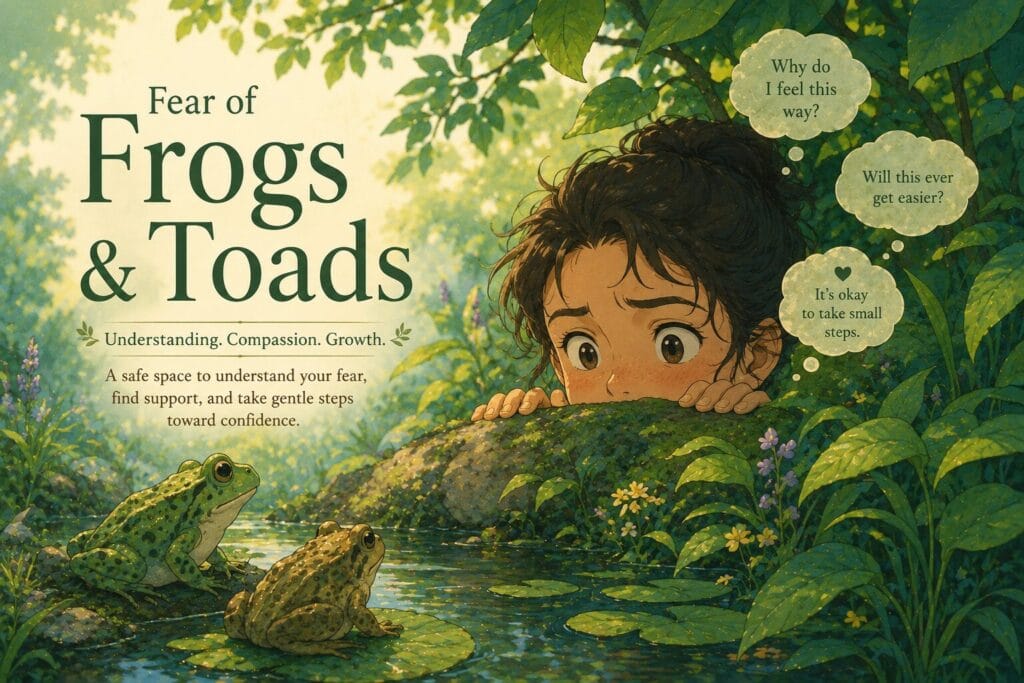
A fear of frogs and toads can feel strangely difficult to explain. Frogs and toads are small, shy amphibians, yet their sudden jumps, damp skin, stillness, bulging eyes, and unexpected appearances can trigger intense anxiety for some people.
For one person, the fear may begin when a frog leaps across a garden path. For another, it may come from the idea of touching wet skin, seeing a toad near a doorstep, or hearing frogs calling from a pond at night. Some people are most unsettled by the way frogs can seem completely still and then move without warning.
If frogs or toads make you avoid ponds, gardens, damp paths, woodland walks, pet shops, classrooms, or nature programmes, you are not being silly. Animal phobias are learned fear responses. With the right support, the brain can learn something new.
This profile explores the fear of frogs and toads, why it develops, how it affects daily life, and how it can be overcome. It also looks at the fascinating lives of amphibians, their importance to gardens and wetlands, common myths, and how understanding can help reduce fear.
Check out our powerful Client Testimonial
What Is the Fear of Frogs and Toads?
The fear of frogs and toads is often called ranidaphobia, which refers to fear of frogs, and sometimes batrachophobia, which can describe fear of amphibians more broadly. Many people simply search for frog phobia, toad phobia, or fear of frogs.
This phobia can involve fear, disgust, panic, or a powerful urge to get away when frogs or toads are nearby. The reaction may happen in gardens, near ponds, after rain, around drains, in woodland, or when viewing images and videos.
Common triggers include sudden jumping, wet or textured skin, unexpected appearances, direct staring, croaking sounds, large numbers of frogspawn or tadpoles, or worries about touching one by accident. Some people fear frogs more than toads, while others find toads more distressing because of their bumpy skin and old folklore associations.
Creature Courage explains this wider pattern in its guide to animal phobias and zoophobia, including why the brain can attach strong fear to animals that are not usually dangerous.

Symptoms of Frog and Toad Phobia
Symptoms can appear when you see a frog or toad, hear one nearby, anticipate encountering one, or visit places where amphibians may be present.
Physical Symptoms
The body may respond with a racing heartbeat, sweating, shaking, nausea, dizziness, chest tightness, or a sudden need to move away. Some people freeze because the animal's stillness and sudden movement make it difficult to predict what will happen next.
Emotional Symptoms
Emotionally, the fear may include panic, disgust, dread, embarrassment, or the feeling that the frog or toad is too close even when it is not touching you. You may also feel anxious before entering gardens, outdoor toilets, ponds, sheds, greenhouses, or damp pathways.
Behavioural Symptoms
Behavioural symptoms often involve avoidance. You might refuse to walk near ponds, ask someone else to check the garden, avoid outdoor spaces after rain, keep away from nature reserves, or stop children from exploring places where frogs and toads may live.
Common Amphibian-Specific Triggers
Frogs and toads can be difficult for the nervous system to read. They may sit motionless for a long time, then suddenly leap. Their skin can look wet or bumpy. Their eyes may seem fixed. Their calls can appear from nowhere at dusk. These qualities can make them feel more unpredictable than they really are.
How Frog and Toad Phobias Develop
A fear of frogs and toads rarely has one simple cause. It often develops through a mixture of experience, learning, disgust, surprise, and avoidance.
Startling Encounters
Many people remember a frog jumping unexpectedly near their feet, a toad appearing by a back door, or an amphibian moving suddenly during childhood. Even if nothing harmful happened, the shock can become linked to future fear.
Disgust and Texture Sensitivity
For some people, the fear is not only about being harmed. It is about the idea of damp skin, bumpy texture, slime, pond water, or accidental touch. Disgust is a natural protective emotion, but in phobias it can become too loud and too quick.
Learned Fear and Family Reactions
Children can absorb fear from adults, siblings, friends, or media. If frogs and toads are repeatedly treated as disgusting, dirty, poisonous, or creepy, the brain may begin to react before there is time to think clearly. Creature Courage explores this process in its article on parent anxiety and child phobia therapy.
Folklore, Stories and Cultural Associations
Toads have often appeared in folklore alongside witches, potions, curses, and old ideas about warts or poison. These stories may be imaginative, but they can still influence how people feel when they see a real toad in a garden.
The Avoidance Cycle
Avoidance provides quick relief. However, every avoided pond, damp path, or garden corner teaches the brain that frogs and toads must be dangerous. Over time, the fear can become stronger and more easily triggered.
Creature Courage explains this survival pattern in its article on caveman brain awareness, which explores why the body can react before the logical mind catches up.

Jumping In Frog and Toad Phobias
This section is unique to frogs and toads because movement is often the centre of the fear.
Unlike many animals that move steadily, frogs may wait in complete stillness and then leap in a single burst. This is not designed to frighten humans. It is a survival strategy. A frog's jump helps it escape predators quickly, cross ground efficiently, and reach safer cover.
For the anxious brain, however, stillness followed by sudden movement can feel like a trapdoor opening. The fear response is not only reacting to the frog. It is reacting to uncertainty. Once the brain expects a sudden jump, it may stay tense even when the frog is sitting quietly.
Understanding this pattern can help. The jump is not aggression. It is escape.
The Skin, Slime and Touch Factor
Another unique part of frog and toad phobia is the sensory response. Many people do not fear being attacked. They fear the feeling, appearance, or imagined texture of amphibian skin.
Frogs have moist skin because they partly breathe and absorb water through it. Toads usually have drier, bumpier skin, which helps them spend more time away from water. These features can look strange if you are used to fur, feathers, or scales.
However, their skin is not a sign that they are dirty or trying to contaminate you. It is part of how amphibians survive. They are delicate animals whose bodies are closely connected to moisture, temperature, and habitat quality.
You do not need to touch a frog or toad to recover from a phobia. For many people, progress begins with understanding why the animal looks and feels different.
Why Amphibians Appear After Rain
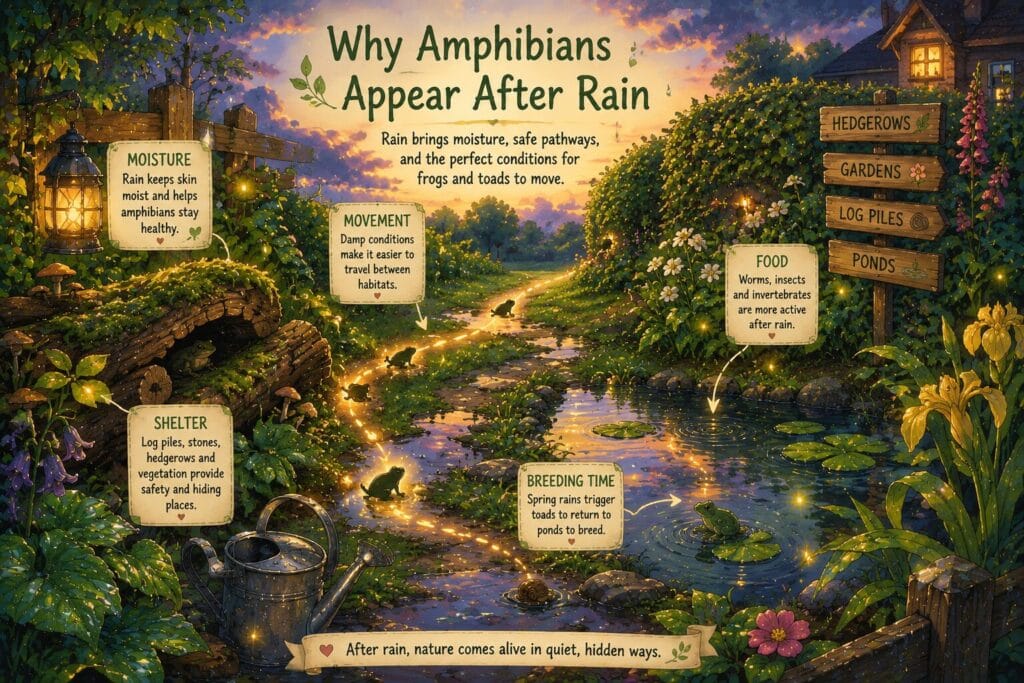
Many people with a fear of frogs and toads become more anxious after rain. This makes sense because damp evenings are often when amphibians move around most.
Frogs and toads rely on moisture. Rain helps keep their skin from drying out and makes it easier for them to travel between ponds, gardens, hedgerows, log piles, and feeding areas. In spring, toads are especially famous for migrating back to breeding ponds on mild, damp evenings.
The Wildlife Trusts' guide to the common toad explains that toads breed in ponds during spring and spend much of the rest of the year in places such as woodland, gardens, hedgerows, grassland, and log piles.
Knowing why amphibians appear after rain can reduce the sense that they are appearing randomly. Their behaviour follows moisture, safety, and seasonal rhythms.
Fascinating Facts About Frogs and Toads
Fear narrows attention. Curiosity widens it. Frogs and toads are much more interesting than their old folklore reputation suggests.
They Live Between Two Worlds
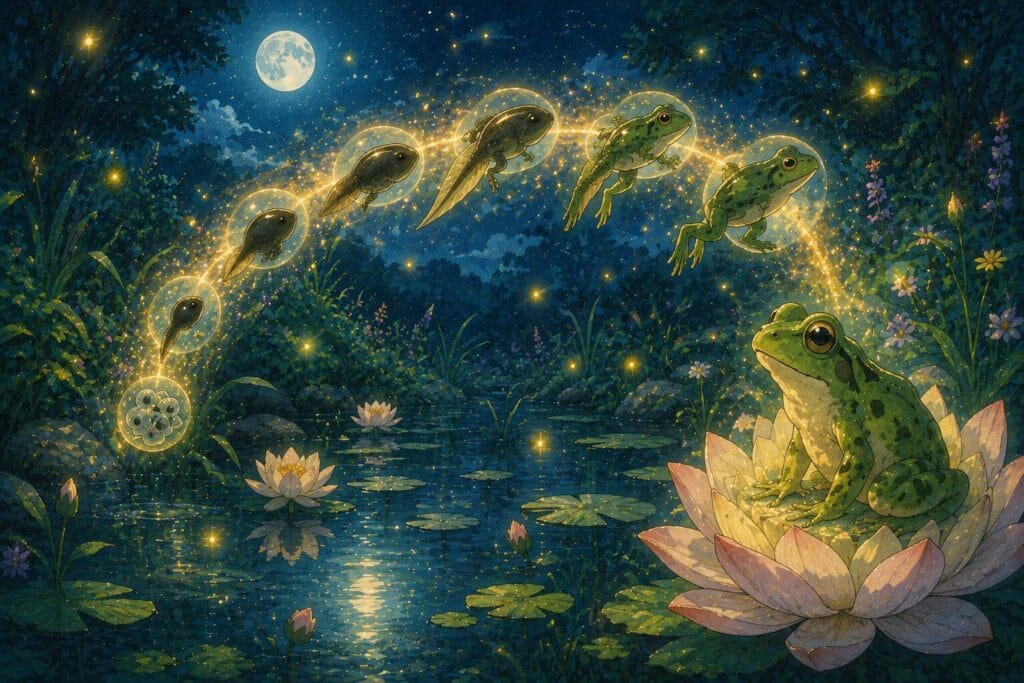
Amphibians begin life in water and often spend adulthood moving between wet and dry habitats. Tadpoles breathe underwater, while adult frogs and toads use lungs and their skin to help them survive.
Their Skin Is Highly Sensitive
Because amphibian skin is so sensitive, frogs and toads can be affected by pollution, drought, disease, and habitat loss. This makes them important indicators of environmental health.
Toads Make Remarkable Journeys
Common toads often return to ancestral breeding ponds year after year. Some must cross roads during migration, which is why UK conservation groups organise toad patrols to help them travel safely.
Frogs and Toads Help Gardeners Naturally
Frogs and toads feed on invertebrates such as slugs, snails, worms, flies, and other small creatures. The Wildlife Trusts' guide to the common frog describes frogs as regular garden pond visitors that feed on slugs and snails.
They Have Ancient Origins
Amphibians have survived for hundreds of millions of years. They carry an ancient story of water, land, adaptation, and survival in bodies small enough to hide beneath leaves.
Common Myths About Frogs and Toads
Myth: Toads Give People Warts
Why People Believe It
Toads have bumpy skin, and old stories often connected them with warts, witches, and illness.
The Reality
Warts are caused by viruses, not by touching toads. The bumps on a toad are natural skin structures, not contagious growths.
Why Understanding Matters
Removing this myth can reduce disgust and fear around toads, especially for people who worry about contamination.
Myth: Frogs and Toads Want to Jump at People
Why People Believe It
A frog's jump can feel sudden and personal if it happens close to your feet.
The Reality
Frogs usually jump to escape, reach cover, or move away from disturbance. They are not trying to attack or frighten anyone.
Why Understanding Matters
Seeing jumping as escape behaviour can help the nervous system interpret movement less threateningly.
Myth: All Frogs and Toads Are Poisonous
Why People Believe It
A few amphibians around the world use toxins for defence, and this can make all frogs and toads seem dangerous.
The Reality
Most UK encounters with frogs and toads are not dangerous. It is still sensible to avoid handling wild amphibians unless necessary, partly because they are delicate and can be harmed by chemicals on human skin.
Why Understanding Matters
Balanced caution is more useful than panic. Respectful distance protects both you and the animal.
Why Frogs and Toads Matter to Nature
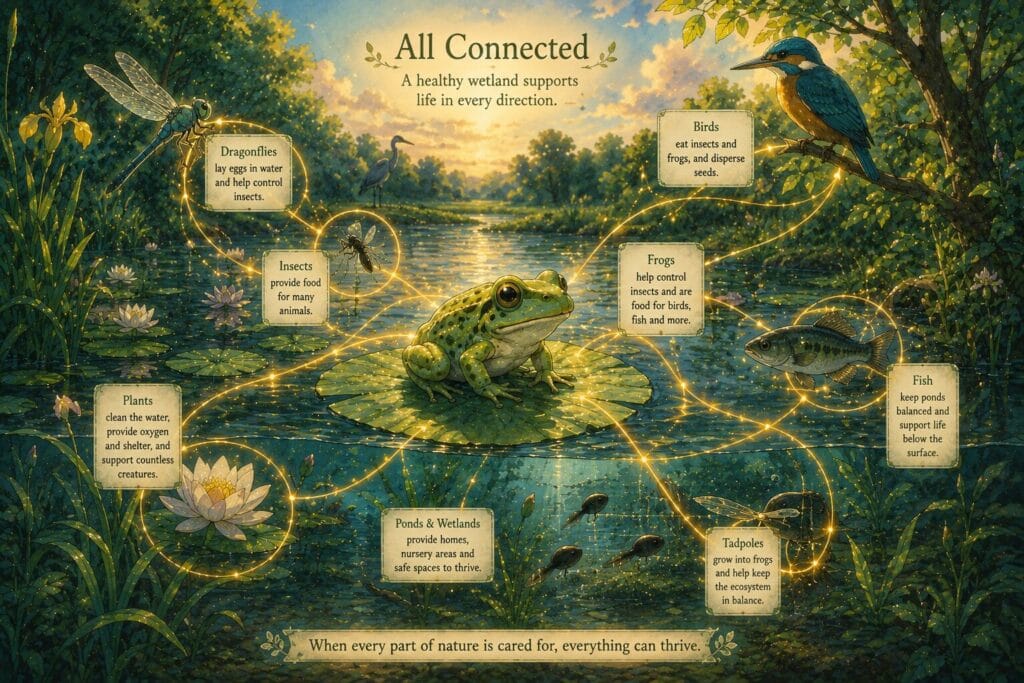
Frogs and toads play important roles in gardens, ponds, wetlands, woodland edges, and wider food webs.
As predators, they feed on many small invertebrates. This helps balance insect and slug populations in gardens and natural habitats. As prey, they support birds, grass snakes, mammals, fish, and larger amphibians.
Their eggs and tadpoles also contribute to pond ecosystems. Tadpoles feed, grow, and transform within the water, linking the aquatic world with life on land.
Amphibians are also sensitive to environmental change. The Natural History Museum's amphibian conservation research highlights the importance of understanding and protecting amphibian species worldwide.
In the UK, Froglife works to conserve amphibians, reptiles, and their habitats. Their work reflects a wider truth: healthy amphibian populations are part of healthy ecosystems.
Seeing Frogs and Toads Through a Compassionate Lens
Fear can make frogs and toads feel strange, unpleasant, or threatening.
Compassion asks what life is like for them.
A frog or toad spends its life avoiding drying out, finding food, hiding from predators, surviving winter, locating breeding ponds, and navigating a world changed by roads, pollution, garden chemicals, habitat loss, and climate pressures.
A toad crossing a road on a damp spring night is not trying to invade human space. It is following an ancient route to water. A frog hiding in long grass is not waiting to frighten anyone. It is trying not to be eaten.
This does not mean you need to love amphibians. Empathy is quieter than that. It simply allows the story to change from "that animal is disgusting" to "that animal is vulnerable and trying to survive".

Creating a Frog-Friendly Garden Without Feeling Overwhelmed
This section is not about forcing closeness. It is about calm, practical coexistence. Spending more time around frogs and toads is also one of the best ways to get over the fear in a lasting way!
If you want a garden that supports wildlife while still feeling manageable, small steps can help. Keeping areas tidy near doorways may reduce surprise encounters, while leaving a quiet log pile or shaded corner farther from seating areas can give amphibians somewhere safer to shelter.
A pond is helpful for amphibians, but it is not essential for everyone. If the idea of frogs in the garden currently feels too much, you can begin with knowledge rather than habitat creation.
For those who do feel ready, wildlife organisations such as Froglife provide guidance on supporting amphibians and reptiles in ways that respect both wildlife and people.
Peaceful Coexistence With Frogs and Toads
Peaceful coexistence does not mean touching frogs, picking up toads, or pretending the fear has vanished. It means learning how to respond calmly when an encounter happens.
If you see a frog or toad, pause before moving. Give it space. Let it move away if it wants to. Avoid sudden stamping, chasing, poking, or trying to remove it while panicking. If it is somewhere unsafe, such as a road or busy path, ask a confident person for help rather than forcing yourself beyond your current ability.
In most garden encounters, the amphibian is simply passing through or sheltering. It is not interested in chasing, biting, or approaching you.
The goal is calm distance, not forced contact.

Why Address a Fear of Frogs and Toads?
A fear of frogs and toads may seem easy to avoid until it begins shaping everyday choices. You may feel tense in gardens, avoid ponds, skip wildlife parks, dislike walking after rain, or feel unable to relax in outdoor spaces during spring and summer.
The fear can also affect family life. Children may want to explore ponds, learn about tadpoles, visit nature reserves, or take part in school wildlife projects. If your anxiety is strong, these moments can become stressful rather than enjoyable.
Addressing the fear is not about becoming an amphibian enthusiast. It is about regaining choice. You may simply want to walk through a garden calmly, visit a pond without panic, or stop feeling trapped when a toad appears near the door.
Can the Fear of Frogs and Toads Be Treated?
Yes. Specific animal phobias are among the most treatable anxiety conditions.
Fear is learned through experience, association, and repetition. This means it can also be changed through new learning. Effective treatment may include education, gradual exposure therapy, Cognitive Behavioural Therapy, nervous system regulation, and confidence-building experiences.
The NHS guidance on phobias explains that phobias can create intense anxiety and that treatment may include talking therapies such as CBT.
Creature Courage also explains how supported exposure works in its guide to exposure therapy for animal phobias.
Good treatment does not begin by placing a frog in your hands. It begins with helping the nervous system feel safe enough to learn. For some people, the first step may be saying the word frog without panic. For others, it may be looking at a gentle illustration or discussing what happens when the animal jumps.
The Creature Courage® Approach
At Creature Courage®, we understand that overcoming an animal phobia requires more than being told there is nothing to fear.
Founded by Britain Stelly, Creature Courage specialises in animal phobia therapy using psychology, neuroscience, animal education, and carefully guided exposure experiences.
Through our Animal Phobia Therapy programme, clients learn how fear develops, how the nervous system responds to perceived threats, and how confidence can be rebuilt step by step.
Creature Courage also provides wider animal phobia treatment for many different fears, including insects, reptiles, birds, dogs, rodents, and other animals.
Many clients are surprised to discover why one-day phobia therapy can work so effectively for specific animal fears. Others may benefit from a more gradual approach, especially when disgust, touch sensitivity, or wider anxiety patterns are involved.
Creature Courage also uses a holistic approach to animal phobias, recognising that fear is not only about the animal itself but also about the wider nervous system.
For younger clients, our children's phobia therapy provides age-appropriate support designed to build confidence without pressure.
Every fear story is different. Some people fear frogs jumping. Some fear toads near the door. Some fear pond life, frogspawn, tadpoles, or accidental touch. Our goal is not to make you love frogs and toads. Our goal is to help you feel calmer, safer, and more in control.
Therapeutic Techniques to Overcome a Fear of Frogs and Toads
At Creature Courage, we use a holistic and highly personalised approach to helping people overcome their fear of frogs and toads.
Every person arrives with a different history, different triggers and different goals. Therefore, no two sessions are exactly the same.
Some of the techniques that may be used include:
Animal Education
Understanding often reduces fear.
Education forms a central part of our Animal Phobia Therapy Programmes. We teach people about lizards, their behaviour, their role in nature and the myths that surround them.
As fascination grows, fear often begins to shrink.
Exposure Therapy
Exposure therapy allows the brain to update its fear response through direct experience.
Through carefully structured Exposure Therapy for Animal Phobias, fearful assumptions can gradually be replaced with real-world evidence and confidence.
Cognitive Behavioural Therapy (CBT)
Cognitive Behavioural Therapy (CBT) helps people become more aware of the thoughts, beliefs and assumptions that may be maintaining the fear.
As part of our wider Animal Phobia Therapy Approach, CBT techniques can help develop a calmer and more balanced perspective.
Guided Imagination Exercises
The brain often responds to imagined experiences in similar ways to real ones.
Guided imagination exercises are frequently incorporated into our Animal Phobia Therapy Sessions to help transform how people mentally picture lizards and prepare them for real-world encounters.

Taking the First Step
Living with a fear of frogs and toads can make ordinary outdoor moments feel tense. Gardens, ponds, rainy evenings, woodland walks, and family wildlife activities may all become wrapped in anxiety.
However, phobias are not fixed forever. With the right support, education, and gradual exposure, the brain can learn a new response.
You do not need to begin by touching a frog, holding a toad, or standing beside a pond at night. You begin with understanding.
And understanding is often where courage starts to hop forward.
If you are ready to explore support, you can contact Creature Courage to discuss your experience, ask questions, and discover which approach may be right for you.
Frequently Asked Questions About the Fear of Frogs and Toads
What is the fear of frogs called?
The fear of frogs is often called ranidaphobia. Some people also use batrachophobia to describe a fear of amphibians more broadly.
Is a fear of frogs and toads a real phobia?
Yes. If frogs or toads cause intense anxiety, panic, disgust, avoidance, or disruption to daily life, the fear can function as a specific animal phobia.
Why am I afraid of frogs?
Your fear may be linked to sudden jumping, texture, disgust, childhood experiences, learned fear, folklore, or the way your nervous system reacts to unpredictable movement.
Why do toads make me feel disgusted?
Toads have bumpy skin and strong folklore associations. Disgust may also be linked to worries about touch, dampness, contamination, or old myths about warts.
Can frogs or toads give you warts?
No. Warts are caused by viruses, not by frogs or toads.
Are frogs and toads dangerous in the UK?
Most everyday encounters with UK frogs and toads are not dangerous. It is still best to avoid unnecessary handling because amphibians are delicate.
Why do frogs jump towards people?
Frogs usually jump to escape, reach cover, or move away from disturbance. The movement may feel personal, but it is normally defensive or practical.
Can children develop a fear of frogs and toads?
Yes. Children may develop this fear after a startling encounter, learned family reactions, or repeated negative messages about amphibians.
Can exposure therapy help with frog phobia?
Yes. Gradual exposure therapy can help the brain learn that frog-related situations are safer than the phobia predicts.
Do I need to touch a frog to recover?
No. Recovery goals should be personal. Many people simply want to feel calmer around frogs or toads without touching them.
Can I completely overcome a fear of frogs and toads?
Many people achieve significant improvement with the right support, education, and carefully planned exposure work.
Where can I get help for frog or toad phobia?
Specialist support from Creature Courage's Animal Phobia Therapy programme can help you understand and retrain your fear response around frogs and toads.
Further Reading
You may also find these resources helpful:
Creature Courage Resources
- Animal Phobia Therapy
- Animal Phobia Treatment
- Exposure Therapy for Animal Phobias
- Why One-Day Phobia Therapy Works
- A Holistic Approach to Animal Phobias
- Understanding Animal Phobias (Zoophobia)
- Children's Phobia Therapy
- Contact Creature Courage
External Resources
- NHS Specific Phobias Guide
- The Wildlife Trusts: Common Frog
- The Wildlife Trusts: Common Toad
- Froglife
- Natural History Museum: Amphibian Conservation