Overcoming the Fear of Flies: Understanding and Conquering Pteronarcophobia
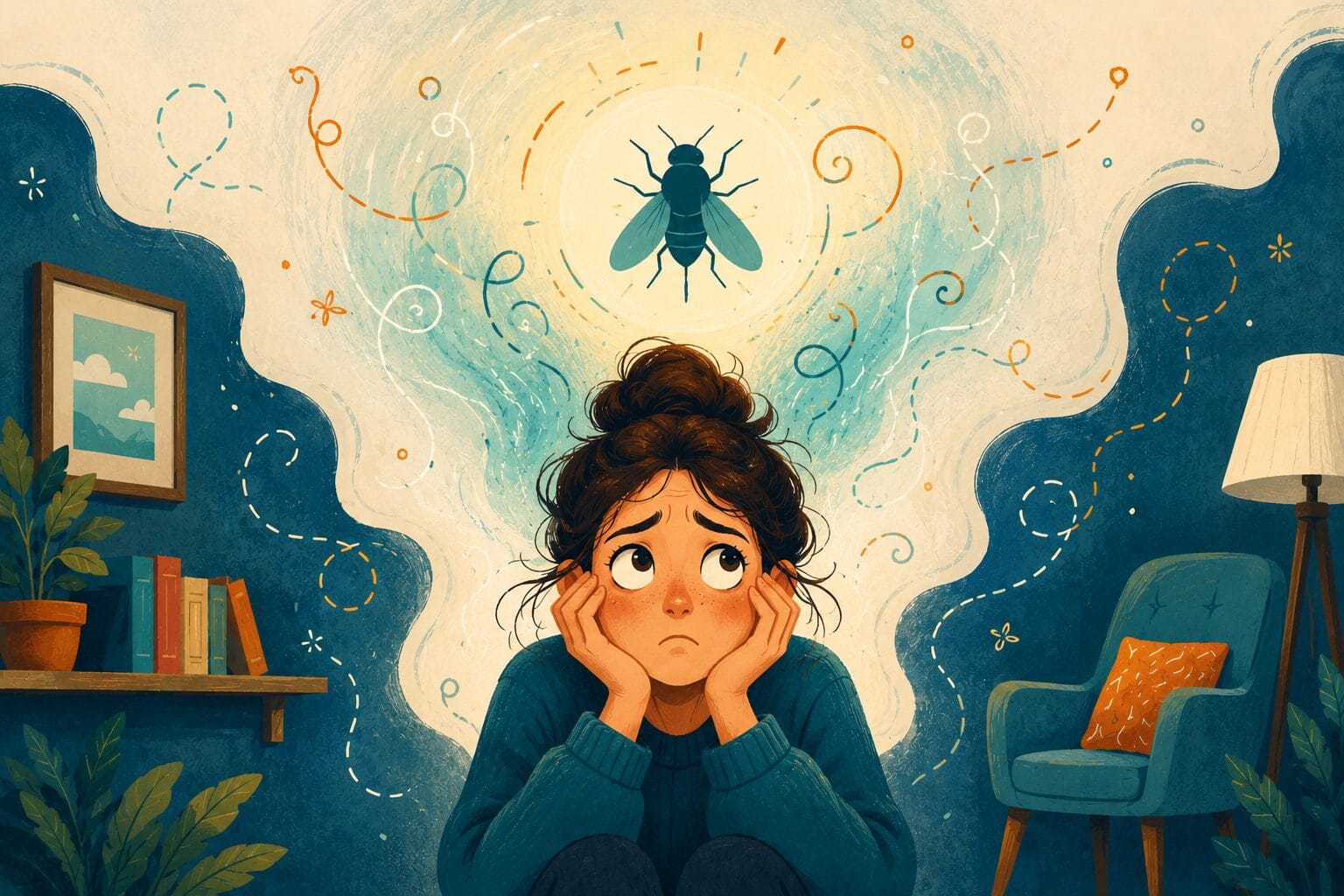
Fear of Flies: Understanding and Overcoming Fly Phobia
Understanding the Fear of Flies
A fear of flies can feel frustrating, embarrassing, and difficult to explain. Flies are small, common insects, yet their buzzing, sudden movement, close approach, and association with germs can trigger intense anxiety for many people.
For some, the fear begins when a fly enters the room and refuses to stay still. For others, the distress comes from the sound near the ear, the thought of contamination, or the unpredictable way a fly lands on surfaces, food, or skin.
If you avoid open windows, outdoor meals, kitchens, gardens, bins, farms, or summer events because of flies, you are not alone. Animal and insect phobias are learned fear responses. With the right support, they can change.
A phobia of flies is also closely associated with Entomophobia, which is the fear of insects. It also has an association with Mysophobia (the fear of germs), so you can see where flies might easily buzz in.
People who suffer from Pteronarcophobia often avoid going outside and may even choose to stay indoors. Understanding this, adn learning how to manage and overcome the fear of flies can, genuinely, be life-changing.
This profile explores the fear of flies, why it develops, how it affects daily life, and how it can be overcome. It also looks at fly behaviour, surprising facts, ecological value, common myths, and how understanding these insects can reduce fear.
Change Your Life in Just One Day with Creature Courage
What Is the Fear of Flies?
The fear of flies is a specific insect-related phobia involving intense fear, anxiety, disgust, or panic around flies. Some people may describe it as part of a wider fear of insects, known as entomophobia, while others are specifically distressed by flies.
There is no single universally used clinical name for the fear of flies. Some sources may use terms such as pteronarcophobia for fear of flies or flying insects, although many people simply search for fly phobia or fear of flies.
Common fly-specific triggers include:
- Buzzing near the face or ears
- Sudden darting movement
- Flies landing on skin
- Flies landing on food
- Multiple flies in one room
- Large houseflies, bluebottles, or cluster flies
- Association with bins, waste, decay, or germs
- Feeling unable to control where the fly goes next
Creature Courage explains how animal fears develop more broadly in its guide to animal phobias and zoophobia, including why the brain can attach strong fear to animals that are not usually dangerous.

Symptoms of Fly Phobia
Fly phobia can affect the body, emotions, thoughts, and behaviour. Symptoms may appear when a fly enters the room, when you hear buzzing, or when you anticipate flies being present.
Physical Symptoms
- Racing heartbeat
- Sweating
- Shaking or trembling
- Tightness in the chest
- Feeling sick
- Dizziness
- Muscle tension
- A strong urge to escape the room
Emotional Symptoms
- Panic when a fly comes close
- Fear of being touched or landed on
- Disgust or contamination anxiety
- Feeling trapped indoors
- Fear of losing control
- Embarrassment about the reaction
Behavioural Symptoms
- Leaving rooms when flies appear
- Keeping windows closed during warm weather
- Avoiding outdoor meals or picnics
- Checking rooms repeatedly for flies
- Avoiding bins, compost areas, farms, or stables
- Asking others to remove flies
- Feeling unable to relax until the fly is gone
Common Fly-Specific Triggers
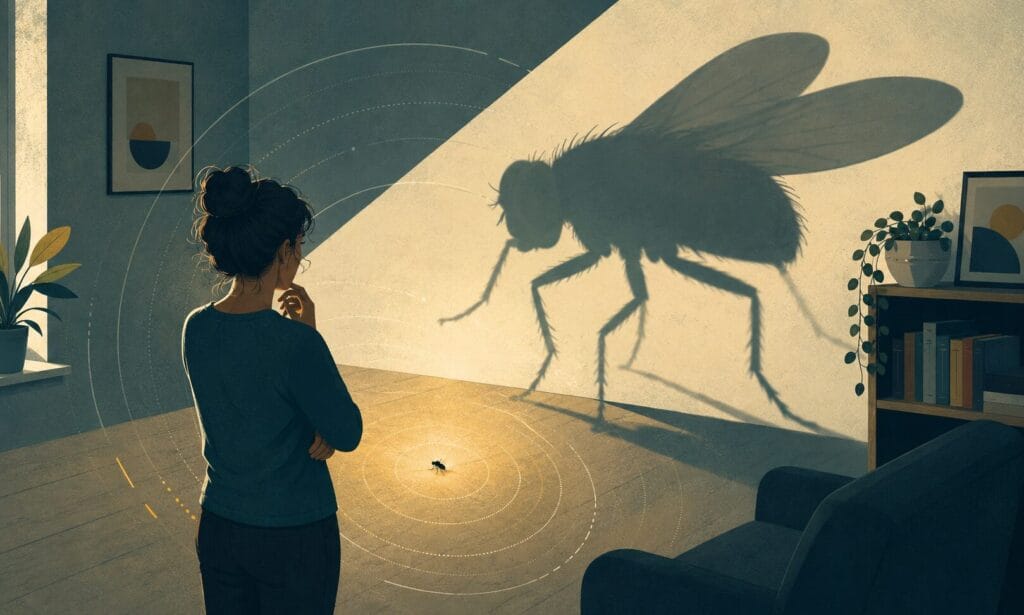
Flies can feel especially distressing because they rarely move in predictable lines. They circle, disappear, return suddenly, and seem to ignore personal space. This makes them feel harder to track and harder to control.
Why Flies Feel So Hard to Ignore
This is one of the reasons fly phobia can feel so intense.
A fly does not need to be large to capture attention. The buzzing sound is high, close, and difficult to tune out. Its movement is fast, irregular, and often near the face. The brain treats this combination as important information.
For someone with a fear of flies, the insect can become the loudest thing in the room, even if nobody else seems bothered.
This does not mean you are overreacting. It means your attention system has learned to prioritise the fly as a possible threat. Once that alarm is active, the body may scan constantly until the fly leaves.
Creature Courage discusses this survival response in its article on caveman brain awareness, which explains why the body can react before the logical mind has time to settle the situation.
How Fly Phobias Develop
Fly phobia can develop through a mixture of experience, learning, disgust, and avoidance. The cause is not always obvious.
Startling Encounters
A fly landing suddenly on the face, ear, mouth, or skin can feel intensely unpleasant. If the event causes panic, the brain may store flies as something to avoid in future.
Disgust and Contamination Learning
Flies are often linked with bins, waste, spoiled food, decay, and germs. For some people, the fear is not only about the insect itself. It is also about what the fly may have touched.
Learned Fear
Children can absorb fear from adults, siblings, friends, or media. If flies are repeatedly described as dirty, horrible, invasive, or disgusting, the nervous system may learn to react before the person has a chance to think.
Creature Courage explores family patterns in its article on parent anxiety and child phobia therapy.
Media and Cultural Associations
Flies are often used in films, horror scenes, and stories to symbolise decay, illness, or death. These associations can make them feel more sinister than they are in everyday life.
The Avoidance Cycle
Avoidance brings quick relief. However, it also teaches the brain that flies must be dangerous because escape seems necessary.
Over time, avoidance can make the fear more sensitive. A single fly may then feel like a full emergency.

The Disgust Factor in Fly Phobia
Some phobias are driven mainly by fear. Others are fuelled by disgust. A fear of flies often contains both.
Disgust is a protective emotion. It helps humans avoid contamination, spoiled food, infection, and unsafe substances. Around flies, that system can become too sensitive. You may know that one fly in a room is unlikely to harm you, yet still feel a powerful urge to clean, leave, throw food away, or avoid touching nearby surfaces.
This does not mean your reaction is silly. It means your brain is trying to protect you using a very old safety system. Treatment can help that system become more accurate, so it no longer treats every fly encounter as a crisis.
Why Address a Fear of Flies?
A fear of flies can quietly shrink everyday life, especially during warmer months.
It may affect:
- Opening windows
- Eating outdoors
- Cooking or spending time in kitchens
- Visiting farms, gardens, cafés, or markets
- Going on holidays
- Enjoying summer events
- Relaxing at home
- Sleeping if a fly is in the room
Some people feel embarrassed because flies are small and common. However, phobias are not measured by the size of the animal. They are measured by the strength of the fear response and the impact on daily life.
Addressing the fear is not about becoming fond of flies. It is about feeling calmer, freer, and less controlled by them.

Fascinating Facts About Flies
Flies are often dismissed as pests, but they are far more complex than most people realise.
Flies Are Expert Fliers
Flies can make rapid turns, hover, accelerate quickly, and react to movement with astonishing speed. Their flight may feel unpredictable to us, but it is part of their survival toolkit.
They Have Remarkable Eyes
Many flies have large compound eyes made from many tiny lenses. This helps them detect movement quickly, which is one reason they are so difficult to swat.
Some Flies Are Important Pollinators
Hoverflies, bee-flies, and many other flies visit flowers and move pollen between plants. The Natural History Museum's guide to insect pollination highlights hoverflies as prolific pollinators that visit many food crops and wildflowers.
Flies Help Break Down Waste
Many fly larvae feed on decaying organic matter. Although this can seem unpleasant, it plays an important role in nutrient recycling.
There Are Many More Types Than People Realise
Houseflies are only one small part of a huge and varied group. The Wildlife Trusts' fly guide shows just how diverse UK flies can be, including hoverflies, soldier flies, bee-flies, and crane flies.
Common Myths About Flies
Myth: All Flies Are Filthy
Why People Believe It
Flies are often seen around bins, food waste, compost, or animal mess. This creates a strong association with dirt.
The Reality
Some flies do visit unhygienic places, so sensible food hygiene matters. However, not all flies live the same way. Many feed on nectar, visit flowers, or play useful roles in ecosystems.
Why Understanding Matters
Seeing flies as a varied group can reduce the feeling that every fly is equally threatening.
Myth: Flies Deliberately Chase People
Why People Believe It
Flies may circle back repeatedly, land nearby, or approach the face, which can feel personal.
The Reality
Flies are usually responding to heat, smell, light, moisture, food, or air movement. They are not chasing in a planned or malicious way.
Why Understanding Matters
Knowing that the behaviour is not targeted can help reduce panic and the feeling of being attacked.
Myth: If a Fly Lands on Food, Everything Is Dangerous
Why People Believe It
Flies can carry bacteria, so it is understandable that people feel uneasy when one lands on food.
The Reality
Food hygiene is important, especially around uncovered food. However, anxiety can sometimes move beyond sensible caution into compulsive avoidance or panic.
Why Understanding Matters
The goal is balanced caution: clean, cover food, and remove waste calmly without treating every fly as a disaster.
Why Flies Matter to Nature
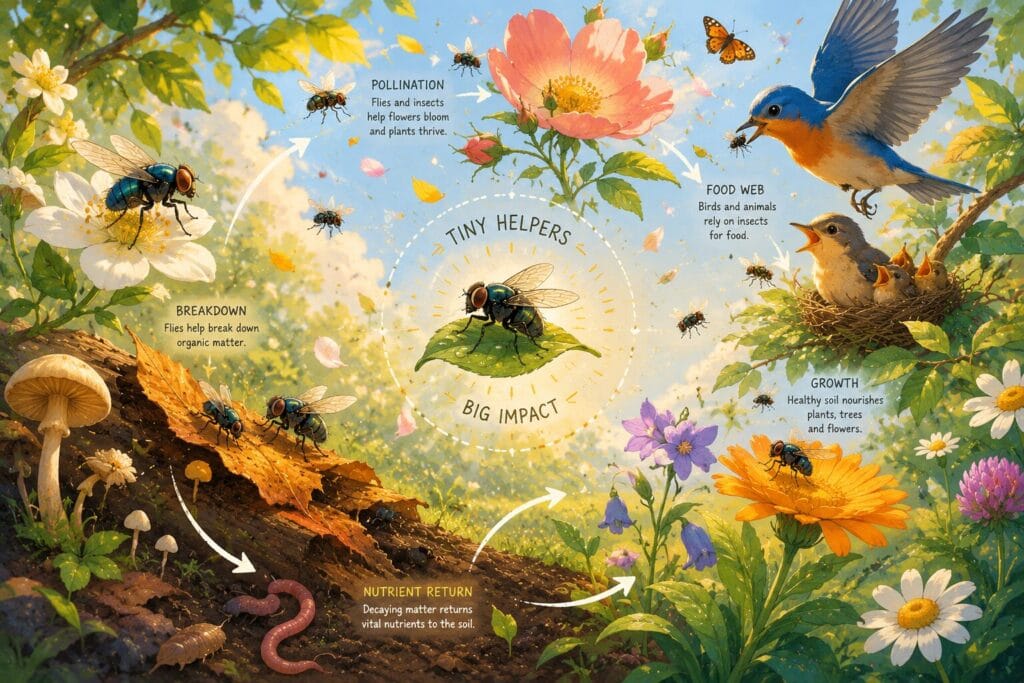
Flies play several important ecological roles. They may not have the public charm of butterflies or bees, but nature does not run on popularity.
Many flies help pollinate flowers. Some pollinate wild plants, while others contribute to crops and garden plants. The Smithsonian National Museum of Natural History notes that flies pollinate more than 100 agricultural crops, including onions, strawberries, carrots, apples, lettuce, tomatoes, and buckwheat.
Fly larvae also help break down dead plants, waste, and decaying material. This returns nutrients to soil and supports the wider cycle of life.
Flies are also food for birds, bats, amphibians, reptiles, spiders, and other insects. Remove flies from an ecosystem and many other animals would feel the gap.
Understanding their ecological role does not mean you need to welcome flies into your kitchen. It simply helps place them within a larger natural system.
Seeing Flies Through a Compassionate Lens
Fear can make flies feel invasive, dirty, and chaotic. Compassion asks a different question: what is the fly trying to do?
A fly is not plotting, pursuing, or trying to frighten anyone. It is searching for food, warmth, moisture, shelter, or somewhere to reproduce. Its quick movements help it avoid predators. Its sensitivity to smell and light helps it navigate the world.
Many flies live short lives and are extremely vulnerable. They are hunted by birds, spiders, frogs, bats, and other insects. Their speed is not aggression. It is survival. This perspective does not require affection. It simply softens the story from "this creature is attacking me" to "this creature is trying to survive".

How to Peacefully Coexist With Flies
Because flies often appear indoors, practical confidence matters.
Helpful steps include:
- Keep food covered when possible
- Empty food waste regularly
- Use window screens where practical
- Open one clear exit point, such as a window or door
- Dim indoor lights and allow daylight to guide the fly out
- Use calm breathing before trying to remove the fly
- Ask for help if the anxiety feels too strong
The aim is not to create a perfectly fly-free world. That is impossible. Instead, the goal is to build confidence that you can handle an occasional fly without panic taking charge.
How to be Calm around Flies
Peaceful coexistence with flies means balanced, realistic behaviour. You do not need to touch them. You do not need to like them. You do not need to share food with them. However, you can learn to respond calmly when they appear.
Try to:
- Pause before reacting
- Remind yourself that the fly is not targeting you
- Move slowly rather than swatting frantically
- Use practical hygiene without excessive checking
- Leave the room briefly if needed, then return
- Practise tolerating mild discomfort in small steps
Confidence grows when the brain learns that the presence of a fly does not require emergency action.

Can the Fear of Flies Be Treated?
Most certainly! Specific animal and insect phobias are among the most treatable anxiety conditions. Fear is learned through experience, association, and repetition. That means it can also be changed through new learning.
Effective approaches may include:
- Exposure therapy
- Cognitive Behavioural Therapy (CBT)
- Education about insect behaviour
- Disgust tolerance work
- Nervous system regulation techniques
- Gradual confidence-building experiences
The NHS guidance on phobias explains that phobias can cause intense anxiety and that treatment may include talking therapies such as CBT.
Creature Courage also explains how supported exposure works in its guide to exposure therapy for animal phobias.
Treatment is not about throwing someone into a room full of flies. It is about helping the nervous system learn, step by step, that it can remain safe and steady.
Therapeutic Techniques to Overcome the Fear of Flies
- Cognitive-Behavioural Therapy (CBT): CBT helps individuals identify and challenge irrational fears and develop healthier thought patterns. Specific cognitive-behavioural therapy research has pointed to the fact that lasting results can be found in just one therapy session, and we can whole-heartedly vouch for that - and so can our clients.
- Exposure Therapy: Gradual, controlled exposure to flies helps desensitise individuals to their fear. Understanding flies and their behaviours can foster a sense of fascination and help to reduce fear. At Creature Courage, we strongly recommend exposure therapy, which allows you to interact with the animals in a controlled environment. You will always be supported by expert animal phobia specialists to help you face your fears in a gentle yet empowering way. The therapy is always led by you and is in your control at all times.
- Hypnotherapy:This helps our clients to rewire their brains at a subconscious level. Hypnotherapy also helps our clients to have calmer and more effective exposure therapy.
- NLP (Neuro-Linguistic programming): Helps to create understanding around how we think and speak. NLP gives us tools to change the stories we tell ourselves, to create new positive mindsets. We teach NLP techniques to condition your mind to be able access these powerful positive emotions.
- Art Therapy: We can use imagination techniques and then make them more real through creating art. This extra cognitive step helps the mind make the memory of the meditation more vivid and lasting.
- Animal Education: This one isn't a psychological technique learned and perfected over years. It's classroom stuff that we have come to realise gives an improved understanding about dogs, which in turn, allows you to begin building compassion and fascination. Believe when we say this step cannot be missed out if you truly want an end to your phobia. What's the adage: 'knowledge is power', and here it will most definitely be one of your most important tools in defeating fear.
All these techniques are combined together into one highly powerful session.
The Creature Courage® Approach
At Creature Courage®, we understand that overcoming an animal or insect phobia requires more than being told there is nothing to fear.
Founded by Britain Stelly, Creature Courage specialises in animal phobia therapy using psychology, neuroscience, animal education, and carefully guided exposure experiences.
Through our Animal Phobia Therapy programme, clients learn how fear develops, how the nervous system responds to perceived threats, and how confidence can be rebuilt step by step.
If your fear is part of a wider insect phobia, our animal phobia treatment can be tailored to your specific triggers, whether they involve flies, spiders, bees, wasps, or other insects.
Many clients are surprised to discover why one-day phobia therapy can work so effectively for specific animal fears. Others may benefit from a more gradual approach, especially when disgust, contamination anxiety, or wider anxiety patterns are involved.
Creature Courage also uses a holistic approach to animal phobias, recognising that fear is not only about the insect itself but also about the wider nervous system.
For younger clients, our children's phobia therapy provides age-appropriate support designed to build confidence without pressure.
Every fear story is different. Some people fear buzzing. Some fear landing. Some fear contamination. Some feel panic when a fly enters a room and cannot settle until it is gone.
Our goal is not to make you love flies. Our goal is to help you feel calmer, safer, and more in control.

Taking the First Step
Living with a fear of flies can make ordinary moments feel tense. A summer picnic, an open kitchen window, a café table, or a bedroom at night can suddenly become difficult.
However, phobias are not fixed forever.
With the right support, education, and gradual exposure, the brain can learn a new response.
You do not need to begin by holding a fly, standing near many flies, or forcing yourself through panic.
You begin with understanding.
And understanding is often where courage starts to unfold its wings.
If you are ready to explore support, you can contact Creature Courage to discuss your experience, ask questions, and discover which approach may be right for you.
Frequently Asked Questions About the Fear of Flies
What is the fear of flies called?
Many people simply call it a fear of flies or fly phobia. It may also be linked to entomophobia, which is a fear of insects.
Is a fear of flies a real phobia?
Yes. If flies cause intense anxiety, avoidance, panic, or disruption to daily life, the fear can function as a specific phobia.
Why am I so scared of flies?
Your fear may be linked to buzzing, sudden movement, contamination concerns, disgust sensitivity, past experiences, or learned fear.
Why does buzzing make me panic?
Buzzing near the ear can feel close, unpredictable, and invasive. The nervous system may treat the sound as an urgent signal.
Can a fear of flies be linked to contamination anxiety?
Yes. Some people are more distressed by what flies may have touched than by the insect itself.
Are all flies dirty?
No. Some flies are associated with waste, so hygiene matters. However, many flies feed on nectar, pollinate plants, or play useful ecological roles.
Can children develop a fear of flies?
Yes. Children may develop a fear after a startling encounter, learned family reactions, or repeated negative messages about insects.
Should I force myself to stay in a room with a fly?
No. Forced exposure can increase distress. Structured exposure should be gradual, supported, and manageable.
Can exposure therapy help with a fear of flies?
Yes. Gradual exposure therapy can help the brain learn that fly-related situations are safer than the phobia predicts.
Do I need to touch a fly to recover?
Not usually. Recovery goals should be personal. For many people, being able to remain calm when a fly is nearby is enough.
Can I completely overcome a fear of flies?
Many people achieve significant improvement with the right support, education, and carefully planned exposure work.
Where can I get help for fly phobia?
Specialist support from Creature Courage's Animal Phobia Therapy programme can help you understand and retrain your fear response around flies.
Further Reading
You may also find these resources helpful:
Creature Courage Resources
- Animal Phobia Therapy
- Animal Phobia Treatment
- Exposure Therapy for Animal Phobias
- Why One-Day Phobia Therapy Works
- A Holistic Approach to Animal Phobias
- Understanding Animal Phobias (Zoophobia)
- Children's Phobia Therapy
- Contact Creature Courage
External Resources
- NHS Specific Phobias Guide
- The Wildlife Trusts Guide to Flies
- Natural History Museum: Why Flies Are Fabulous
- Natural History Museum: Insect Pollination
- Smithsonian: Precious Pollinators
Discover the Path to Overcoming Your Fear with Creature Courage