
Fear of Fish (Ichthyophobia): Understanding and Overcoming Fish Phobia

Understanding the Fear of Fish
A fear of fish, sometimes called ichthyophobia, can feel difficult to explain. Fish are often associated with calm aquariums, seaside holidays, fishing trips, or peaceful underwater scenes. Yet for some people, seeing a fish, touching one, swimming near one, or even looking at images of fish can trigger intense anxiety.
Perhaps the movement of fish feels unpredictable. Maybe their eyes, scales, mouths, or sudden darting motion create discomfort. For others, the fear is linked to swimming in lakes, rivers, or the sea without knowing what may be beneath the surface.
If your fear has made you avoid aquariums, beaches, seafood counters, swimming, fishing trips, or nature programmes, you are not being dramatic. Animal phobias are real, learned fear responses. With the right support, they can also change.
This article explores the fear of fish, why it develops,how it can affect daily life, and how it can be overcome. It also looks at what makes fish fascinating, why they matter to ecosystems, and how understanding can gently reduce fear.
Check out our powerful Client Testimonial
What Is the Fear of Fish?
The fear of fish, or ichthyophobia, is a specific animal phobia involving intense fear, disgust, anxiety, or panic around fish.
Some people are afraid of live fish. Others feel anxious around dead fish, fish tanks, seafood displays, or underwater footage. Some people are most affected by the idea of fish touching them while swimming.
Common fish-specific triggers include:
- Fish swimming close to the body
- Sudden darting movements
- Fish eyes or open mouths
- Scales, fins, gills, or slippery textures
- Dead fish or fish smells
- Large fish in aquariums
- Murky water where fish cannot be seen clearly
- Images or videos of fish underwater
Unlike ordinary dislike, a phobia activates the body's threat-detection system. The response can feel automatic, even when the thinking mind knows the fish is unlikely to cause harm.
Creature Courage explains this broader pattern in its guide to animal phobias and zoophobia, which explores how the brain can attach fear to specific animals.

Symptoms of Fish Phobia
Ichthyophobia can affect the body, thoughts, emotions, and behaviour. Symptoms may appear when seeing fish in real life, anticipating contact with water, or viewing fish-related media.
Physical Symptoms
- Racing heartbeat
- Sweating
- Nausea
- Shaking or trembling
- Chest tightness
- Dizziness
- Shortness of breath
- A strong urge to move away
Emotional Symptoms
- Panic or dread around fish
- Fear of being touched by a fish
- Disgust or revulsion
- Feeling trapped near water
- Fear of losing control
- Embarrassment about the reaction
Behavioural Symptoms
- Avoiding aquariums or pet shops
- Refusing to swim in the sea, lakes, or rivers
- Avoiding seafood counters or fish markets
- Skipping beach holidays or boat trips
- Avoiding fishing activities
- Checking water repeatedly before entering
Common Fish-Specific Triggers
Many people with a fear of fish find the anxiety becomes stronger when visibility is poor. Murky water can feel especially unsettling because the imagination fills in what cannot be seen.
Other people feel most anxious around fish tanks, where fish move quickly and unpredictably behind glass. For some, the biggest trigger is texture: scales, slime, fins, or the idea of accidental contact.

How Ichthyophobia Develops
Fish phobia can develop in several ways. Often, it is not caused by one single event but by a mixture of experience, learning, and imagination.
Frightening Water Experiences
A sudden encounter with a fish while swimming can feel startling, especially for a child. Even harmless contact may be remembered by the brain as threatening if it caused panic at the time.
Fear of the Unknown Beneath the Water
Fish phobia is often linked to uncertainty. In lakes, rivers, or the sea, the body may react not only to fish themselves but also to the hidden world below the surface.
This is where fear can become a shadow theatre. The less the mind can see, the more it may invent.
Disgust Sensitivity
Some animal phobias are strongly connected to disgust. For fish, this may involve smell, texture, scales, dead fish, or the slippery feeling people imagine when thinking about contact.
Learned Fear
Children can absorb fear from adults, siblings, friends, or media. If fish are repeatedly presented as unpleasant, dirty, dangerous, or frightening, the brain may begin to treat them as a threat.
Creature Courage explores how family patterns can shape phobic responses in its article on parent anxiety and child phobia therapy.
Media and Cultural Influences
Films and dramatic wildlife programmes sometimes portray underwater animals as threatening. Even when the content is not about ordinary fish, the emotional association can spread to fish more generally.
The Avoidance Cycle
Avoidance can bring quick relief. However, it also teaches the brain that fish really are dangerous.
Over time, avoiding aquariums, beaches, lakes, seafood aisles, or underwater images can make the fear stronger. Creature Courage explains this pattern further in its article on caveman brain awareness, which describes how the survival brain can keep sounding the alarm even when there is no real danger.
Why Address a Fear of Fish?
A fear of fish may seem easy to avoid at first. However, many people discover that the fear quietly takes away experiences they would otherwise enjoy.
Ichthyophobia may affect:
- Beach holidays
- Swimming in natural water
- Aquarium visits
- Boat trips
- Snorkelling or diving opportunities
- Restaurants or seafood markets
- Family days out
- Nature documentaries
Some people also feel embarrassed because others may not understand the fear. Yet phobias are not a choice. They are protective responses that have become overactive.
Addressing the fear is not about forcing yourself to love fish. It is about regaining choice, calm, and confidence.
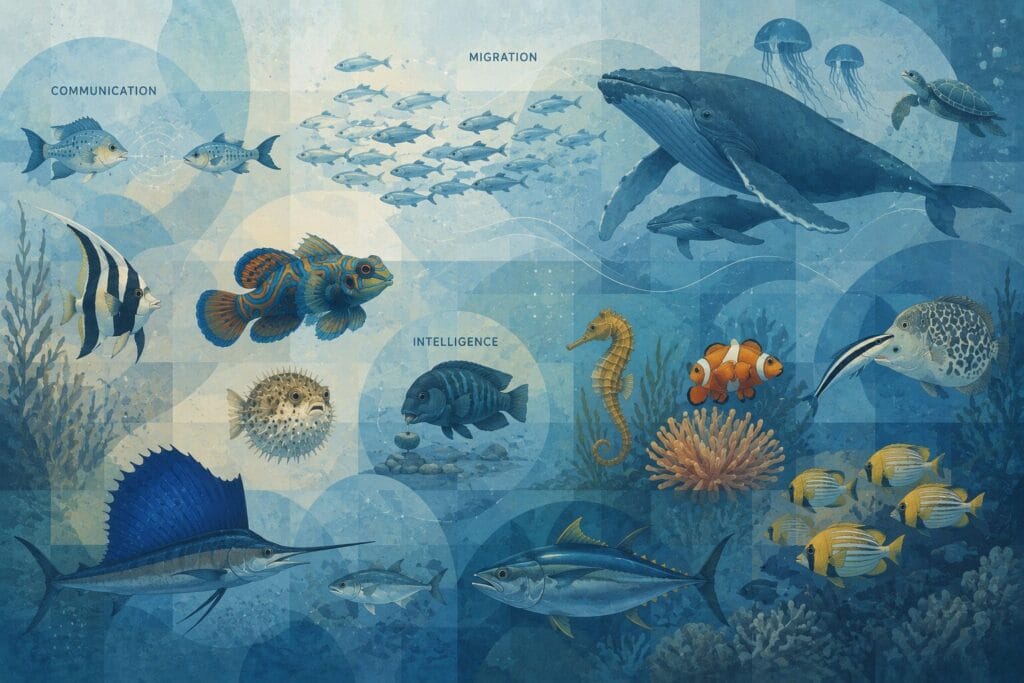
Fascinating Facts About Fish
Fear often narrows attention to the most unsettling details. Curiosity helps widen the view.
Fish Are Incredibly Diverse
Fish are among the most diverse groups of vertebrates on Earth. They live in coral reefs, deep oceans, mountain streams, rivers, lakes, caves, and polar waters.
Some Fish Can Recognise Patterns and Learn
Fish are more capable than many people assume. Studies of fish behaviour have shown learning, memory, problem-solving, and social awareness in several species.
Fish Communicate in Subtle Ways
Fish use colour, movement, posture, vibration, scent, and sound to communicate. Their world is not silent or simple. It is full of signals most humans never notice.
Some Fish Build Homes
Certain fish create nests, guard eggs, arrange stones, or maintain territories. These behaviours show that fish are active participants in their environments, not passive shapes moving through water.
Fish Help Us Understand the Health of Water
Fish populations can reveal changes in water quality, pollution, habitat health, and climate pressures. In this way, fish act as living indicators of environmental change.
Common Myths About Fish
Myth: All Fish Are Dirty
Why People Believe It
Fish are often associated with smell, slime, mud, or seafood counters. These sensory experiences can strongly influence fear and disgust.
The Reality
Fish are adapted to aquatic environments. Their protective mucus, scales, and gills help them survive in water. These features are biological adaptations rather than signs of dirtiness.
Why Understanding Matters
Learning why fish feel or look different can reduce disgust-based fear.
Myth: Fish Want to Touch or Attack People
Why People Believe It
Unexpected movement in water can feel personal, especially if a fish swims nearby.
The Reality
Most fish avoid humans. If they swim close, they are usually investigating, feeding, or moving through their habitat rather than seeking contact.
Why Understanding Matters
Recognising that fish are not targeting you can help reduce panic during water-based encounters.
Myth: Murky Water Is Always Dangerous Because Fish Are Hiding There
Why People Believe It
Low visibility naturally increases uncertainty. The brain may interpret hidden spaces as unsafe.
The Reality
Murky water does not automatically mean danger. It simply means visibility is reduced because of sediment, algae, light levels, or natural water conditions.
Why Understanding Matters
Separating uncertainty from danger helps the nervous system respond more calmly.
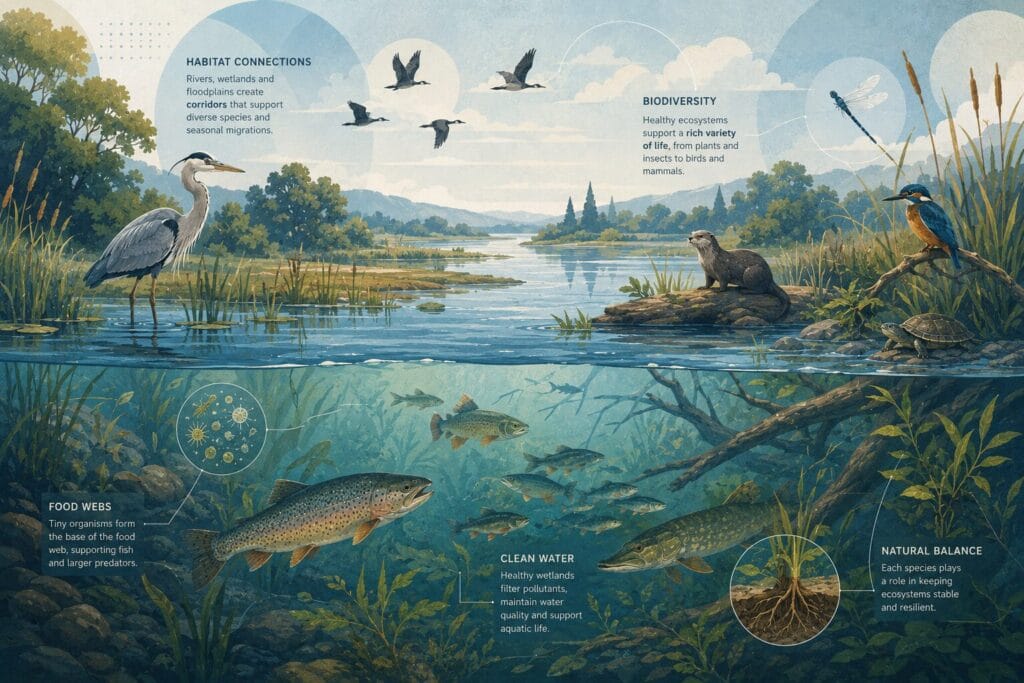
Why Fish Matter to Nature
Fish are essential to aquatic ecosystems. They help maintain balance in rivers, lakes, wetlands, reefs, and oceans.
Fish support food webs by eating algae, insects, plankton, smaller fish, and plant matter. In turn, they provide food for birds, mammals, reptiles, larger fish, and people.
Some fish help control algae growth. Others move nutrients through waterways. Reef fish support coral ecosystems, while freshwater fish contribute to the health of rivers and wetlands.
Organisations such as The Wildlife Trusts, the Marine Conservation Society, and the Natural History Museum provide valuable information about aquatic life, conservation, and the importance of healthy habitats.
When we understand fish as part of a living system, they become less mysterious. They become part of the wider story of rivers, seas, food chains, and biodiversity.
Seeing Fish Through a Compassionate Lens
Fear can make fish feel strange, alien, or unsettling.
Compassion invites us to look again.
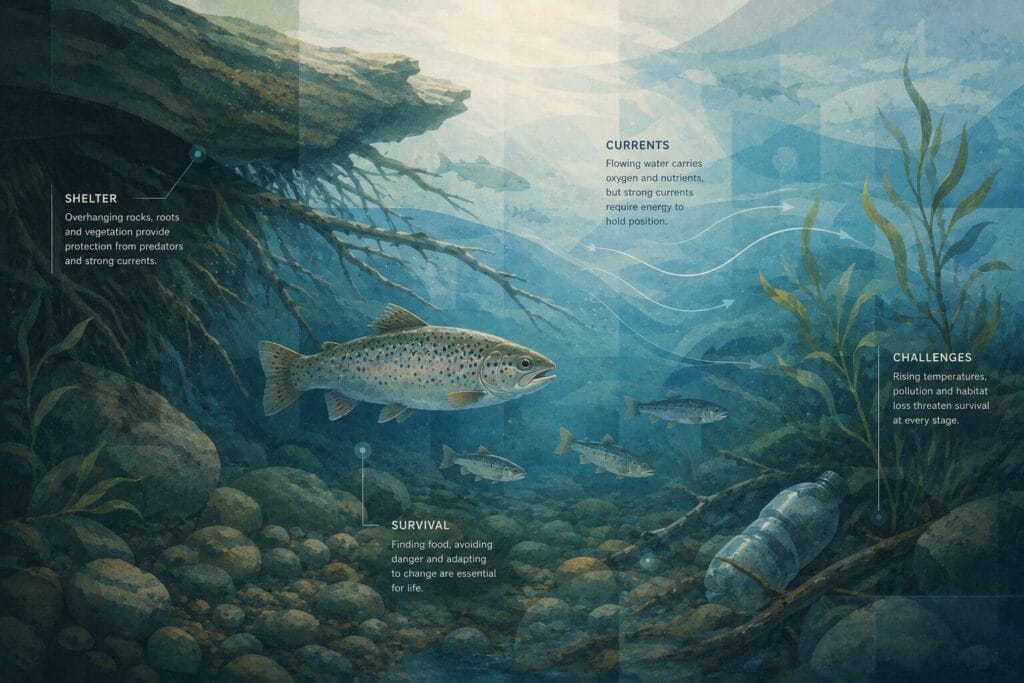
A fish lives in a world that is constantly moving. It must find food, avoid predators, respond to currents, locate safe shelter, reproduce, and survive changes in temperature, oxygen, pollution, and habitat quality.
Many fish are prey animals. Their quick movements are not designed to frighten us. They are survival responses.
A fish darting away is often trying to stay just stay alive.
A fish swimming in a shoal of other fish is using togetherness as protection.
Understanding can create empathy. Fish are very different from humans but like us, they want to survive and enjoy life.
Peaceful Coexistence With Fish
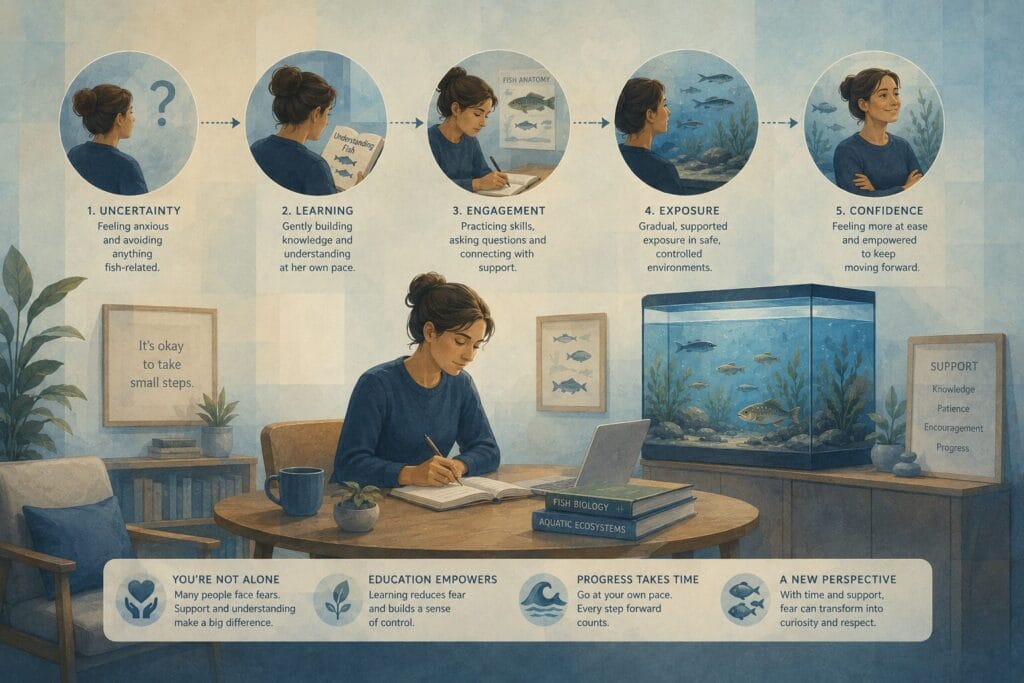
Most people do not need close contact with fish to overcome ichthyophobia. Instead, the first goal is usually to feel calmer around fish-related situations.
Helpful steps may include:
- Learning about fish in a calm environment
- Looking at gentle, non-triggering illustrations
- Gradually viewing fish images or videos
- Visiting an aquarium at a quiet time
- Standing near water without entering it
- Swimming only where you feel safe and supported
- Using slow breathing to calm the nervous system
If you are near fish in water, try to move slowly and give yourself space to observe and challenge negative thoughts. Take time to be fascinated and curious instead.
Can the Fear of Fish Be Treated?
Yes. Specific animal phobias are among the most treatable anxiety conditions. Fear is learned through experience, association, and repetition. That means it can also be changed through new learning.
The NHS guidance on phobias explains that phobias can create intense anxiety and that treatment often involves gradually facing feared situations in a supported way.
Creature Courage also explains how this works in practice in its guide to exposure therapy for animal phobias.
Treatment should never feel like being thrown into the deep end. For fish phobia, that phrase is especially unhelpful. Good support begins at the edge of the water, not in the middle of it.
The Creature Courage® Approach
At Creature Courage®, we understand that overcoming an animal phobia requires more than being told there is nothing to fear.
Founded by Britain Stelly, Creature Courage specialises in animal phobia therapy using psychology, neuroscience, animal education, and carefully guided exposure experiences.
Through our Animal Phobia Therapy programme, clients learn how fear develops, how the nervous system responds to perceived threats, and how confidence can be rebuilt step by step.
Many clients are surprised to discover why one-day phobia therapy can work so effectively for specific animal fears. Others may benefit from a more gradual approach, especially when the fear is connected to water, swimming, disgust, or wider anxiety.
Creature Courage also uses a holistic approach to animal phobias, recognising that fear is not only about the animal itself but also about the wider nervous system.
For younger clients, our children's animal phobia therapy options provide age-appropriate support designed to build confidence without pressure.
Every fear story is different. Some people fear aquariums. Some fear swimming near fish. Some fear dead fish or seafood counters. Others cannot look at fish images at all.
Our goal is to help you feel calmer, safer, and more in control of your emotions.

Therapeutic Techniques to Overcome the Fear of Fish
- Cognitive-Behavioural Therapy (CBT): CBT helps individuals identify and challenge irrational fears and develop healthier thought patterns. Specific cognitive-behavioural therapy research has pointed to the fact that lasting results can be found in just one therapy session, and we can whole-heartedly vouch for that - and so can our clients.
- Exposure Therapy: Gradual, controlled exposure to Fish helps desensitize individuals to their fear. Understanding fish and their behaviours can foster a sense of fascination and help to reduce fear. At Creature Courage, we strongly recommend exposure therapy, which allows you to interact with the animals in a controlled environment. You will always be supported by expert animal phobia specialists to help you face your fears in a gentle yet empowering way. The therapy is always led by you and is in your control at all times.
- Hypnotherapy:This helps our clients to rewire their brains at a subconscious level. Hypnotherapy also helps our clients to have calmer and more effective exposure therapy.
- NLP (Neuro-Linguistic programming): Helps to create understanding around how we think and speak. NLP gives us tools to change the stories we tell ourselves, to create new positive mindsets. We teach NLP techniques to condition your mind to be able access these powerful positive emotions.
- Art Therapy: We can use imagination techniques and then make them more real through creating art. This extra cognitive step helps the mind make the memory of the meditation more vivid and lasting.
- Animal Education: This one isn't a psychological technique learned and perfected over years. It's classroom stuff that we have come to realise gives an improved understanding about dogs, which in turn, allows you to begin building compassion and fascination. Believe when we say this step cannot be missed out if you truly want an end to your phobia. What's the adage: 'knowledge is power', and here it will most definitely be one of your most important tools in defeating fear.
All these techniques are combined together into one highly powerful session.
Taking the First Step
Living with a fear of fish can make parts of life feel smaller than they need to be. Holidays, swimming, aquariums, family activities, restaurants, and nature experiences may all become wrapped in anxiety.
However, phobias are not fixed forever.
With the right support, education, and gradual exposure, the brain can learn a new response.
You do not need to begin by touching a fish, swimming in the sea, or visiting a busy aquarium.
You begin with understanding.
And understanding is often where courage starts to ripple outward.
If you are ready to explore support, you can contact Creature Courage to discuss your experience, ask questions, and discover which approach may be right for you.
Frequently Asked Questions About the Fear of Fish
What is the fear of fish called?
The fear of fish is often called ichthyophobia.
Is ichthyophobia a real phobia?
Yes. Ichthyophobia falls within the category of specific animal phobias and can cause intense anxiety or avoidance.
Why am I afraid of fish?
Your fear may be linked to a past experience, uncertainty in water, sensory disgust, learned fear, or the way your nervous system interprets fish movement and appearance.
Can fish phobia include fear of dead fish?
Yes. Some people feel more anxious around dead fish, fish smells, seafood counters, or fish being handled than around live fish.
Why do fish make me feel disgusted?
Disgust can be triggered by texture, smell, scales, eyes, gills, or the idea of slippery contact. This response can become part of the phobia.
Can children develop a fear of fish?
Yes. Children may develop fish phobia after a startling water experience, learned fear, or exposure to frightening images or stories.
Is fear of fish linked to fear of water?
It can be. Some people are mainly afraid of fish, while others fear what may be hidden beneath the surface of natural water.
Can exposure therapy help with fish phobia?
Yes. Gradual exposure therapy can help the brain learn that fish-related situations are safer than the phobia predicts.
Should I force myself to touch a fish?
No. Forced exposure can increase distress. Structured support should begin gently and progress at a pace that feels manageable.
Can I overcome a fear of fish?
Many people achieve significant improvement with the right support, education, and carefully planned exposure work.
Do I need to swim with fish to recover?
Not necessarily. Recovery goals should be personal. For some people, confidence around images or aquariums is enough. Others may eventually want to swim comfortably in natural water.
Where can I get help for ichthyophobia?
Specialist support from Creature Courage's Animal Phobia Therapy programme can help you understand and retrain your fear response around fish.
Further Reading
You may also find these resources helpful:
Creature Courage Resources
- Animal Phobia Therapy
- Animal Phobia Treatment
- Exposure Therapy for Animal Phobias
- Why One-Day Phobia Therapy Works
- A Holistic Approach to Animal Phobias
- Understanding Animal Phobias (Zoophobia)
- Contact Creature Courage