
Fear of Dogs (Cynophobia): Understanding and Overcoming A Dog Phobia
Understanding the Fear of Dogs
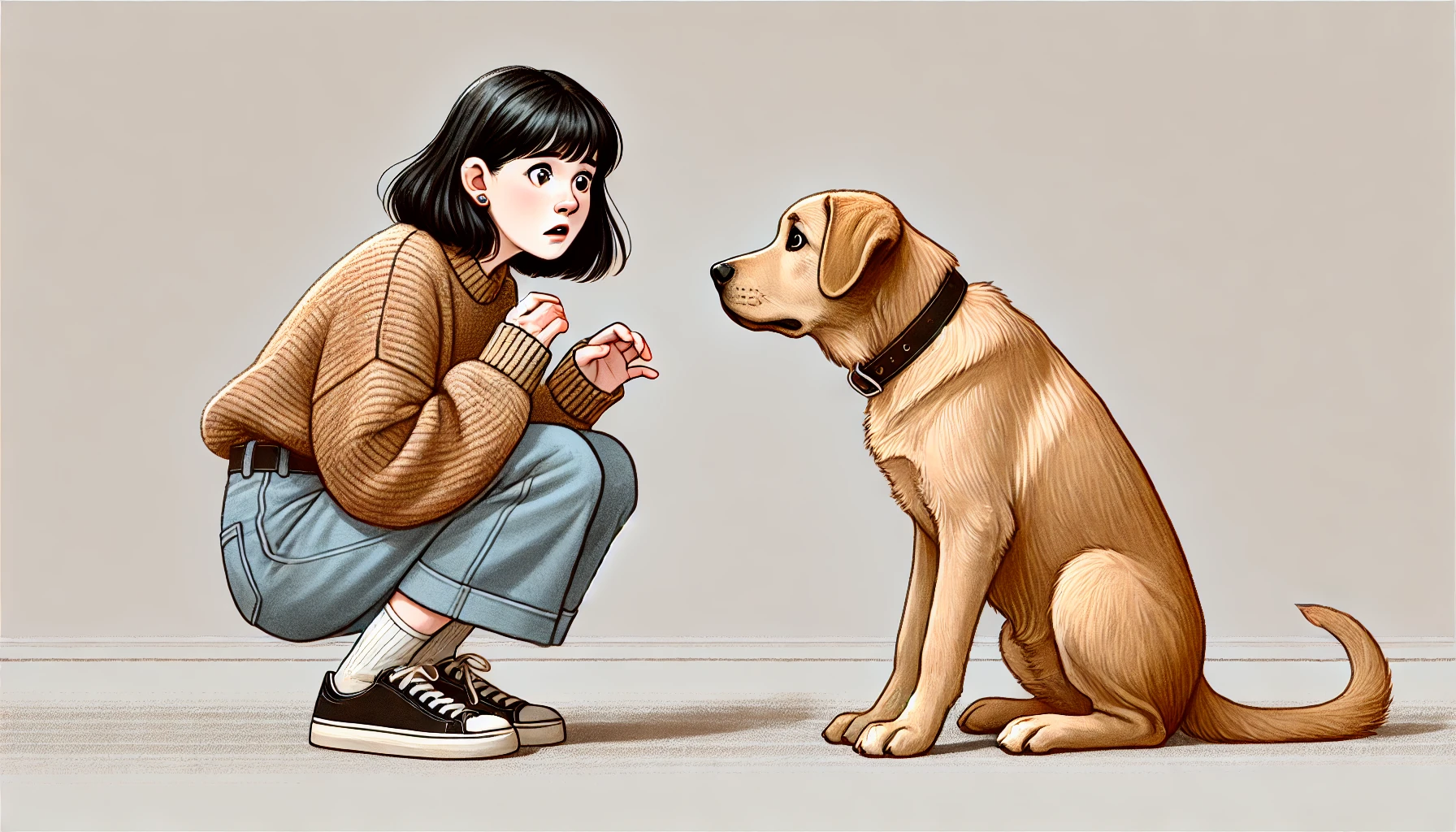
A fear of dogs, known as cynophobia, can affect far more than your feelings about animals. For many people, it influences daily routines, social activities, family visits, holidays, exercise, and even where they choose to walk.
Perhaps you were chased as a child. Maybe a dog barked unexpectedly and startled you. For some people, it is the size and strength of dogs that feels overwhelming. Others fear being bitten, jumped on, or losing control during an encounter.
Whatever the cause, a fear of dogs is a genuine phobia. It is not a sign of weakness, and it is not something you simply "get over". It is a learned fear response that can become deeply connected to the nervous system.
This article explores the fear of dogs, why it develops, how it affects people, and most importantly, how it can be overcome. Along the way, you will learn about dog behaviour, discover surprising facts about dogs, understand their role in society, and see how a fearful relationship can gradually become a more confident one.
Understanding is often the first step towards courage.
Check out our powerful Client Testimonial
What Is the Fear of Dogs?
The fear of dogs, or cynophobia, is a specific animal phobia involving intense fear, anxiety, or panic when encountering dogs, thinking about dogs, or anticipating situations where dogs may be present.
Unlike ordinary caution around unfamiliar animals, a phobia causes the brain's threat-detection system to respond as though danger is immediate and unavoidable.
People with cynophobia may fear:
- Being bitten
- Being chased
- Being jumped on
- Losing control during an encounter
- Large or powerful breeds
- Unpredictable behaviour
- Barking and growling
- Off-lead dogs
While dogs are among the most familiar animals in modern society, they are also one of the most difficult animals to avoid completely. This can make the fear of dogs particularly disruptive to daily life.

Symptoms of Cynophobia
Symptoms vary from person to person, but they often occur when seeing a dog, hearing barking, visiting places where dogs may be present, or even viewing images and videos.
Physical Symptoms
- Rapid heartbeat
- Sweating
- Trembling
- Shortness of breath
- Nausea
- Dizziness
- Muscle tension
- Feeling frozen on the spot
Emotional Symptoms
- Intense fear or panic
- Feeling trapped
- Fear of attack
- Fear of losing control
- Anticipating the worst possible outcome
- Persistent worry before outings
Behavioural Symptoms
- Avoiding parks and public spaces
- Crossing roads to avoid dogs
- Avoiding friends or relatives with dogs
- Refusing countryside walks
- Leaving situations when dogs appear
- Constantly scanning surroundings
Common Dog-Specific Triggers
People with cynophobia often report anxiety when:
- A dog runs towards them
- A dog barks suddenly
- An off-lead dog approaches
- A large breed is nearby
- Multiple dogs are present
- A dog stares directly at them
- A dog jumps up unexpectedly
How Dog Phobias Are Formed
A dog phobia often originates from a traumatic experience with a dog during childhood. Incidents such as being bitten, barked or growled at, or being accidentally knocked over by an overly affectionate and enthusiastic dog can create a fear trigger.
More commonly, animal phobias are learned behaviours. A child may develop a fear of dogs by observing a parent or sibling's fearful reaction.
Children naturally look to their parents to understand what is safe and what is not. Therefore, if a parent displays fear around dogs, a child may subconsciously learn to view dogs as a threat and, consequently, develop that fear in themselves.
Think about your fear of dogs. Can you pinpoint where it springs from?
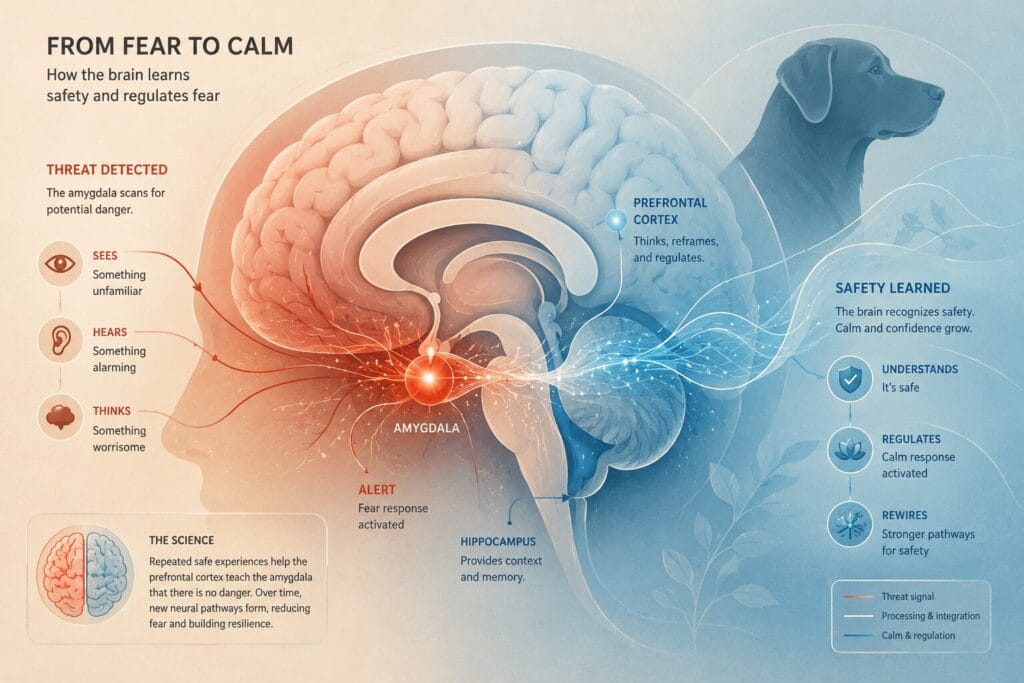
Our brain's rapid formation of fear responses to perceived danger is a survival mechanism, but it can be maladaptive in the modern world - dogs no longer pose the same threat as their wild ancestors used to.
A lot has changed, and dogs are now our beloved pets and are found in parks, in shops, walking merrily down the street, basically, everywhere.
Therefore, when we make the conscious decision to avoid encountering dogs it will realistically limit our way of living and interacting in what is considered to be a normal and healthy life.
How Cynophobia Develops
There is rarely a single cause. Instead, dog phobias often develop through a combination of experiences, learning, and natural survival responses.
Frightening Experiences
Many people can identify a specific incident that contributed to their fear.
Examples include:
- Being chased
- Being bitten
- Being knocked over
- Witnessing an aggressive dog
Even when physical injury is minor, the emotional impact can be significant. The brain may store the event as a warning and then react strongly to future dog encounters.
Learning From Others
Children frequently learn fear by observing adults. If parents, siblings, or other trusted individuals react fearfully around dogs, similar associations can develop.
For families where anxiety is passed between parent and child, Creature Courage has explored this pattern in its article on why parent anxiety can matter before child phobia therapy.
Media Influences
News stories involving dog attacks often receive extensive coverage. Although serious incidents are relatively uncommon, repeated exposure can lead the brain to overestimate risk.
Evolutionary Survival Systems
Humans naturally pay attention to animals with sharp teeth, loud vocalisations, and unpredictable movement. These features activate ancient survival mechanisms designed to keep us safe.
Creature Courage describes this automatic fear system in its article on caveman brain awareness, which explains why the body can react before the thinking mind has caught up.
The Avoidance Cycle
Avoidance feels helpful in the short term. However, every avoided park, street, or social gathering reinforces the belief that dogs are dangerous.
Over time, confidence shrinks while fear grows.
Why Address a Fear of Dogs?
Unlike some animal fears, dogs are woven into everyday life.
A fear of dogs can affect:
- Family visits
- Friendships
- Holidays
- Exercise
- Children's activities
- Community events
- Public spaces
Many people feel embarrassed by their fear because dogs are often viewed positively by society. However, phobias are not logical decisions. They are learned fear responses.
Addressing cynophobia is not about becoming a dog lover. It is about regaining freedom and reducing anxiety's influence over your choices.
How to Overcome a Fear of Dogs
At Creature Courage, we offer specialised treatments for animal phobias. Our approach helps clients overcome their fear of dogs with tailored one-on-one therapy. The great majority of them have either taken huge strides or overcome their fear within a single-day!
Overcome Your Fear of Dogs in a Single Day
We’ve adapted our successful methods from our internationally famous Spider Courage Experience, endorsed by the British Tarantula Society, for its fast and sustained success in curing arachnophobia. Creature Courage can help those with other animal phobias, including cynophobia, with the same life changing methods.
We are the only service that provides a full range of proven phobia fighting techniques within one session. It's this unique blend of neuroscience techniques that gives us our incredible success rate.
Therapeutic Techniques to Overcome the Fear of Dogs
- Cognitive-Behavioural Therapy (CBT): CBT helps individuals identify and challenge irrational fears and develop healthier thought patterns. Specific cognitive-behavioural therapy research into overcoming dog phobia in children has pointed to the fact that lasting results can be found in just one therapy session, and we can whole-heartedly vouch for that - and so can our clients.
- Exposure Therapy: Gradual, contr
- olled exposure to dogs helps desensitise individuals to their fear. Understanding dogs and their behaviours can foster a sense of fascination and help to reduce fear. At Creature Courage, we strongly recommend exposure therapy, which allows you to interact with the animals in a controlled environment. You will always be supported by expert animal phobia specialists to help you face your fears in a gentle yet empowering way. The therapy is always led by you and is in your control at all times.
- Hypnotherapy:This helps our clients to rewire their brains at a subconscious level. Hypnotherapy also helps our clients to have calmer and more effective exposure therapy.
- NLP (Neuro-Linguistic programming): Helps to create understanding around how we think and speak. NLP gives us tools to change the stories we tell ourselves, to create new positive mindsets. We teach NLP techniques to condition your mind to be able access these powerful positive emotions.
- Art Therapy: We can use imagination techniques and then make them more real through creating art. This extra cognitive step helps the mind make the memory of the meditation more vivid and lasting.
- Animal Education: This one isn't a psychological technique learned and perfected over years. It's classroom stuff that we have come to realise gives an improved understanding about dogs, which in turn, allows you to begin building compassion and fascination. Believe when we say this step cannot be missed out if you truly want an end to your phobia. What's the adage: 'knowledge is power', and here it will most definitely be one of your most important tools in defeating fear.
All these techniques are combined together into one highly powerful session.
Fascinating Facts About Dogs
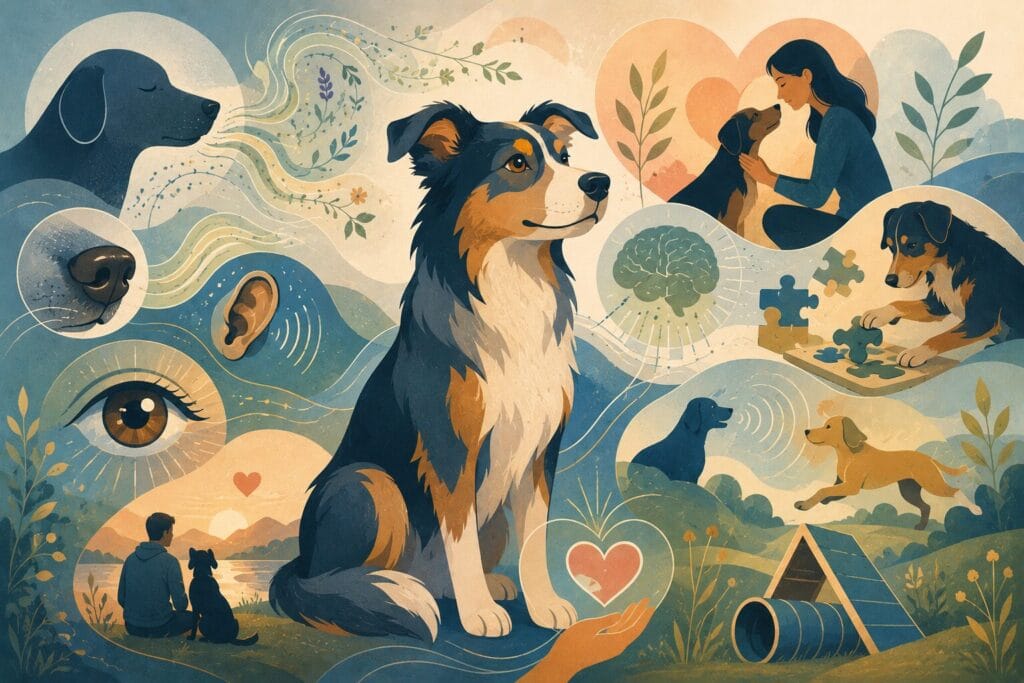
- How Our Lives Became Entwined: We began to train and domesticate wolves over 15,000 years ago, but research suggests that dog domestication came about by accident - rather than to help us hunt, as is often believed. However, after this, dogs adjusted much as we did to become specifically adapted to live life in relationship with us.
- Intelligence: The average dog is as intelligent as a two-year-old child and can understand up to 250 words, but mercifully won't pick up a pen and draw all over the walls! Just to put our beautiful children under pressure, a Border Collie named Chaser recognised 1,022 words!
- Hearing: Did you know that a dogs' hearing is four times better than our own? This allows them to hear at frequencies we can’t even begin to imagine (or hear, more to the point!).
- Sense of Smell: Even more impressive is a dog's sense of smell, which is anywhere between 1,000 to 10-million times more sensitive than that of humans - and yet they seem to get on with babies just fine!
- Dogs can smell your feelings! Dogs really can detect changes in human emotions through scent alone. This is all made possible by their olfactory cortex (the part of the brain associated with smell) being 40x larger than that of our own. To give you an idea of how dog's make use of this: when we’re afraid we breathe faster, while our sweat rate increases, too, changing the scent we give off. This is how dogs detect certain medical conditions and problems such as seizures, or hypoglyceamia in diabetes.
- Health Benefits: Interacting with dogs has been shown to lower our blood pressure and reduce stress. Furthermore, this research suggests that a man is 3x more likely to receive a positive response from a woman if they have a dog in tow! Remember that a dog is for life, not just for finding a girlfriend.
- Science Fact: Did you know that dogs poo in alignment with the Earth’s magnetic field? (No, of course you didn't. I’d be a little worried if you did!)
- Science Fiction: And finally, George Lucas modelled the Ewoks in Return of the Jedi after his family dog, and who doesn't think the Ewoks are cute and cuddly?

Common Myths About Dogs
Myth: A Wagging Tail Means a Dog Is Friendly
Why People Believe It
Popular culture often portrays wagging tails as a universal sign of happiness.
The Reality
Dogs wag their tails for many reasons, including excitement, uncertainty, tension, and arousal.
Why Understanding Matters
Learning to read the whole dog is safer than relying on a single signal.
Myth: Certain Breeds Are Naturally Aggressive
Why People Believe It
Media coverage often focuses on particular breeds, especially after frightening incidents.
The Reality
Behaviour is influenced by genetics, training, socialisation, health, handling, environment, and individual temperament.
Why Understanding Matters
Reducing fear requires understanding behaviour rather than relying only on stereotypes.
Myth: Growling Is Always Dangerous
Why People Believe It
Growling sounds threatening, particularly if someone already feels anxious around dogs.
The Reality
Growling is communication. Dogs often growl to ask for space and avoid escalation.
Why Understanding Matters
Understanding canine communication reduces uncertainty and can help people respond more calmly.
Find Out How You Can Change Your Perspective on Dogs
Why Dogs Matter
Dogs occupy a unique place in human society. Across the world, they perform roles that save lives, improve wellbeing, and support communities.
Examples include:
- Guide dogs supporting visually impaired people
- Assistance dogs helping people with disabilities
- Search and rescue dogs locating missing people
- Medical alert dogs detecting health changes
- Therapy dogs supporting emotional wellbeing
- Conservation dogs helping protect endangered species
Organisations such as Guide Dogs UK and Assistance Dogs UK demonstrate how carefully trained dogs can transform independence, confidence, and quality of life.
For readers interested in therapeutic support, Creature Courage has also explored therapy dogs for anxiety and how carefully managed exposure can support people with dog-related fears.
Understanding dogs' contribution does not mean you need to love them. It simply helps place fear beside a broader, more balanced picture.
For readers interested in therapeutic support, Creature Courage has also explored therapy dogs for anxiety and how carefully managed exposure can support people with dog-related fears.

Seeing Dogs Through a Compassionate Lens
Fear often encourages us to focus on what a dog might do to us. Compassion encourages us to consider what life is like for the dog.
Dogs experience fear too. Many bark because they are anxious. Some react because they feel threatened. Rescue dogs may carry difficult experiences from earlier in life. Others become overwhelmed by unfamiliar situations.
The large dog barking behind a fence may not be trying to intimidate you. It may simply be communicating uncertainty about your presence.
Like people, dogs spend much of their lives trying to feel safe, understood, and connected.
Recognising this shared desire for safety often becomes an important step in reducing fear.
Peaceful Coexistence With Dogs
Understanding dog behaviour can significantly increase confidence.
If an unfamiliar dog approaches:
- Remain calm
- Avoid sudden movements
- Stand sideways rather than face-on
- Avoid direct staring
- Allow the dog to choose distance
- Move away calmly if needed
If you would like to learn more about safe interactions, Creature Courage's guide on how to stay safe around unfamiliar dogs provides practical advice based on canine behaviour and psychology.
For people whose fear is specifically linked to size, power, or certain breeds, the guide to overcoming fear of large dogs and XL Bullies may also be helpful.
Confidence grows through understanding rather than avoidance.
Can Cynophobia Be Treated?
Yes. Specific animal phobias are among the most treatable anxiety conditions. Fear is learned. Therefore, it can also be changed.
Effective approaches include:
- Exposure therapy
- Cognitive Behavioural Therapy (CBT)
- Animal education
- Nervous system regulation techniques
- Confidence-building exercises
Treatment does not involve forcing someone into overwhelming situations. Instead, it helps the brain update old fear responses through carefully structured experiences.
The NHS guidance on phobias explains that phobias can cause intense anxiety and that treatment often focuses on helping people gradually face feared situations in a supported way.
Many people discover they make progress far more quickly than they expected.

The Creature Courage® Approach
At Creature Courage®, we specialise in helping people overcome animal phobias through a unique combination of psychology, neuroscience, education, and real-world exposure experiences.
Founded by Britain Stelly, Creature Courage has helped thousands of people overcome fears that once felt impossible.
Through our Animal Phobia Therapy programme, clients learn how fear develops, how the nervous system responds to perceived threats, and how confidence can be rebuilt step by step.
Many clients are surprised to discover why one-day phobia therapy can work so effectively for specific animal fears. Others prefer a more gradual approach tailored to their needs.
Creature Courage also explains its broader method in the article on a holistic approach to animal phobias, including how education, exposure and nervous system retraining can work together.
For younger clients, the children's animal phobia therapy options provide age-appropriate support designed to build confidence without pressure.
If you would like to understand animal fears more broadly, our guide to animal phobias and zoophobia explores why these fears develop and how recovery can happen.
Every treatment plan is personalised because every fear story is different.
Our goal is not to make you love dogs.
Our goal is to help you feel safe, confident, and free.
Taking the First Step
Living with cynophobia can be exhausting. It can influence where you go, who you visit, and how comfortable you feel in public spaces.
The encouraging news is that phobias are not permanent.
With the right support, education, and experience, meaningful change is possible.
You do not need to face this fear alone.
Your journey does not begin with a dog.
It begins with understanding.
And understanding is often where courage begins to grow.
If you are ready to explore support, you can contact Creature Courage to discuss your experience, ask questions, and discover which approach may be right for you.
Frequently Asked Questions About the Fear of Dogs
What is the fear of dogs called?
The fear of dogs is known as cynophobia.
Is cynophobia common?
Yes. Cynophobia is one of the more common specific animal phobias because dogs are so present in everyday life.
Can I develop a fear of dogs as an adult?
Yes. Phobias can develop at any age following experiences, stress, trauma, or changes in anxiety levels.
Why am I afraid of dogs when other people love them?
Phobias are based on individual learning and experiences, not popularity or social attitudes. Your fear deserves support, not judgement.
Are large dogs more dangerous?
Size alone does not determine behaviour. Understanding canine body language is more useful than focusing only on breed or size.
Can children develop cynophobia?
Yes. Childhood experiences, learned behaviours, and frightening encounters can all contribute to dog fears.
Is exposure therapy effective for cynophobia?
Yes. Exposure therapy is one of the most effective treatments for specific phobias when it is structured, gradual, and properly supported.
Should I force myself to interact with dogs?
No. Gradual, structured exposure is usually more effective and less distressing than forcing yourself into overwhelming situations.
Can barking trigger cynophobia?
Yes. Sudden barking is a common trigger because it is loud, unexpected, and often interpreted by the nervous system as a threat.
Can I completely overcome a fear of dogs?
Many people achieve substantial or complete recovery with appropriate support, education, and exposure therapy.
What if I only fear certain breeds?
This is common. Some people fear large dogs, powerful breeds, dogs with particular appearances, or dogs that behave energetically.
Where can I get help for cynophobia?
Specialist support from Creature Courage's Animal Phobia Therapy programme can help you build confidence and overcome a fear of dogs through education and structured exposure therapy.
Further Reading
You may also find these resources helpful:
Creature Courage Resources
- Animal Phobia Therapy
- Why One-Day Phobia Therapy Works
- How to Stay Safe Around Unfamiliar Dogs
- Overcoming Fear of Large Dogs
- Therapy Dogs for Anxiety
- Understanding Animal Phobias (Zoophobia)
- Contact Creature Courage
External Resources
Overcome Your Fear of Dogs with Creature Courage